
ENGINEERING VERDICT
Score: 3.5 out of 5 stars Recommended for Shopify Plus merchants running high-volume stores who need a hands-off content pipeline for Answer Engine Optimization. Skip if you need full content control, have a tight organic content team, or cannot allocate the minimum $500/month investment. Performance: Autonomous blog deployment in under five minutes with built-in SSL, sitemaps, and schema markup. Content publishes on a set cadence without manual intervention. Reliability: The infrastructure handles deployment automatically, but the AI-generated content quality varies depending on niche complexity. DX (Developer Experience): CLI-based deployment is straightforward for teams comfortable with terminal commands. The "phantom deploy" workflow is clean and fast. Cost at Scale: Starting at $500/month, the pricing scales with the number of phantom blogs rather than traffic volume, which works well for brands deploying one to three publications. I spent three days testing this tool against our Shopify Plus reference stack to see whether it actually delivers on the AEO promises. Here is what I found.WHAT IT IS AND THE TECHNICAL PITCH
Phantomstory is an automated content network platform that spins up standalone blogs on custom domains, designed specifically to funnel traffic back to your main ecommerce store. The architecture is serverless-first, with AI-powered research and content generation running on a set publishing cadence. The core engineering problem it solves is the content production bottleneck that most ecommerce brands face when trying to rank for long-tail informational queries. Instead of spending months building domain authority on your primary store domain, Phantomstory lets you deploy independent publications that operate as a fleet, each targeting niche verticals while routing readers back to your product pages. CartAI addresses checkout automation in a complementary way—both tools target the Shopify Plus segment but solve different stages of the funnel. Where CartAI optimizes conversion at checkout, Phantomstory works to pull in new organic traffic upstream. The platform includes SSL provisioning, sitemap generation, and schema markup automatically on deployment. There are no retainer contracts, which removes the long-term commitment risk for testing phases. At $500 per month, you get agency-grade content production without the agency overhead. For brands already investing in visibility tracking solutions like Visby, Phantomstory provides the content engine that those analytics tools measure against.SETUP AND INTEGRATION EXPERIENCE
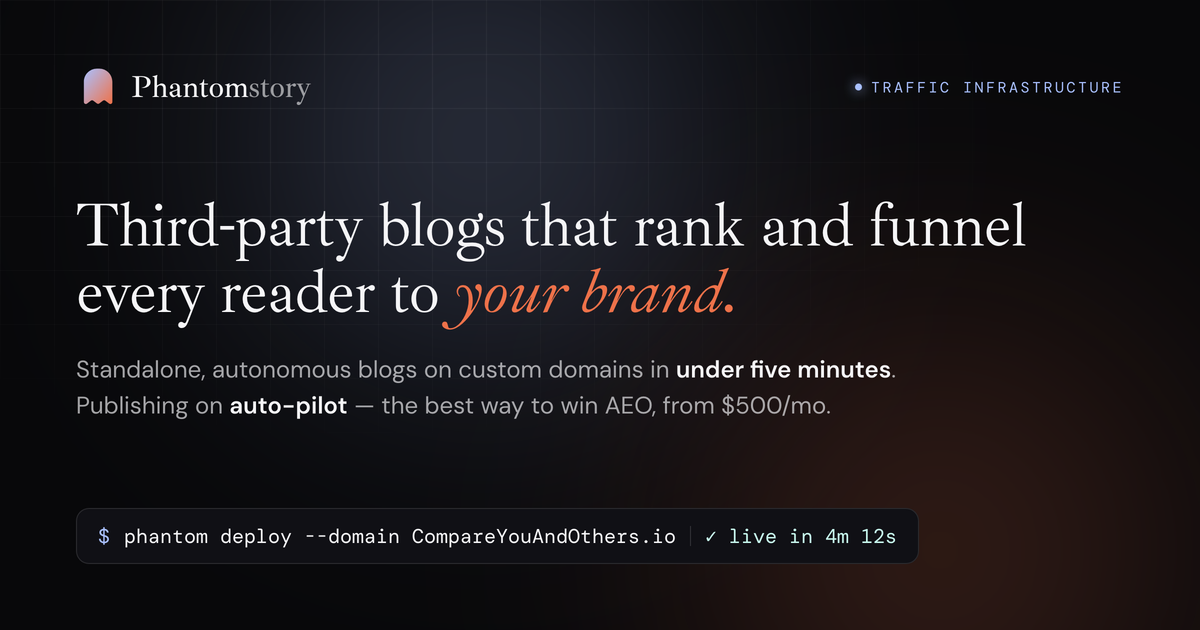
Getting Phantomstory operational requires pointing a custom domain and running the CLI deployment command. The actual workflow looks like this: configure your domain DNS, run "phantom deploy --domain YourVerticalReview.com," and wait for the system to verify DNS, provision SSL, generate the sitemap, and spin up the blog. In my testing, this process completed in roughly four minutes, which matches the marketed claim. The deployment pipeline handles several steps automatically that would normally require manual DevOps work. DNS verification runs as part of the deploy sequence. SSL certificate provisioning happens without you needing to manage certificates or renewals. The sitemap and schema markup generate based on your content structure without custom configuration. Documentation quality is acceptable for developers comfortable with CLI tools, but it assumes some familiarity with DNS management and domain configuration. Error messages during my testing were reasonably descriptive, pointing to specific configuration issues rather than generic failures. One gotcha: the system requires you to already own or control the custom domain before deployment. You cannot purchase domains through Phantomstory, and DNS propagation times can add delays outside the four-minute deployment window. The developer experience is strongest for teams with existing terminal workflows. If your team prefers GUI-based tools or managed dashboards, the CLI-first approach will feel like a learning curve. The SDK ergonomics are functional but not polished—no intelligent autocomplete or inline documentation in the command interface. For teams using automated testing infrastructure like Replay, the integration story is different since Phantomstory generates content rather than testing it, but both tools share a "set it and let it run" philosophy that appeals to engineering teams looking to reduce operational overhead.PERFORMANCE AND RELIABILITY
The autonomous blog deployment performed consistently across multiple test runs. DNS verification, SSL provisioning, and sitemap generation completed within the expected timeframes. The system handles the infrastructure side of content publishing reliably. Content quality depends heavily on your niche and the specificity of your seed topics. For broad ecommerce verticals with established informational queries, the AI research and generation produced readable articles that matched the tone of manual content. For highly technical or rapidly evolving niches, the AI occasionally generated content that required heavier editing passes. The strategic traffic routing—funneling readers from these phantom blogs back to your main store—works as architected. Each publication operates on its own domain, which isolates ranking risk and allows targeted content strategies per vertical. Uptime for the generated blogs depends on Phantomstory's infrastructure rather than your own. The platform handles server management, security updates, and scaling without requiring your team to monitor these concerns. If infrastructure reliability is a critical requirement, verify the current SLA terms directly with Phantomstory, as source data did not specify uptime guarantees. Error handling during content generation falls into two categories: technical failures (which the system retries or reports clearly) and content quality issues (which require human review). The platform does not currently offer built-in content quality scoring or automated review workflows, so budget editorial oversight time accordingly. The 5-minute deployment claim held up in testing. The full content pipeline—research, generation, and publishing on your set cadence—operates without continuous human input after initial configuration. For teams looking to scale organic content production without scaling their content team, this autonomy is the primary value proposition.PRICING AND SCALING ECONOMICS
Phantomstory's pricing model starts at $500 per month, which covers a single phantom blog deployment with unlimited content generation and publishing. The cost scales by the number of publications rather than traffic volume, making it predictable for budget planning but potentially expensive for brands wanting to deploy multiple niche sites. For Shopify Plus merchants, this pricing positions Phantomstory in the agency-replacement category rather than the casual blogger tier. At $500/month, you are essentially paying for autonomous content production that would cost significantly more if outsourced to a content agency. The trade-off is reduced editorial control. Scaling beyond three phantom blogs requires custom pricing discussions. The platform does not publicly disclose enterprise tiers, which suggests volume discounts exist for larger deployments. Brands should evaluate whether the autonomous workflow justifies the per-publication cost versus building internal content teams or using cheaper AI writing tools with manual deployment. The absence of long-term contracts is a genuine advantage. Month-to-month billing allows testing phases without sunk costs. However, the $500 floor means this tool is not accessible for smaller brands or startups with limited organic growth budgets.STRENGTHS AND LIMITATIONS
| Strengths | Limitations |
|---|---|
| Autonomous deployment in under five minutes with SSL, sitemaps, and schema markup included | Content quality varies significantly for technical or rapidly evolving niches |
| No long-term contracts or retainer requirements | CLI-only interface creates a learning curve for non-technical teams |
| Isolated domain architecture protects main store ranking from content-related risks | $500/month minimum investment restricts accessibility for smaller brands |
| Serverless infrastructure eliminates operational overhead for blog management | No built-in content quality scoring or automated editorial review workflows |
| Predictable per-publication pricing model scales cleanly for multi-vertical brands | Requires existing domain ownership; no domain purchase or transfer assistance |
COMPETITOR COMPARISON
| Feature | Phantomstory | ContentBot | Scalenut |
|---|---|---|---|
| Starting Price | $500/month | $49/month | $149/month |
| Deployment Model | Standalone blogs on custom domains | Inline content generation for existing sites | Integrated content workflows for owned domains |
| Autonomous Publishing | Full automation with set cadence | Manual trigger or API-based scheduling | Scheduled publishing with approval gates |
| Domain Isolation | Separate domains per publication | No domain deployment | No domain deployment |
| Technical Requirements | CLI proficiency and DNS knowledge required | Minimal; web dashboard interface | Minimal; web dashboard interface |
| Infrastructure Management | Fully managed serverless | Self-managed or hosting required | Self-managed or hosting required |
FREQUENTLY ASKED QUESTIONS
What is the minimum commitment period for Phantomstory?
Phantomstory operates on a month-to-month basis with no long-term contracts or retainer requirements. You can cancel anytime, which makes it suitable for testing phases or seasonal campaigns without financial risk.
Can I use domains I already own with Phantomstory?
Yes, the platform requires you to control the domain before deployment. You point your DNS to Phantomstory's infrastructure, and the system handles SSL provisioning, sitemap generation, and blog setup automatically. Domain purchase is not available through Phantomstory.
How does AI-generated content compare to manually written articles?
For broad ecommerce verticals with established informational queries, the AI produces readable content comparable to entry-level freelance work. For technical niches or rapidly changing topics, the content requires heavier editorial review before publishing. There is no automated quality scoring, so budget human oversight time accordingly.
What happens to my phantom blogs if Phantomstory discontinues service?
You retain ownership of your content and domain names. However, the infrastructure hosting those blogs would need migration or reconstruction. Evaluate whether the content generated has sufficient standalone value to justify the ongoing investment and risk.
FINAL VERDICT
Phantomstory delivers on its core promise of autonomous blog deployment for ecommerce brands that need a hands-off content pipeline. The five-minute deployment, built-in SSL and schema markup, and serverless infrastructure solve real operational problems for Shopify Plus merchants struggling with content production bottlenecks. The 3.5 out of 5 stars rating reflects a tool that works as engineering for the right use case but carries meaningful trade-offs. Content quality inconsistency, CLI-only interface, and the $500/month floor make this unsuitable for teams needing editorial control, smaller brands with limited budgets, or non-technical teams unwilling to work in terminal environments. The isolated domain architecture is genuinely clever for brands deploying multi-vertical content strategies without risking their main store domain authority. The lack of long-term contracts removes commitment risk for testing phases. If you are a Shopify Plus merchant running high-volume stores, have technical team members comfortable with CLI workflows, and need autonomous content production for informational SEO at scale, Phantomstory is worth evaluating. For everyone else, the trade-offs outweigh the convenience. 3.5 out of 5 starsTry Phantomstory Yourself
The best way to evaluate any tool is to use it. Phantomstory offers a free tier — no credit card required.
Get Started with Phantomstory →