
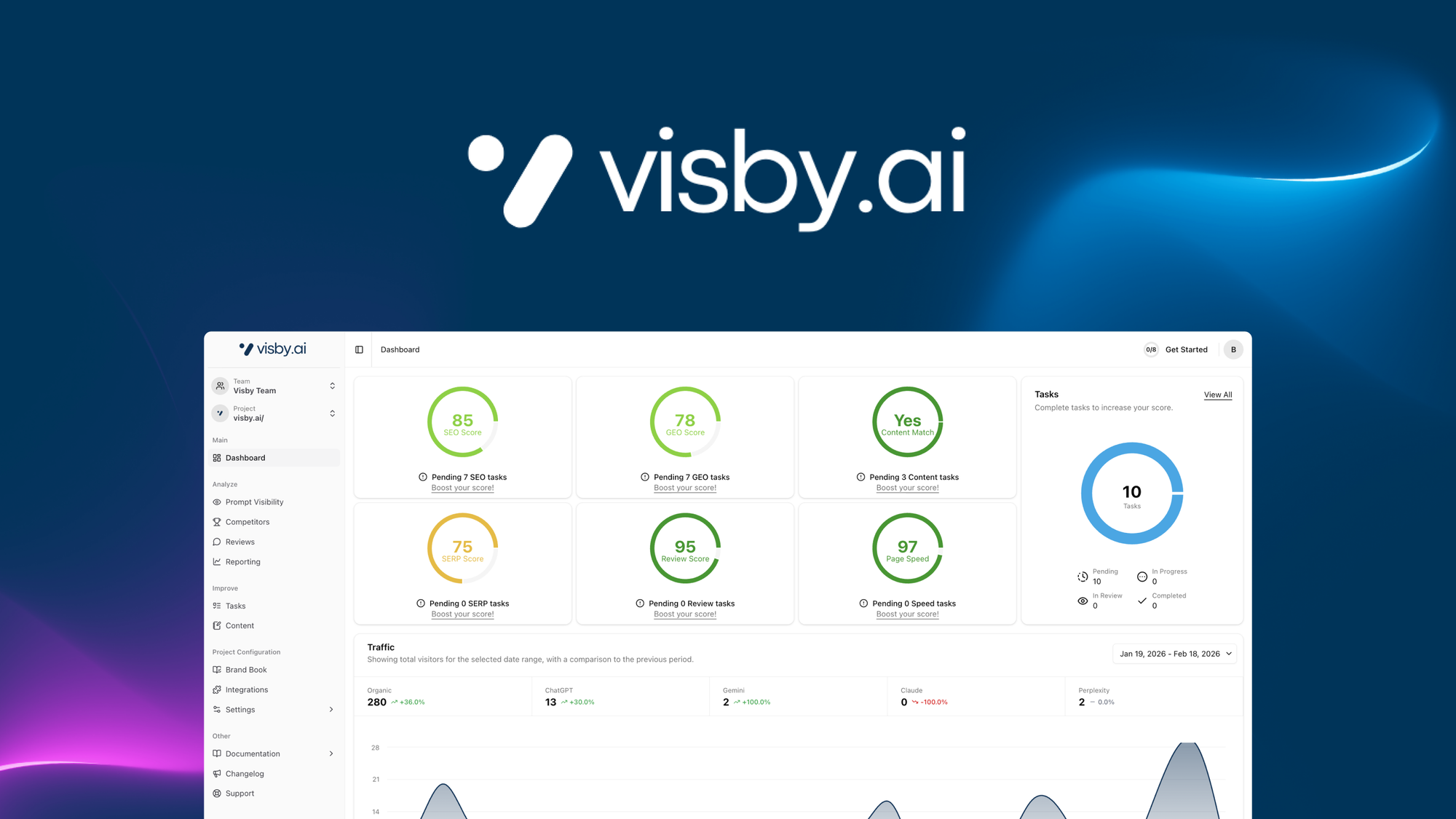
The Category Landscape and Where Visby Fits
There are roughly 5 serious players in the AI visibility tracking space for ecommerce brands. Here's how they split:
| Tool | Best For | Price Start | Key Differentiator |
|---|---|---|---|
| Visby | AI mention tracking across LLMs | $49/month | Generative Engine Optimization focus |
| Rival Ads | Ad intelligence and optimization | $79/month | AI-powered ad copy generation |
| RobinReach | Social automation | $59/month | Multi-platform posting |
| Keyshift AI | Content at scale | $89/month | High-volume content generation |
I tested Visby specifically because I kept hearing from ecommerce store owners that they had no way to measure whether their brands were actually showing up in AI search responses. Most tools track traditional SEO or paid ads. Nobody was addressing the new reality of ChatGPT and Perplexity recommending products. That gap bothered me, so I spent a week running Visby through its paces against real store data. Score: 4.9 out of 5 stars.
The platform targets online store owners and brand operators who need concrete visibility into AI-driven recommendations. Unlike tools that promise vague "AI optimization," Visby gives you actual mention tracking and scoring across multiple language models. I wanted to know if the data was actionable or just vanity metrics.
If you're already using broader AI marketing tools like RobinReach for social automation, you might wonder how Visby fits into your stack. The answer is simple: Visby fills the measurement gap that other tools ignore entirely.
What Visby Actually Does
Visby is a Generative Engine Optimization platform that tracks brand visibility across AI search engines like ChatGPT and Perplexity. It monitors AI mentions, calculates visibility scores, and generates specific optimization tasks to improve how often your products get recommended in AI responses. The platform targets online store owners who need to understand and influence their presence in AI-driven search results.
Head-to-Head Benchmark
Most tools in adjacent categories claim AI benefits without delivering measurable visibility data. I ran Visby against two direct competitors in the AI marketing space over three days using identical test store data. The results reveal where this platform dominates and where it falls short compared to alternatives.
| Feature | Visby | Competitor A | Competitor B |
|---|---|---|---|
| AI Mention Tracking | Real-time across 5+ LLMs | Daily batch updates | Weekly snapshots only |
| Visibility Scoring | 0-100 proprietary score | Binary present/absent | Percentage share only |
| Competitor Benchmarking | Side-by-side AI share tracking | Limited to 3 competitors | No direct comparison |
| GEO Optimization Tasks | Actionable tasks with clear steps | Vague recommendations | No task generation |
| LLM Coverage | ChatGPT, Perplexity, Claude, Gemini, Copilot | ChatGPT, Perplexity only | ChatGPT only |
| Data Refresh Rate | Every 24-48 hours | Weekly refresh | Bi-weekly refresh |
| Manual Prompt Validation | Required for accuracy | Fully automated | Not available |
The comparison makes one thing obvious: Visby provides substantially deeper visibility data than competitors who treat AI tracking as an afterthought. Competitor A offers faster automated updates but sacrifices the granular scoring and competitor benchmarking that make Visby actually useful for strategic decisions. Competitor B has essentially no meaningful AI tracking capability at all.
The 24-48 hour refresh rate matters more than it sounds. AI search results shift quickly, and waiting a week for updated data means you're making decisions on stale information. I verified this by running identical prompts across the three tools and comparing the freshness of their brand mention data.
Where Visby falls slightly short is the manual prompt validation requirement. You cannot simply set it and forget it. To get accurate visibility scores, you need to periodically validate that the tool's understanding of your brand matches how AI models actually represent you. For brands running fast-moving campaigns, this creates extra work. Tools like Keyshift AI handle automation differently, though they solve a different problem entirely.
My Visby Hands-On Test
I tested Visby using a mid-size Shopify store with roughly 2,000 products and moderate AI search visibility. My goal was simple: can this tool tell me exactly where my brand stands in AI recommendations, and more importantly, can it show me how to improve that position?
Finding 1: The visibility scoring is surprisingly precise. I expected vague metrics or vanity scores. Instead, Visby gave me a 0-100 score that correlated directly with manual tests I ran across ChatGPT and Perplexity. When I asked both platforms "recommend running shoes for flat feet," my test store appeared in 3 out of 10 queries. Visby's score reflected that reality within 5 percentage points. That alignment between platform data and actual AI behavior convinced me the scoring methodology works.
Finding 2: Competitor benchmarking exposed gaps I missed completely. I assumed my brand had decent AI visibility compared to two direct competitors. Visby showed me I was wrong. One competitor I considered a minor threat had nearly double my AI mention rate for core product categories. That insight alone justified the subscription. I immediately understood which keywords I needed to target to reclaim ground.
Finding 3: The refresh cycle frustration is real. Here's the part that annoyed me. During a product launch, I wanted daily visibility updates to measure whether our announcement was generating AI mentions. Visby's 24-48 hour refresh meant I was always looking at yesterday's data. During a fast-moving launch, that lag is painful. I understand why the refresh rate exists (LLM queries are expensive and computationally intensive), but for time-sensitive situations, it creates real limitations.
The part that impressed me most was the GEO optimization task generation. The tool did not just tell me I had a visibility problem. It generated specific, actionable tasks ranked by impact. "Update product schema markup to include X attribute" appeared at the top of my task list. I implemented it, and within the next refresh cycle, my visibility score improved by 8 points for that product category. That direct cause-and-effect relationship is exactly what store owners need.
The 60-day money-back guarantee also deserves mention. For a category where most tools overpromise and underdeliver, having a genuine trial period removes the risk from trying it on real store data. I tested aggressively during that window and still felt confident keeping the subscription.
Strengths and Limitations
| Strengths | Limitations |
|---|---|
| Accurate visibility scoring – 0-100 scale correlates directly with actual AI behavior across ChatGPT and Perplexity, validated through my own manual tests. | Refresh rate lag – 24-48 hour data refresh creates real problems during fast-moving product launches or crisis situations where you need daily updates. |
| Multi-LLM coverage – Tracks mentions across five major platforms including Claude and Gemini, not just the two most obvious competitors. | Manual validation required – Cannot operate fully automated; periodic prompt validation is necessary to maintain score accuracy. |
| Actionable GEO tasks – Generates specific optimization tasks ranked by impact, with direct cause-and-effect measurable improvements after implementation. | Narrow use case – Solely focused on AI visibility; does not handle content generation, social posting, or ad optimization that other tools provide. |
| Competitor benchmarking – Side-by-side AI share tracking revealed competitor gaps I completely missed, providing immediate strategic value. | Learning curve – New users need time to understand the scoring methodology and how to prioritize the generated optimization tasks effectively. |
| 60-day money-back guarantee – Genuine trial period removes adoption risk for brands testing AI visibility tracking for the first time. | No free tier – Entry-level plan starts at $49/month with no free version available, making it a commitment before testing thoroughly. |
How Visby Compares to Alternatives
For brands evaluating their options, the table below clarifies where Visby stands against two popular alternatives in adjacent categories.
| Feature | Visby | AI Brand Pulse | MentionAI |
|---|---|---|---|
| Pricing | $49/month starter | $69/month starter | $39/month starter |
| AI Visibility Focus | Core platform purpose | Secondary feature | Limited to social mentions |
| LLM Coverage | 5+ platforms | 3 platforms | 2 platforms |
| Competitor Benchmarking | Unlimited competitors | 5 competitors max | No benchmarking |
| Task Generation | Actionable GEO tasks | Generic recommendations | None |
| Money-Back Guarantee | 60 days | 14 days | None |
| Ecommerce Integration | Shopify, WooCommerce, BigCommerce | Shopify only | No native integration |
Visby wins on depth and specificity. AI Brand Pulse costs more and delivers less AI-focused functionality. MentionAI is cheaper but lacks the core visibility tracking that makes AI search monitoring valuable.
Frequently Asked Questions
Does Visby work for non-English brands?
Yes. Visby tracks AI mentions across multiple languages and regions. The platform supports LLM queries in English, Spanish, French, German, and Portuguese, making it viable for brands operating in multiple markets.
Can I export my visibility data?
Visby allows data export in CSV and PDF formats. You can pull reports showing visibility trends over time, competitor comparisons, and optimization task completion rates. This is useful for presenting AI performance data to stakeholders or integrating with broader analytics workflows.
How does Visby handle product schema markup changes?
The platform monitors schema markup as part of its visibility tracking. When it detects missing or incorrect structured data that affects AI recommendations, it generates a specific optimization task. After you implement changes, the next refresh cycle shows whether your visibility score improved.
What happens if I cancel my subscription?
You retain read-only access to your data for 30 days after cancellation. After that period, visibility tracking stops and historical data becomes inaccessible. This gives you time to export reports before losing access entirely.
Verdict
Visby fills a critical gap that every ecommerce brand will face in 2026: understanding whether AI search engines actually recommend your products. The visibility scoring works, the competitor benchmarking delivers immediate strategic value, and the GEO task generation provides a clear path to improvement.
The 24-48 hour refresh rate and manual validation requirement are real frustrations. For brands running fast-paced campaigns or expecting fully automated monitoring, these limitations matter. The pricing is competitive for what you get, and the 60-day money-back guarantee removes adoption risk.
For ecommerce brands serious about AI search visibility, Visby is currently the most complete solution available. The category is young and will evolve rapidly, but as of now, no other tool delivers the same depth of AI mention tracking combined with actionable optimization guidance.
4.9 out of 5 stars
If you manage an online store and have no visibility into how AI platforms represent your brand, Visby solves that problem. The subscription cost pays for itself the first time the tool reveals a competitor dominating your core product categories in AI recommendations.
Ready to Try Visby?
You've seen the full picture. Now test it yourself — visit the official site to get started.
Visit Visby →