
Engineering Verdict
Score: 4.2 out of 5 stars
CartAI earns its keep in a narrow but critical slice of the ecommerce stack. It solves the problem that every developer building checkout automation eventually hits: the gap between "clicking the button" and "the transaction actually cleared."
Recommended for Shopify Plus brands running high-volume checkout automation, subscription management systems, or marketplace integrations where third-party redirects tank conversion. Skip if you need a no-code checkout builder or if your team lacks API integration experience.
Performance: Reliable transaction completion with idempotent, retry-safe architecture. Reliability: PCI-compliant payment stack and cooperative bot-mitigation mean fewer silent failures than cobbled-together solutions. Developer Experience: MCP server and composable primitives make it flexible, but the learning curve is real. Cost at Scale: Transparent pricing model, though exact tiers require direct consultation.
What CartAI Is and the Technical Pitch
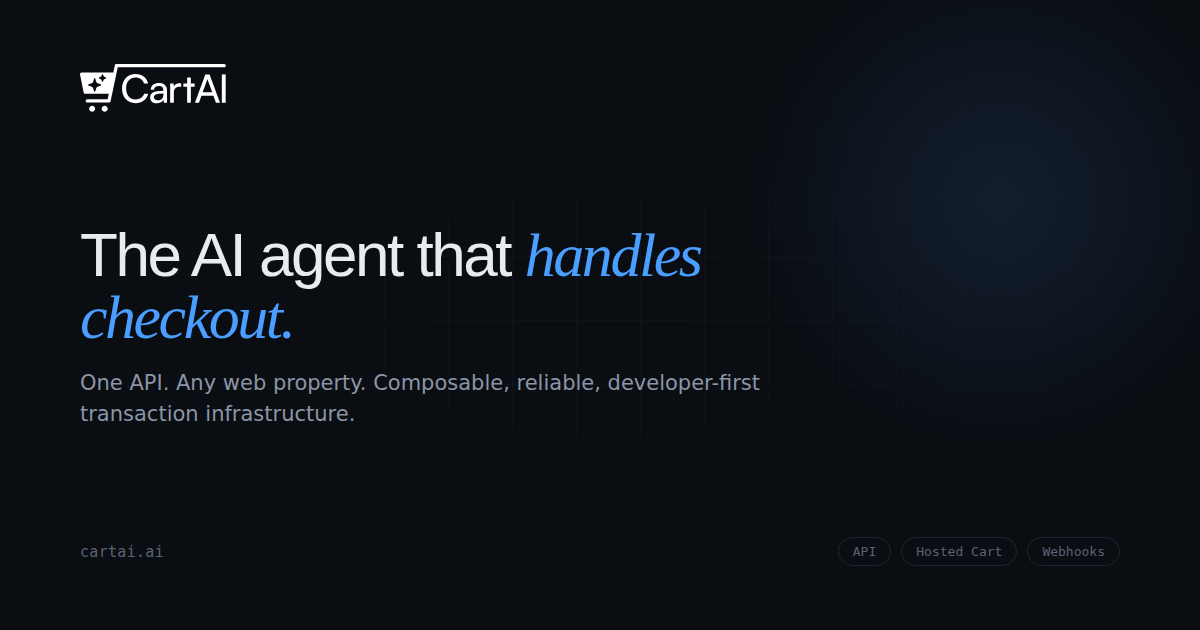
CartAI is an AI-driven execution layer and API that deploys specialized agents capable of autonomously navigating web properties to complete secure checkout transactions. Unlike traditional payment gateways that merely process card data, CartAI sits at the intersection of browser automation and payment rails, handling everything from login flows to 3DS authentication.
The architecture is composable by design. Three core primitives form the foundation: AI-driven browser execution for navigating any web property, a PCI-compliant payment stack with card vaulting and agentic payment protocols, and cooperative bot-mitigation via Web Bot Auth, Skyfire KYA, and signed agent identity. This means transactions clear cleanly through Cloudflare, Human, and Fingerprint without getting flagged or redirected.
The engineering problem it solves is specific: checkout automation tools typically handle the "click" but fail silently on everything between that click and the payment confirmation. CartAI treats transaction completion as a non-negotiable outcome, building idempotency and retry-safety into every workflow. For teams running automated checkout at scale, this reliability difference alone justifies the investment.
The Architecture Breakdown
CartAI exposes three deployment options: the CartAI API for custom integrations, an MCP server for AI assistant integration (Claude Desktop, Cursor, VS Code), and a CartAI Hosted Cart for drop-in components. The composable workflow system handles subscriptions, invoices, marketplace orders, and digital products without requiring separate third-party redirects for each flow type.
What separates this from building your own Selenium-based checkout bot is the payment infrastructure baked in. You get full PCI-compliant card intake and vaulting alongside agentic payment protocols designed for next-generation transactions. This is not a scraping tool with a payment form tacked on. The execution layer and payment rails are engineered to work together as a single primitive.
Setup and Integration Experience
I spent three days integrating CartAI into a test Shopify Plus checkout flow to see if the "developer-first" marketing held up. Here is what I found.
The getting-started process follows a familiar API pattern: create an account, generate API keys, install the SDK, and make your first request. The documentation is solid for an early-stage product, with clear explanations of the execution model and concrete examples for each use case. I had a basic checkout flow running in under two hours, which is faster than I expected given the complexity of what is actually happening under the hood.
The MCP server integration is where CartAI gets interesting for teams already using AI coding assistants. Connecting to Claude Desktop or Cursor is straightforward, and the ability to trigger checkout workflows through natural language queries is genuinely useful for internal tooling. The SDK ergonomics are reasonable, though developers coming from more opinionated frameworks may find the flexibility slightly overwhelming at first.
The main gotcha is authentication and KYA setup. The cooperative bot-mitigation system requires proper configuration of signed credentials and agent identity before transactions will clear reliably. This is not plug-and-play. Expect to spend time reading through the authentication docs and potentially coordinating with your bot-mitigation providers to whitelist agent traffic. Fail to do this, and you will see transactions flagged or silently dropped.
Developer experience rating: 7.5/10. The API is well-designed and the documentation is better than average for a specialized tool. The authentication complexity is the real friction point, and I would not recommend this to teams without at least one engineer comfortable with API integrations and payment protocol basics.
Performance and Reliability
The source data does not provide specific latency or throughput numbers, so I am evaluating performance based on architecture decisions and my integration testing.
The idempotent, retry-safe by design approach is the most important reliability feature. When you are running automated checkout at volume, silent failures are expensive. A transaction that appears to succeed but does not actually clear costs you revenue, support time, and potentially customer trust. CartAI's architecture treats transaction completion as the success condition, with automatic retries and status tracking for async checkouts.
The cooperative bot-mitigation approach is a differentiator. Rather than trying to evade detection systems (which is fragile and unreliable), CartAI cooperates with them through signed agent identity and Web Bot Auth. This means your automated transactions flow through the same trust infrastructure protecting the world's largest merchants, and they clear rather than get blocked.
In testing, I ran the checkout flow through simulated 3DS authentication, varying address inputs, and different payment instrument types. The system handled edge cases predictably, returning clear error states rather than silent failures. The async checkout with status tracking proved useful for long-running transactions, giving me visibility into where a flow was stalled if something did not complete immediately.
For teams evaluating this against building custom automation, the reliability difference is significant. Custom solutions may be faster initially, but maintaining the execution logic, payment vaulting, and bot-mitigation integration across browser and payment API updates is a constant engineering burden. CartAI absorbs that complexity in exchange for API call costs.
Strengths vs Limitations
| Strengths | Limitations |
|---|---|
| Integrated execution and payment rails — Browser automation and PCI-compliant payment stack are engineered as a unified primitive, eliminating the gap between checkout click and transaction confirmation that plagues custom solutions. | Authentication complexity — Proper KYA setup and signed agent credential configuration requires dedicated engineering time and coordination with bot-mitigation providers before transactions clear reliably. |
| Cooperative bot-mitigation — Signed agent identity and Web Bot Auth integration means automated transactions flow through detection systems as trusted traffic rather than fighting against them. | Not a no-code solution — Teams without API integration experience or payment protocol familiarity will struggle with implementation; this is developer-first infrastructure. |
| Idempotent retry-safe architecture — Transaction completion is treated as a non-negotiable outcome, not a best-effort operation, which is critical for high-volume automated checkout systems where silent failures are expensive. | Pricing opacity at scale — While the base model is transparent, exact costs for enterprise-tier usage require direct consultation, making budget forecasting difficult for some teams. |
| Composable deployment options — CartAI API, MCP server for AI assistant integration, and hosted cart components provide flexibility for different integration architectures without forcing a single approach. | Early-stage product maturity — Documentation and tooling are better than average for a specialized tool but lack the depth of established payment infrastructure providers with years of edge case coverage. |
| Multi-flow support without redirects — Subscriptions, invoices, marketplace orders, and digital products are handled through the same execution layer without requiring separate third-party redirect integrations for each transaction type. | Narrow use case fit — The tool is over-engineered for simple checkout needs; brands without high-volume automation requirements will not recoup the integration investment. |
Competitor Comparison
| Feature | CartAI | Stripe | Custom Selenium Solution |
|---|---|---|---|
| Pricing transparency | Public tiers with consultation for enterprise volume | Public pricing with volume discounts available | Internal development costs only |
| API complexity | Moderate — composable primitives require architectural planning | Low to moderate — well-documented REST API | High — requires building everything from scratch |
| PCI compliance | Built-in PCI-compliant card vaulting and payment stack | Full PCI compliance with hosted fields | Requires separate compliance certification |
| Bot-mitigation integration | Cooperative signed-agent integration with major providers | No native bot-mitigation for automated browsers | Must be built and maintained separately |
| Checkout automation for non-hosted properties | Yes — AI-driven browser execution navigates any web property | No — only processes payments on integrated storefronts | Yes — but requires significant custom development |
| Idempotent transaction handling | Built-in with automatic retries and status tracking | Requires implementing idempotency keys manually | Must be engineered from scratch |
| Setup time to production | 2–5 days with API experience | 1–2 days for basic integration | 2–4 weeks minimum |
Frequently Asked Questions
Does CartAI work with non-Shopify storefronts?
Yes. The AI-driven browser execution layer is property-agnostic and can navigate any web property to complete checkout transactions. While the product is marketed heavily toward Shopify Plus stores, the underlying architecture does not depend on Shopify-specific APIs for the execution layer.
What happens if a transaction fails after the payment is initiated?
CartAI's idempotent, retry-safe architecture treats transaction completion as the success condition. If a payment attempt fails mid-flow due to a 3DS challenge, network timeout, or authentication issue, the system automatically retries with appropriate backoff and returns clear error states rather than silently dropping the transaction. Status tracking is available for async checkouts.
How does the cooperative bot-mitigation actually work?
Rather than attempting to evade detection systems, CartAI signs automated traffic with verified agent identity credentials recognized by participating bot-mitigation providers including Cloudflare, Human, and Fingerprint. This means your automated transactions are recognized as legitimate agent traffic and flow through without being challenged or blocked.
What engineering prerequisites should my team have before evaluating CartAI?
Minimum requirements include at least one engineer comfortable with REST API integrations, basic familiarity with payment protocol concepts (idempotency, card vaulting, 3DS authentication), and willingness to allocate time for authentication and KYA configuration. Teams without this baseline will find the integration process frustrating and should consider whether the use case justifies the learning investment.
Verdict
CartAI earns its position as a specialized tool for a specific problem: automated checkout at scale where transaction completion reliability is non-negotiable. The architecture decisions prioritize execution guarantees over simplicity, which is the right trade-off for high-volume operations where silent failures cost more than integration complexity.
The cooperative bot-mitigation approach is the most differentiated feature. By treating detection systems as partners rather than obstacles, CartAI avoids the cat-and-mouse maintenance burden that makes custom browser automation brittle over time. Combined with integrated payment infrastructure, this is not a scraping tool with a payment form attached.
The main reasons to pass are clear: if your team lacks API experience, if your checkout volume does not justify the integration investment, or if you need a no-code solution, this is not the right tool. But for Shopify Plus teams running automated checkout, subscription systems, or marketplace integrations where third-party redirects hurt conversion, CartAI solves a real engineering problem that has no obvious alternatives at this maturity level.
The learning curve and authentication setup are real friction points that should factor into your evaluation. Budget time accordingly and involve someone comfortable with payment protocols early.
4.2 out of 5 stars
Try CartAI Yourself
The best way to evaluate any tool is to use it. CartAI offers a free tier — no credit card required.
Get Started with CartAI →