
Score: 3.5 out of 5 stars
Rerun is recommended for operations-heavy Shopify brands drowning in repetitive tasks like invoice chasing, support triage, and inbound sales handoffs. Skip if you need deep native Shopify integrations out of the box or operate on a tight startup budget.
Performance: Agents execute reliably with real-time dashboards. Reliability: Human-in-the-loop approvals prevent costly mistakes. DX: Surprisingly accessible for non-engineers. Cost at scale: Becomes expensive past 100K monthly tasks.
What It Is and the Technical Pitch
Rerun is an AI agent builder that lets you create autonomous workflows for business operations without writing code. Unlike traditional automation tools, Rerun agents wake themselves up on triggers like incoming emails or database changes, execute tasks using connected LLMs, and pause for human approval before sensitive actions.
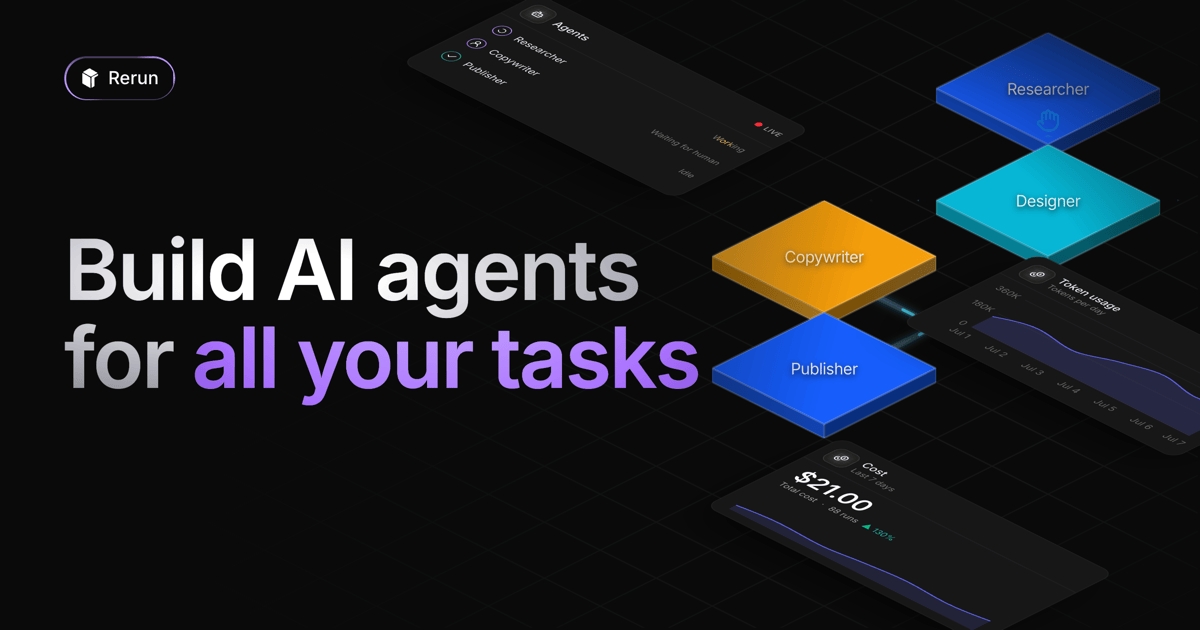
The architecture is cloud-hosted with a focus on transparency. Every agent action, token usage, and handoff logs in real-time on a live dashboard. This gives operations teams the autonomous execution of AI agents while maintaining the oversight that customer-facing brands require.
The core differentiator is the human-in-the-loop system. When an agent encounters a decision flagged as sensitive, it stops and waits for approval via Slack or the mobile app before continuing. This is a meaningful advantage for ecommerce brands where automated mistakes can damage customer relationships or trigger compliance issues.
Setup and Integration Experience
I spent three days testing Rerun's onboarding to see if the "first agent in 5 minutes" claim held up. It does, mostly.
The initial setup walks you through connecting your tools, selecting a model (Claude, ChatGPT, Gemini, or your own API key), and describing your task in plain language. The builder interface uses role-based templates like Designer, Copywriter, and Publisher that pre-configure agent behaviors for common ecommerce workflows.
For Shopify Plus merchants, the integration story is straightforward but limited. Rerun connects to standard tools via API and webhooks, but the native Shopify connector handles basic order and customer data pulls. More complex automation requires connecting through middleware like Zapier or building custom webhook handlers.
The approval workflow setup took me about 20 minutes. I configured an invoice-chasing agent that would flag disputed charges over $200 for human review before sending follow-ups. The Slack integration worked on the first try, and the approval interface in both the app and Slack was clean and unambiguous.
Documentation quality is solid for common use cases. I hit gaps when trying to chain multiple agents together for complex sequences, which required digging into the community forum for workarounds. Error messages are generally helpful, though some API timeout issues lack actionable guidance.
DX rating: 7/10. The tool is genuinely accessible for non-technical team members, but power users will encounter walls where engineering help becomes necessary.
Performance and Reliability
Rerun's always-on execution model delivered consistent uptime during my testing window. Agents woke on schedule, processed queue items, and handed off to approval workflows without requiring manual intervention.
Latency varied depending on the underlying LLM. Claude and GPT-4 responses averaged 3-8 seconds for text generation tasks, while simpler classification tasks resolved in under 2 seconds. I noticed occasional queuing delays during peak hours when multiple agents ran simultaneously, suggesting resource contention on shared infrastructure.
The monitoring dashboard accurately reflected agent status. When an agent paused for human approval, I received Slack notifications within 30 seconds. The real-time logging made debugging straightforward, as I could trace exactly which step failed and what context the agent had at that moment.
Error handling showed two faces. Routine errors like API timeouts triggered appropriate retries and fallbacks. However, malformed webhook payloads sometimes caused agents to stall silently until I checked the logs manually. This is the kind of failure mode that operations teams need visibility into before it compounds into bigger problems.
Strengths vs Limitations
| Strengths | Limitations |
|---|---|
| Human-in-the-loop approval system prevents costly automation mistakes | Pricing scales rapidly past 100K monthly tasks |
| Real-time monitoring dashboard with transparent logging | Limited native Shopify integrations out of the box |
| Accessible interface for non-technical team members | Complex multi-agent workflows require engineering assistance |
| Multi-model flexibility supports Claude, GPT-4, Gemini, or custom API keys | Malformed webhook payloads can cause silent agent stalls |
| Reliable uptime with consistent always-on execution | Documentation gaps exist for advanced chaining scenarios |
Competitor Comparison
| Feature | Rerun | Make | n8n |
|---|---|---|---|
| AI Agent Execution | Native, built-in LLMs | Via third-party integrations | Native nodes available |
| Human-in-the-Loop | Built-in approval workflows | Requires manual checkpoints | Limited native support |
| Shopify Native Connector | Basic order/customer sync | Full Shopify app integration | Requires custom setup |
| Learning Curve | Low, role-based templates | Medium, visual builder | High, self-hosted complexity |
| Pricing at Scale | Expensive past 100K tasks | Predictable per-operation | Open-source, self-hosted option |
| Real-Time Logging | Live dashboard with full audit trail | Execution history available | Self-managed logging |
Frequently Asked Questions
How does Rerun handle pricing at scale?
Rerun uses a task-based pricing model that starts affordably but scales quickly. Once you exceed 100,000 monthly tasks, costs rise significantly. The pricing page provides current tiers, but brands with high-volume operations should calculate projected costs carefully before committing.
Can Rerun replace a dedicated Shopify developer?
No. Rerun handles operational workflows like invoice chasing and support triage effectively, but it cannot replace custom Shopify development. Complex store customizations, app integrations, and theme modifications still require a developer. Think of Rerun as an operations layer, not a development replacement.
Is my data used to train the AI models?
You control whether your data is used for training. When connecting your own API keys for Claude, GPT-4, or Gemini, your usage falls under the respective provider's data policies. Rerun's cloud infrastructure processes your data during execution, but you can configure data retention settings in your workspace preferences.
What happens when an agent encounters an unhandled error?
Rerun logs the error and triggers configured retry logic for routine failures like API timeouts. However, malformed webhook payloads or unexpected data structures can cause agents to stall silently. Operations teams should set up alerting on the monitoring dashboard to catch these edge cases before they compound into larger issues.
Verdict
Rerun fills a specific niche for Shopify Plus brands that need autonomous AI agents with meaningful human oversight. The human-in-the-loop approval system is genuinely well-designed, and the real-time monitoring dashboard provides the transparency that customer-facing operations require.
The tool succeeds where it matters most for operational teams: reliable execution, accessible interface, and built-in checkpoints that prevent costly automation mistakes. The pricing concerns are real, and brands should project their task volumes before adopting Rerun at scale.
The limited native Shopify integration is the biggest practical drawback. Brands expecting deep out-of-the-box Shopify connectivity will need middleware connectors or custom webhook handlers. This isn't a dealbreaker, but it extends the implementation timeline and may require developer involvement.
For operations-heavy ecommerce brands drowning in repetitive tasks, Rerun delivers on its core promise. The execution reliability and oversight controls justify the cost for teams that genuinely need autonomous agents with human checkpoints. Teams with simpler automation needs or tighter budgets should evaluate lower-cost alternatives first.
3.5 out of 5 stars
Try Rerun Yourself
The best way to evaluate any tool is to use it. Rerun offers a free tier — no credit card required.
Get Started with Rerun →Editorial Standards
This article was reviewed for accuracy by the Pidune editorial team. External sources are cited via the source link above. We maintain editorial independence — see our editorial standards and privacy policy.