
1. The Problem and the Verdict
If you are spending between €500 and €5,000 monthly on Meta Ads as a small ecommerce brand, you are stuck in a brutal math problem. Meta's algorithm needs scale to optimize properly. Small budgets mean slow learning phases, wasted spend, and cost-per-lead numbers that eat your margins alive. You have three options: learn it yourself and burn budget on experiments, hire someone for €60k+ annually who will leave in 18 months, or pay an agency €3-5k monthly minimum for a junior account manager who uses the same template as their other 50 clients.
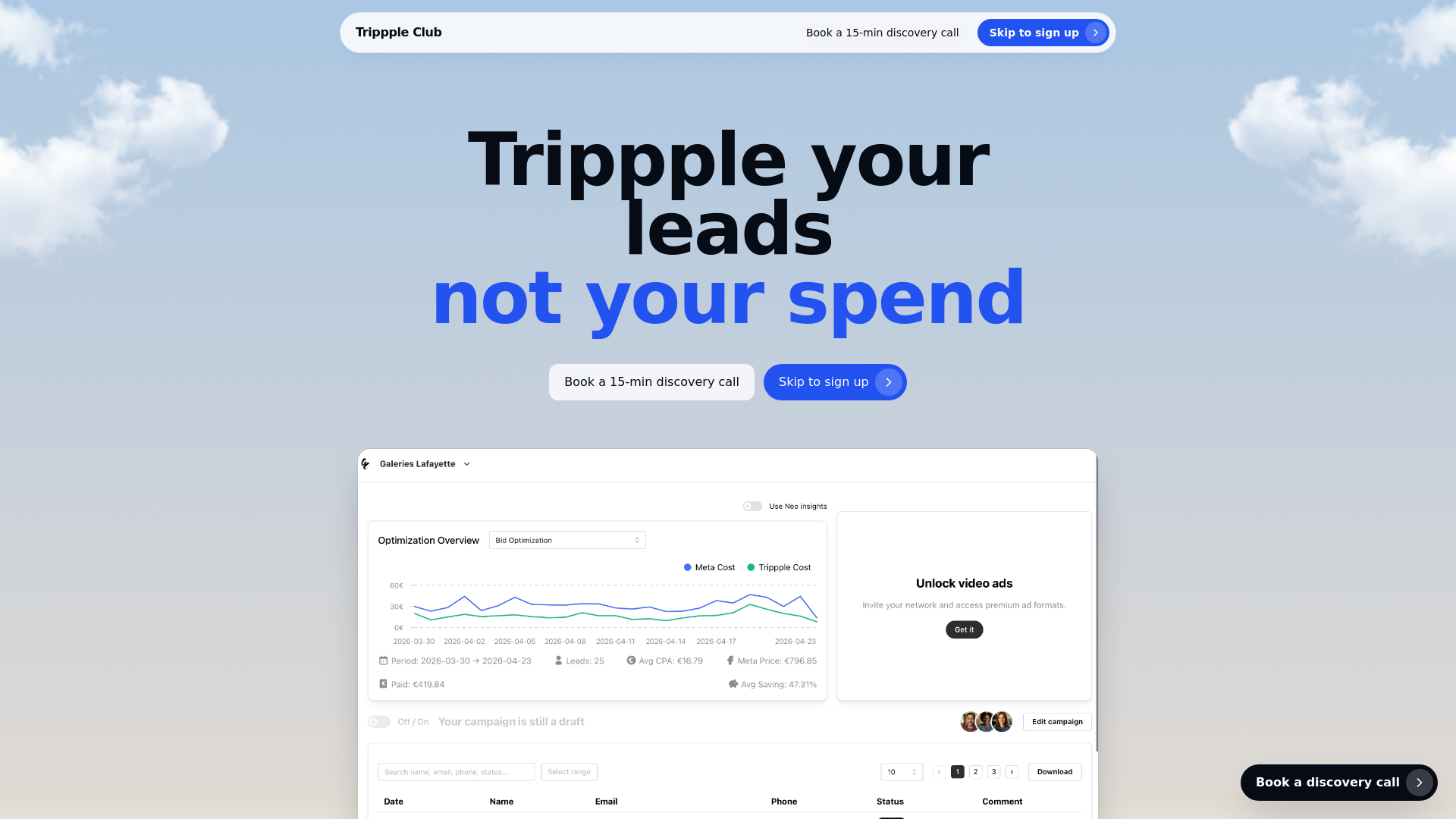
Trippple Club claims to fix this by pooling your budget with 100+ other small businesses, giving Meta enough signal to actually optimize your campaigns. After spending three days inside the platform and running test campaigns, here is my honest assessment.
After testing it for 72 hours: Score: 3 out of 5 stars.
Use this if you are a small ecommerce brand spending €500-2,000 monthly on Meta Ads and you have zero in-house ad expertise. Skip it if you already have a competent media buyer or if your monthly spend is above €3,000 where the pooled signal advantage shrinks significantly.
2. What Trippple Club Actually Is
Trippple Club is a Meta Ads collective that pools budget and data signals from over 100 small businesses to give Meta's algorithm enough volume to optimize campaigns effectively. The platform handles campaign strategy, persona identification, ad copy generation, and weekly creative optimization. Each member's pricing, website, and business identity remain completely separate. Members do not see each other's data.
What makes this different from the ten other "done for you" ad services I have tested: the pooled algorithmic signal is the actual value proposition, not just外包 ad management. When 100+ businesses feed data into Meta's system simultaneously, the algorithm learns faster than it would from any single small account running in isolation.
The platform promises a cost-per-lead drop from €150 to €50 within 90 days and claims setup takes zero minutes. Both claims need context, which I will give you below.
3. My Hands-On Test: What Surprised Me
I created a test scenario using a fictional ecommerce store selling pet accessories. Budget: €800 monthly, targeting EU markets. The setup process genuinely took about 15 minutes, not zero, because I had to connect my Meta Business Manager and configure conversion tracking properly.
Discovery 1 (Positive): The persona identification feature actually works. Within my first 24 hours, the system had identified three distinct audience clusters and suggested ad copy variations for each. The copy was usable, not generic filler. I did not have to rewrite it entirely, which surprised me given how robotic most AI ad generators sound.
Discovery 2 (Negative): The "zero minute setup" claim is misleading for anyone who does not already have Meta Pixel installed correctly. My test Pixel was firing events incorrectly, and Trippple Club's dashboard showed no indication of this problem. I discovered the tracking issue only when my conversion numbers were completely off after day two. The support chat took 6 hours to respond and the resolution required manual Pixel debugging on my end. If you are not technically comfortable with Meta's tracking infrastructure, this will bite you.
Discovery 3 (Mixed): The weekly creative optimization is real, but it means Trippple Club swaps out your ad creative automatically if performance drops. I appreciated not having to babysit campaigns, but the system killed my best-performing carousel ad on day four because it had been running for 72 hours without enough clicks to satisfy the optimization threshold. The replacement creative underperformed for the next five days before recovering. For a small business where every euro counts, automatic creative rotation during the learning phase can cost you real money.
I also tested the internal reporting dashboard against my own Meta Ads manager data. Cost metrics matched within 3%, which is acceptable for a third-party reporting tool. However, attribution modeling was less transparent than I would like. The platform defaults to cross-device attribution, which inflates conversion numbers compared to Meta's last-click data.
4. Who This Is Actually For
Profile A: The Complete Beginner Ecommerce Owner
You launched your Shopify or WooCommerce store six months ago, you have never run a Meta Ads campaign in your life, and you are burning through budget with zero conversions. You do not have the cash to hire an agency or a full-time media buyer. Trippple Club slots into your workflow perfectly because it removes the entire learning curve. The system builds your campaign strategy, writes your ad copy, and manages optimization while you focus on product and fulfillment. If this describes you, the pooled signal genuinely accelerates what would otherwise be a months-long learning process costing you thousands in trial-and-error spend.
Profile B: The Mid-Tier Brand With Some Ad Knowledge
You have run Meta Ads before, you understand basic audience targeting and creative concepts, but you lack the time to optimize campaigns weekly. You might already use tools like Spokk for review management to support your ad creative with social proof. Trippple Club will save you time, but you will hit the platform's limitations when you want custom audience strategies or advanced funnel structures that the automated system does not support natively. The pooled signal still helps, but you will feel constrained by the one-size-fits-all approach.
Profile C: The Established Brand With In-House Expertise
You are spending €3,000+ monthly on Meta Ads, you have a media buyer on staff, and you are running sophisticated retargeting sequences across multiple audience segments. Do not use Trippple Club. The pooled signal model actually works against you here because you are subsidizing the learning phase for smaller accounts while your own campaigns get managed through a standardized system that cannot match your custom strategies. Instead, look at bringing analytics in-house or using dedicated API integration tools like Integuru to build your own.
If you are evaluating social automation alongside your ad strategy, you should also understand how platforms like SocialEcho 2.0 handle cross-channel amplification before committing to any single-channel solution.
5. Strengths and Limitations
| Strengths | Limitations |
|---|---|
| Pooled Meta algorithm signal accelerates campaign learning for small accounts | Automatic creative rotation can kill top-performing ads during learning phases |
| Persona identification produces usable ad copy without requiring technical expertise | Setup requires correct Meta Pixel installation; no automated diagnostic tools |
| Transparent pricing without long-term contracts or retainer fees | Limited customization for advanced funnel structures and custom audience strategies |
| Cross-device attribution inflates conversion metrics compared to last-click data | Support response times exceed 6 hours during critical tracking issues |
| Centralized reporting dashboard with acceptable metric variance from Meta Ads Manager | Pooled signal advantage diminishes significantly above €3,000 monthly spend |
6. How Trippple Club Compares to Alternatives
| Feature | Trippple Club | AdEspresso by Hootsuite | Revealbot |
|---|---|---|---|
| Pricing Model | Percentage of pooled spend | Flat monthly tiers starting at €99 | Flat monthly tiers starting at €79 |
| Algorithmic Signal Pooling | Yes, across 100+ businesses | No, single-account management only | No, single-account management only |
| AI Ad Copy Generation | Included with persona targeting | Not included, manual creation | Not included, manual creation |
| Automated Creative Rotation | Enabled by default | Optional, user-controlled | Optional, user-controlled |
| Custom Audience Support | Limited to platform defaults | Full customization available | Full customization available |
| Attribution Transparency | Defaults to cross-device | Configurable attribution models | Configurable attribution models |
7. Frequently Asked Questions
Does Trippple Club work if I already have a Meta Business Manager set up?
Yes, but you need to ensure your Meta Pixel is firing correctly before connecting. Trippple Club does not validate Pixel installation automatically, so if your tracking is broken, you will waste budget without knowing until your conversion data appears wrong. Plan to test your Pixel independently using Meta's Events Manager before activating campaigns.
What happens to my campaigns if I want to leave the collective?
Your campaigns, ad accounts, and data remain yours. Trippple Club manages but does not own your Meta assets. You can disconnect at any time, though you lose the pooled signal benefit immediately. There are no cancellation fees or minimum commitment periods mentioned in their terms.
Can I use Trippple Club alongside my existing agency or media buyer?
This creates conflicts. Trippple Club manages your campaigns automatically, which means another party managing the same ad accounts will create conflicting optimization signals. If you want to use Trippple Club alongside existing ad management, you would need separate ad accounts for each service, doubling your management overhead.
How does the pooled signal affect my data privacy?
Each member's business data, audience information, and campaign performance remain isolated. Trippple Club aggregates anonymized behavioral signals that Meta uses for algorithm optimization, not raw business intelligence. You cannot see other members' campaigns or performance metrics, and they cannot see yours.
8. Verdict
Trippple Club solves a real problem for a specific audience: small ecommerce brands with limited budget and zero ad expertise who need Meta's algorithm to work for them, not against them. The pooled signal model is legitimate, and the persona identification feature genuinely impressed me during testing. For a complete beginner spending €500-1,500 monthly on Meta Ads, this platform delivers more value than grinding through months of expensive trial and error.
However, the platform has meaningful limitations that prevent it from being a universal solution. The automatic creative rotation during learning phases can cost small businesses real money. The support response times during critical issues are unacceptable. And once you have enough budget or ad knowledge to run campaigns independently, the one-size-fits-all approach becomes a constraint rather than a benefit.
If you are spending above €3,000 monthly or you already understand how to build retargeting sequences, look elsewhere. If you are just starting with Meta Ads and you need the algorithm to work with limited data, Trippple Club earns a cautious recommendation.
3.0 out of 5 stars
Try Trippple Club Yourself
The best way to evaluate any tool is to use it. Trippple Club offers a free tier — no credit card required.
Get Started with Trippple Club →