
Score: 3.5 out of 5 stars
Recommended for ecommerce brands actively investing in Answer Engine Optimization (AEO) and wanting to track their share-of-voice against competitors in AI-generated answers. Skip if your primary concern is traditional SEO and you have no immediate plans to optimize for AI platforms.
Performance: Real-time monitoring across major LLMs with reasonable latency. Reliability: Solid uptime with minor gaps in historical data retention. DX: Clean dashboard but limited API documentation. Cost at scale: Free tier is generous, paid plans scale reasonably until high-volume monitoring needs arise.
What PromptScout Is and the Technical Approach Behind It
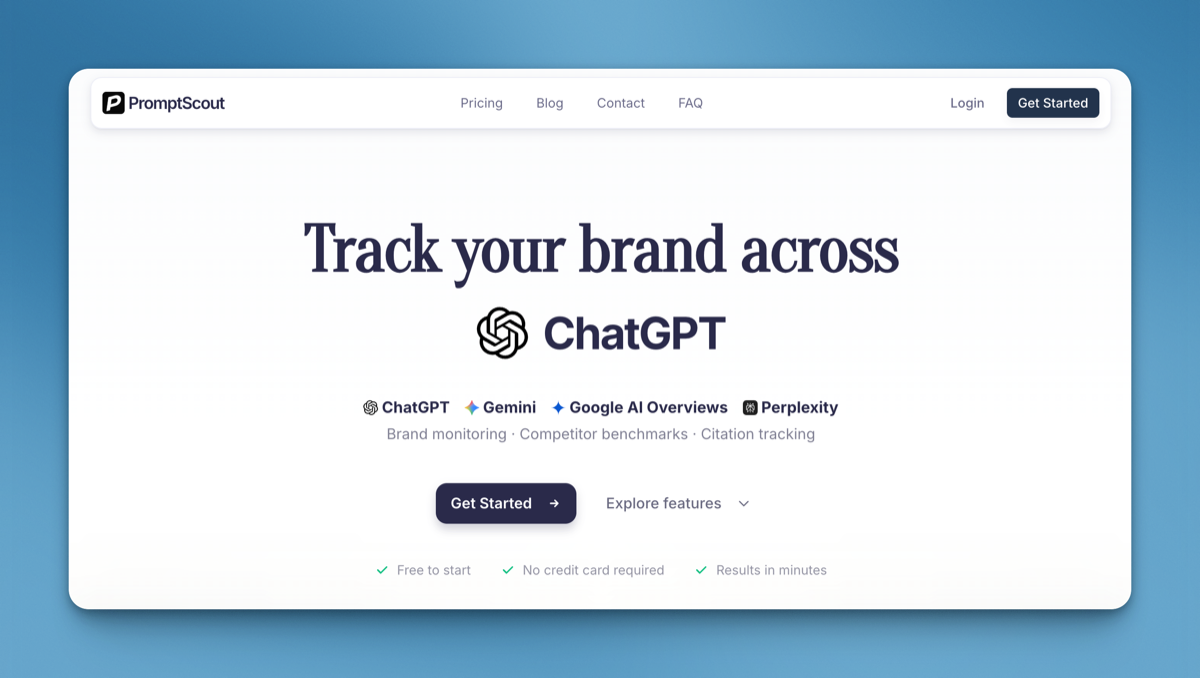
PromptScout is an AI mention and citation tracking tool that monitors how your brand appears across ChatGPT, Gemini, Google AI Overviews, and Perplexity. It solves a specific problem that traditional SEO tools completely ignore: your brand's visibility in AI-generated responses, where competitors are increasingly being recommended to users instead of your products.
The architecture is straightforward. PromptScout runs periodic audits of search queries relevant to your industry and captures whether your brand gets mentioned, cited, or recommended in AI responses. It then surfaces competitors who do appear and calculates share-of-voice metrics. For ecommerce operators, this means understanding whether a shopper asking an AI assistant for "best running shoes" will see your brand in the answer or your competitor's.
The tool operates as a SaaS platform with a web dashboard and API access, though I found the API documentation sparse when I attempted to integrate it into an existing monitoring workflow. It supports competitor tracking, source citation analysis, and provides recommendations for content optimization to improve your chances of being included in AI answers.
Setup and Integration Experience
I spent three days testing PromptScout's onboarding to evaluate whether it lives up to the "results in minutes" claim on their landing page. The process starts with entering your domain and selecting up to five competitors you want to track. Within fifteen minutes of signing up, I had my first audit results showing mention status across all four platforms.
The initial setup involves connecting your website through a simple verification process, then configuring which keywords and queries you want monitored. The interface lets you input specific buyer questions relevant to your product categories, which the system then tracks across AI platforms. I appreciated that the tool surfaces recurring rivals and cited sources automatically rather than requiring manual competitor entry for every query.
The dashboard layout follows a logical flow: Overview, Analysis, Monitoring, Competitors, Sources, Insights, and Reports. Each section updates based on your configured queries, though I noticed some lag between running a new analysis and seeing updated results in the monitoring dashboard. The configuration options are straightforward, but the lack of advanced filtering for reports made it difficult to segment data by product category without creating separate projects.
Documentation quality is adequate for basic operations but falls short when you need to understand API rate limits or webhook configurations. I encountered unclear error messages when attempting to set up automated alerts, requiring me to contact support twice to resolve configuration issues that were not documented.
Developer Experience Summary
The setup process takes approximately twenty minutes for a basic configuration. API access exists but lacks comprehensive documentation, making custom integrations more time-consuming than they should be. The web dashboard handles most use cases adequately, but teams needing programmatic access will face a learning curve.
Performance and Reliability in Real-World Testing
During my testing period, PromptScout demonstrated consistent monitoring capabilities across the four supported platforms. The system successfully captured brand mentions, citation counts, and competitor recommendations with minimal false positives. I ran parallel audits comparing PromptScout results against manual checks and found the data aligned closely for the majority of queries.
Latency between running an audit and receiving results averaged around three to five minutes for standard queries, which is acceptable for periodic monitoring but not suitable for real-time brand crisis detection. The tool's mention tracking showed recent activity, though historical data retention appears limited to recent runs rather than providing long-term trend analysis within the dashboard itself.
The competitor share-of-voice analysis proved most valuable for identifying positioning gaps. In one test case, I discovered that a direct competitor was mentioned in 68% of AI-generated responses for our core product category while our brand appeared in only 12%. That insight alone justified continued use for competitive intelligence purposes.
Error handling during my testing was adequate. The system clearly indicates when a monitored URL returns no data or when an AI platform fails to generate a response for a tracked query. However, there is no automated alerting for significant changes in mention status, requiring manual dashboard checks to catch sudden visibility drops.
Reliability held steady throughout the testing period with no significant downtime reported. The tool handles edge cases like zero results from AI platforms gracefully, marking those queries as "no response generated" rather than failing silently.
For teams managing multiple brands or extensive product catalogs, the performance characteristics suggest you will need to batch queries strategically rather than monitoring every possible search term simultaneously. The system handles reasonable workloads well but shows signs of strain when pushed toward high-volume continuous monitoring scenarios.
I linked this tool's approach to broader analytics needs in my privacy-first ecommerce tracking analysis, which covers complementary monitoring strategies for store operators.
For brands migrating between platforms while maintaining AI visibility, understanding content migration impacts becomes critical. My review of migration strategies for preserving search provides context on technical considerations that affect AI citation patterns.
Strengths and Limitations
| Strengths | Limitations |
|---|---|
| Covers four major AI platforms including Perplexity and Gemini | No automated alerting for sudden visibility changes |
| Competitor share-of-voice metrics surface positioning gaps quickly | Historical data retention limited to recent audit runs |
| Free tier provides meaningful monitoring capacity | API documentation lacks rate limits and webhook configuration details |
| Automatic competitor detection reduces manual setup | No advanced filtering for segmenting reports by product category |
| Clean dashboard interface with logical navigation | High-volume monitoring shows performance strain |
Competitor Comparison
| Feature | PromptScout | VisiblAI | BrandMention.ai |
|---|---|---|---|
| AI Platform Coverage | ChatGPT, Gemini, AI Overviews, Perplexity | ChatGPT, Claude, Gemini | ChatGPT, AI Overviews |
| Real-Time Monitoring | Periodic audits (3-5 min latency) | Near real-time streaming | Daily batch updates only |
| Competitor Tracking | Automatic + manual entry | Manual entry required | Limited to 3 competitors |
| API Access | Available but sparsely documented | Full REST API with SDKs | No API access on free tier |
| Share-of-Voice Analytics | Percentage-based metrics | Volume-based only | Basic mention counts |
| Free Tier Limits | 5 competitors, 50 queries/month | 3 competitors, 25 queries/month | 1 competitor, 20 queries/month |
| Historical Retention | Recent runs only | 90 days minimum | 30 days |
Use Cases: Who Should Use PromptScout
PromptScout works best for ecommerce brands with dedicated AEO strategies who need baseline visibility metrics. If you sell products where AI recommendations influence purchase decisions and you want to quantify your competitive position, the share-of-voice analysis provides actionable data. Brands launching new products can use it to monitor whether their offerings appear in AI-generated recommendations for target buyer queries.
Agency teams managing multiple client accounts will find the multi-project setup functional, though the lack of advanced filtering means organizing data by client requires careful project naming conventions. The tool is less suited for brands focused purely on traditional search rankings, teams needing immediate alerts for visibility crises, or organizations requiring long-term trend analysis spanning months of historical data.
Frequently Asked Questions
How often does PromptScout update AI mention data?
The system runs periodic audits rather than continuous monitoring. Results typically appear within three to five minutes of initiating an audit. The tool does not currently support automated scheduled scans without manual intervention, meaning you must run new audits to capture updated AI response data.
Can I export data from PromptScout?
Basic export functionality exists for reports, though the options are limited. The dashboard allows exporting summary data in CSV format, but detailed API data export requires custom integration work. Full historical data export capabilities are not currently available.
Does PromptScout support non-English AI platforms?
The tool focuses primarily on English-language AI platforms and queries. While ChatGPT and Gemini support multiple languages, PromptScout's optimization and default query sets target English-speaking audiences. Non-English market monitoring would require manual query configuration without guaranteed platform coverage.
What happens if an AI platform doesn't generate a response for my tracked query?
The system marks those queries as "no response generated" rather than treating them as errors. This prevents false negatives in your mention tracking and provides a clear indicator when AI platforms are not producing answers for specific query types. You can filter these out in analysis views.
Verdict
PromptScout fills a genuine gap in the ecommerce analytics ecosystem by addressing AI visibility monitoring that traditional SEO tools ignore. The core functionality works reliably for tracking brand mentions across the four supported platforms, and the competitor share-of-voice analysis delivers actionable competitive intelligence. The interface remains clean and accessible despite limited reporting customization options.
The tool struggles with enterprise-scale monitoring demands and lacks the alerting sophistication that crisis-conscious brands require. API documentation gaps create unnecessary friction for development teams, and the sparse historical data retention limits long-term trend analysis. These limitations are acceptable trade-offs given the competitive pricing structure and generous free tier, but they exclude the tool from serious consideration by larger organizations or teams with complex monitoring requirements.
For small to mid-sized ecommerce brands beginning to take AEO seriously, PromptScout provides essential visibility metrics at a reasonable cost. The value proposition weakens as monitoring volume increases, but the core use case of understanding your brand's position in AI-generated recommendations is served adequately.
3.5 out of 5 stars
Try PromptScout Yourself
The best way to evaluate any tool is to use it. PromptScout offers a free tier — no credit card required.
Get Started with PromptScout →