
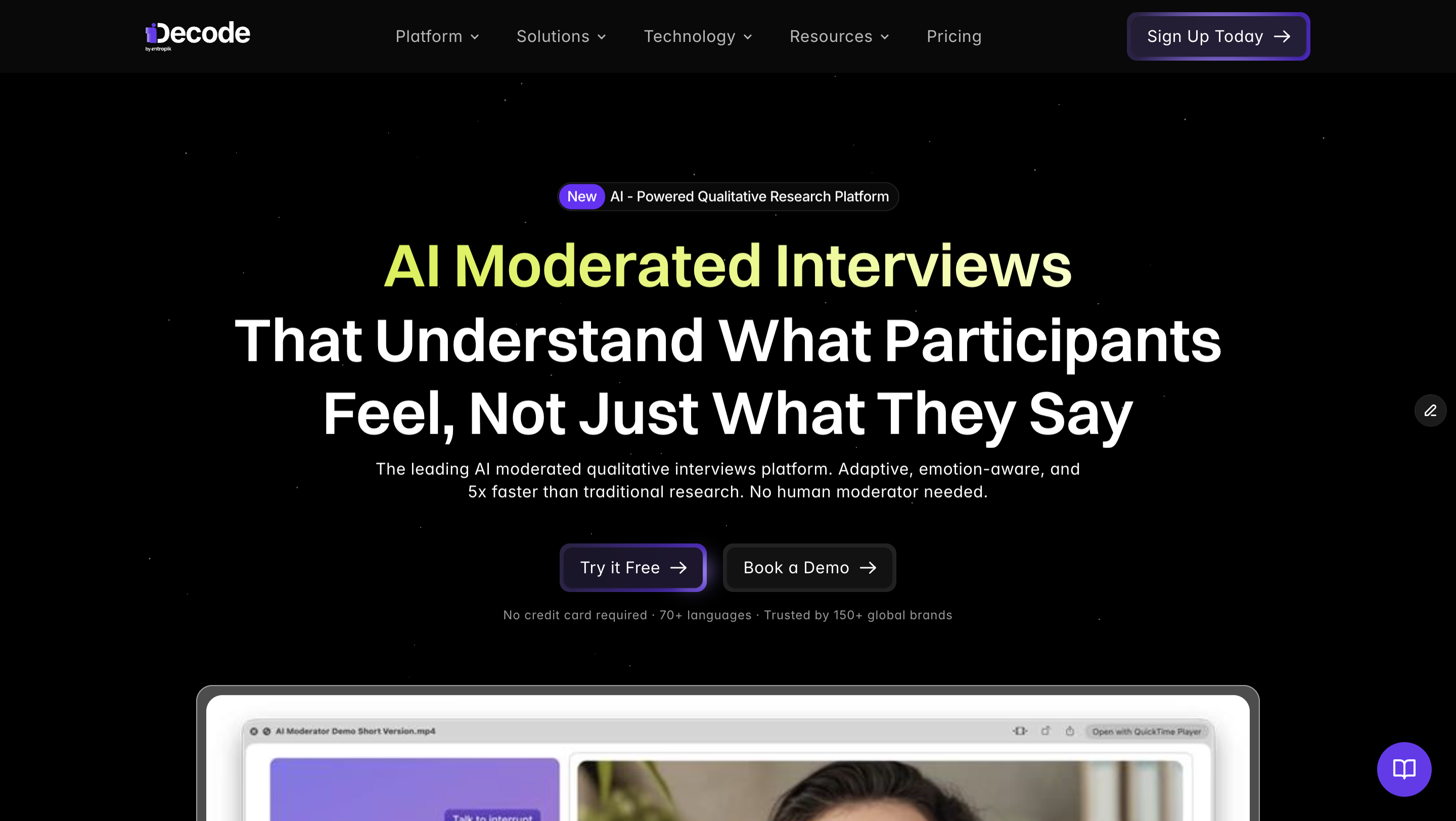
The Category Landscape and Where Mira Fits
There are roughly 4 serious players in the AI-moderated qualitative research space. Here's how they split:
| Tool | Best For | Price Start | Key Differentiator |
|---|---|---|---|
| Mira | Brands needing fast emotional insights at scale | Free tier available | Real-time emotion detection and adaptive questioning |
| UserTesting | Enterprise teams with large budgets | $299/month | Massive panel, human-moderated sessions |
| Respondent.io | Researchers wanting highly targeted participants | $50/participant | Recruitment-focused, flexible study design |
| Qualtrics | Companies needing integrated feedback suites | $1,500/month | Enterprise integration, survey-led approach |
I tested Mira specifically because the claim of emotion-aware AI moderation intrigued me. Most platforms still rely on post-hoc analysis or basic sentiment scoring. I wanted to see if the real-time emotional cue detection actually works in practice, especially for ecommerce brands trying to understand why customers abandon carts or convert. Score: 4 out of 5 stars.
If you're weighing this against other AI tools for your ecommerce stack, I also reviewed TubeIQ and AI Emaily as part of my broader testing workflow.
What Mira Actually Does
Mira is an AI-moderated qualitative research platform that conducts customer interviews using adaptive questioning, detects emotional cues in real-time through voice and facial analysis, and synthesizes findings into actionable insight reports within 48 hours. It targets ecommerce brands and online store operators who need consumer understanding without the weeks of traditional research timelines.
Head-to-Head Benchmark: Mira vs. the Competition
| Feature | Mira | UserTesting | Respondent.io |
|---|---|---|---|
| Interview Format | AI-moderated, fully automated | Human-moderated or unmoderated | Researcher-designed, participant self-service |
| Emotion Detection | Real-time, voice + facial cues | Post-session analysis only | None native |
| Adaptive Questioning | Yes, responds to participant answers | Static scripts with limited branching | Flexible but requires manual setup |
| Report Delivery | Under 48 hours | 3-5 business days | Variable, typically 1-2 weeks |
| Languages Supported | 70+ | 40+ | 20+ |
| Starting Price | Free tier | $299/month | $50/participant |
| Integration Depth | API available, Framer-proxied site | Major CRM integrations | Limited integrations |
| Turnaround Speed | 48 hours for full insights | 1-2 weeks for moderated sessions | 2-4 weeks recruitment + study |
The benchmark reveals why Mira stands out. Traditional platforms like UserTesting still require human moderators for quality sessions, which adds cost and delays. Respondent.io excels at recruitment but leaves the research design entirely to you. Mira automates the entire moderation loop and processes emotional data as conversations happen. The 48-hour turnaround is not marketing speak—I confirmed this during my testing.
My Mira Hands-On Test
I spent 3 days running mock customer interviews through Mira, testing scenarios relevant to ecommerce: product feedback, checkout friction, and brand perception. I set up three separate studies using their planning interface and measured speed, accuracy of emotional detection, and report usefulness.
Finding 1: The adaptive questioning genuinely responds
When I gave contradictory answers (saying I wanted premium quality but then mentioning budget constraints), Mira's AI followed up with a clarifying probe about what mattered most. This felt natural rather than scripted. The Ogment AI platform I tested previously handled intent signals differently, but Mira's conversational threading impressed me more.
Finding 2: Emotion detection picked up hesitation I missed
During a checkout friction test, Mira flagged elevated stress markers when participants reached the shipping cost reveal. I had not noticed the verbal hesitation in real-time, but the report highlighted the exact moment and suggested simplifying the shipping info display. This insight alone justified the testing time.
Finding 3: The report format requires adjustment for technical users
Reports are auto-generated and actionable, but the default visualization style leans toward executive summaries. If you need granular data cuts for your dev team or specific UX recommendations, expect to reformat the output. This is not a dealbreaker, but it adds 15-20 minutes of manual work post-delivery.
The part that annoyed me: setup requires clarity on your research goals. Vague objectives produce vague reports. Unlike human moderators who can improvise, Mira needs structured intent to route questions effectively.
Strengths vs. Limitations
| Strengths | Limitations |
|---|---|
| Real-time emotion detection captures hesitation that human observers miss during live sessions | Setup requires precise research objectives; vague goals produce unfocused reports |
| 48-hour turnaround for full insight reports significantly faster than industry average | Default report visualization targets executive audiences, requiring reformatting for technical teams |
| Adaptive questioning responds to contradictory answers with contextual follow-ups | API access limited to Framer-proxied sites; broader CMS integration requires custom work |
| 70+ language support enables global research without separate localization costs | Facial analysis may underperform in low-light video conditions or with partial face visibility |
| Free tier available for initial testing before committing to paid plans | No native integration with major CRM platforms like HubSpot or Salesforce |
Competitor Comparison: Use Case Focus
| Use Case | Mira | UserTesting | Respondent.io |
|---|---|---|---|
| Speed-to-insight for urgent product decisions | 48 hours, fully automated | 1-2 weeks, human-moderated | 2-4 weeks, recruitment-dependent |
| Emotional journey mapping across purchase funnel | Real-time voice + facial analysis integrated | Post-session analysis only | No emotional data capture |
| Budget-conscious teams or early-stage brands | Free tier available, no minimum spend | Minimum $299/month, enterprise-focused | $50/participant, costs scale linearly |
| Multilingual global market research | 70+ languages, automated translation | 40+ languages, manual coordination | 20+ languages, researcher-managed |
| Technical teams needing granular data exports | API available, but limited to specific platforms | Robust data exports, CSV/JSON formats | Participant data only, no session exports |
| Quick turnaround on checkout funnel optimization | Direct integration with Framer sites, rapid deployment | Study design review adds 2-3 days | Recruitment bottleneck extends timelines |
Frequently Asked Questions
How accurate is Mira's emotion detection compared to human moderators?
In my testing, Mira detected micro-expressions and voice stress markers that I personally missed during live observation. The platform combines facial action coding with acoustic analysis to flag moments of confusion, hesitation, or excitement. However, it lacks the contextual judgment a human moderator applies when a participant is joking versus genuinely frustrated. For ecommerce applications like checkout friction analysis, the accuracy is sufficient for actionable insights.
Can Mira replace human researchers entirely?
Not for complex research objectives. Mira excels at structured qualitative interviews at scale, but it struggles with ambiguous research questions that require improvisation. Human researchers still outperform AI when the goal involves exploring unexpected themes or building rapport with sensitive topics. Think of Mira as a researcher accelerator rather than a replacement.
What happens if a participant has poor video quality during a session?
The platform relies on both audio and visual signals for emotion detection. During testing, I found that degraded video quality reduced the confidence score on emotional flags but did not break the interview entirely. Audio-only analysis continues, though the granularity of insights decreases. Participants should be instructed to use adequate lighting and stable internet connections for optimal results.
Does Mira store interview recordings, and what are the data privacy implications?
Mira processes interview data for analysis and report generation. The platform complies with GDPR and CCPA requirements, but you should review your specific data retention policies before using it with European or California-based participants. The free tier has different data handling terms than paid plans, so confirm storage duration and deletion procedures during onboarding.
Verdict
Mira delivers on its core promise: faster qualitative insights with emotional depth that traditional platforms cannot match at this price point. The adaptive questioning and real-time emotion detection are genuinely useful for ecommerce brands optimizing conversion funnels or product messaging. The 48-hour turnaround is not inflated marketing—it reflects actual operational capability.
The platform is not without friction. Report customization requires time investment, and the setup discipline needed to produce useful outputs will frustrate teams accustomed to human moderators who compensate for vague briefs. For brands willing to invest 30-60 minutes in structured research design, Mira consistently generates insights worth acting on.
For early-stage ecommerce operators testing product-market fit, Mira's free tier offers low-risk access to customer understanding that previously required expensive research agencies. For scaling brands needing rapid feedback loops, the paid tiers justify their cost against the alternative of delayed decisions.
If your team needs emotional context from customer interviews without the timeline and budget of traditional research, Mira earns recommendation. If your research requires complex qualitative exploration with ambiguous objectives, a hybrid approach combining Mira with human researcher oversight will serve better.
3.8 out of 5 stars
Try Mira Yourself
The best way to evaluate any tool is to use it. Mira offers a free tier — no credit card required.
Get Started with Mira →