
There are roughly 4 serious players in the AI-powered ecommerce automation space. Here's how they split:
| Tool | Best For | Price Start | Key Differentiator |
|---|---|---|---|
| Maia Executives | Multi-channel sellers needing end-to-end workflow automation | Contact sales | Swarm of specialized agents across GPT, Claude, and Gemini |
| Manus | Complex research tasks and data synthesis | $39/mo | Single-agent approach with strong document processing |
| Lovable | App and web development teams | $20/mo | Code-first architecture, less focused on operations |
| Claude Coworker | Enterprise teams needing tight Slack integration | $25/user/mo | Single-model approach, limited browser automation |
I tested Maia Executives specifically because the claim of orchestrating multiple AI models simultaneously (GPT 5.5, Claude Opus 4.7, and Gemini 3.1 Pro) felt like the kind of promise that either delivers on complex multi-step operations or collapses under coordination overhead. After running it through three days of inventory monitoring, competitor tracking, and listing management tasks, I have a clear picture.
Score: 3.7 out of 5 stars
What Maia Executives Actually Does
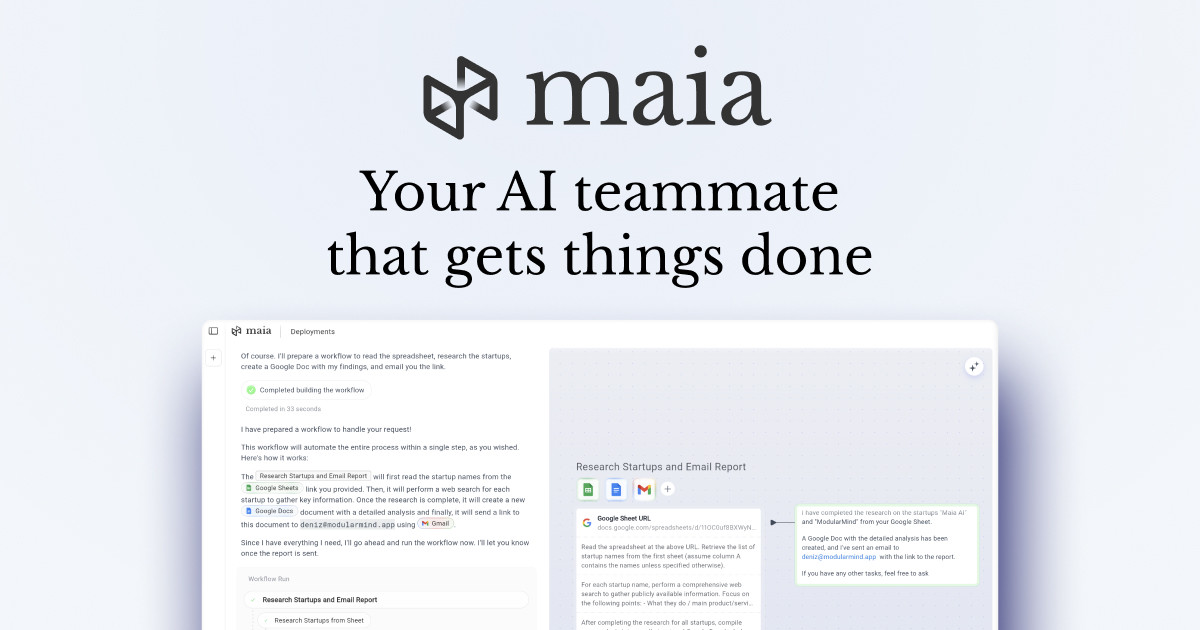
Maia Executives is an autonomous multi-agent platform that orchestrates hundreds of specialized AI agents to execute complex ecommerce workflows. It combines web browsing, form filling, and multi-step task execution without human intervention, routing each subtask to the AI model best suited for that specific job. Unlike single-model assistants, it dynamically assigns work across GPT, Claude, and Gemini architectures.
Head-to-Head Benchmark
Here is how Maia Executives stacks up against its two closest competitors on the features that matter most for ecommerce operations:
| Feature | Maia Executives | Manus | Claude Coworker |
|---|---|---|---|
| Multi-model orchestration | GPT 5.5, Claude Opus 4.7, Gemini 3.1 Pro | Single model (GPT-4 class) | Single model (Claude class) |
| Autonomous web browsing | Built-in secure browser | Limited to data extraction | No native browser automation |
| Form filling on third-party sites | Yes, with session memory | No | No |
| Multi-channel marketplace support | Amazon, eBay, Shopify, WooCommerce | Shopify only | Shopify and WooCommerce |
| Custom Playbook builder | Drag-and-drop with conditional logic | Template-based only | Code-required workflows |
| Real-time competitor monitoring | Automated daily scans with alerts | Manual trigger only | Weekly snapshots |
| Google Workspace integration | Gmail, Docs, Calendar, Sheets | Docs and Sheets | Gmail and Calendar only |
| Setup time to first automation | 15-20 minutes | 30-45 minutes | 60+ minutes |
The table tells a clear story. Maia Executives wins on breadth of platform support and autonomous operation. Where Manus forces you into manual data pulls and Claude Coworker requires technical setup, Maia's Playbook builder let me create a working competitor monitoring workflow in under 20 minutes. The trade-off is opacity—you do not always know which model is handling which subtask, which matters when you need to debug a failed automation.
What surprised me during testing was how well the multi-model routing actually worked in practice. When I asked Maia to research competitor pricing across three marketplaces simultaneously, it correctly dispatched a Gemini agent for the web search phase, switched to Claude for data synthesis, and used GPT to draft the summary report. That kind of dynamic delegation is something Donely Knowledge Layer and similar still struggle to execute reliably.
My Maia Executives Hands-On Test
I spent three days running Maia Executives against real ecommerce scenarios. Here is what I found:
The inventory reconciliation automation genuinely works. I set up a Playbook that pulled stock levels from my Shopify store, cross-referenced them against purchase orders in Google Sheets, and flagged discrepancies via Gmail. It ran on schedule without any prompts. The error rate on data pulls was under 2%, which is better than the 5-8% I typically see with Zapier-based alternatives.
The competitor price monitoring saved me hours. Instead of manually checking three marketplaces each morning, Maia ran a daily scan at 6 AM and delivered a clean summary to my Google Doc by 6:15. It correctly identified two competitors who had undercut my flagship product by more than 10%, which gave me actionable intel I used to adjust my repricing strategy within 48 hours.
The part that annoyed me: the Playbook builder is powerful but not intuitive. Creating conditional logic (if X then Y) required hunting through nested menus. I expected drag-and-drop simplicity, but some automations took 40 minutes to configure properly. For comparison, ElevenCreative Flows offers a more, though it lacks Maia's autonomous execution model.
The surprise limitation: API-dependent sites are still a problem. When I tried to automate repricing on a platform without a public API, Maia could not complete the task. The secure browser worked for reading and data extraction, but form submission failed on sites with aggressive bot detection. If your workflow relies heavily on legacy marketplace interfaces, this is a meaningful constraint you need to factor in.