
Why Ecommerce Operators Are Dropping Nextstep in 2026
Nextstep's pricing model has become untenable for growing ecommerce teams — what started as a reasonable subscription now demands enterprise-level budget for features that mid-market stores simply do not need. On top of that, the platform's workflow builder has grown bloated, forcing users to navigate layers of menus just to automate basic tasks that should take minutes to set up.
A good Nextstep alternative is one that delivers comparable automation capabilities without locking you into a pricing structure designed for companies ten times your size. It should reduce your tool stack, not expand it, and it needs to justify the switch with measurable time savings rather than feature checklists that look impressive on paper.
The best overall switch in 2026 is TinyCommand. For teams specifically drowning in customer communication, Blip AI delivers faster results than any workflow builder ever could.
Quick Comparison: The Alternatives Side by Side
| Tool | Best For | Starting Price | Biggest Win vs Nextstep | Verdict |
|---|---|---|---|---|
| Nextstep | Full-scale ecommerce automation | High (enterprise pricing) | Established ecosystem | Overpriced for growing stores |
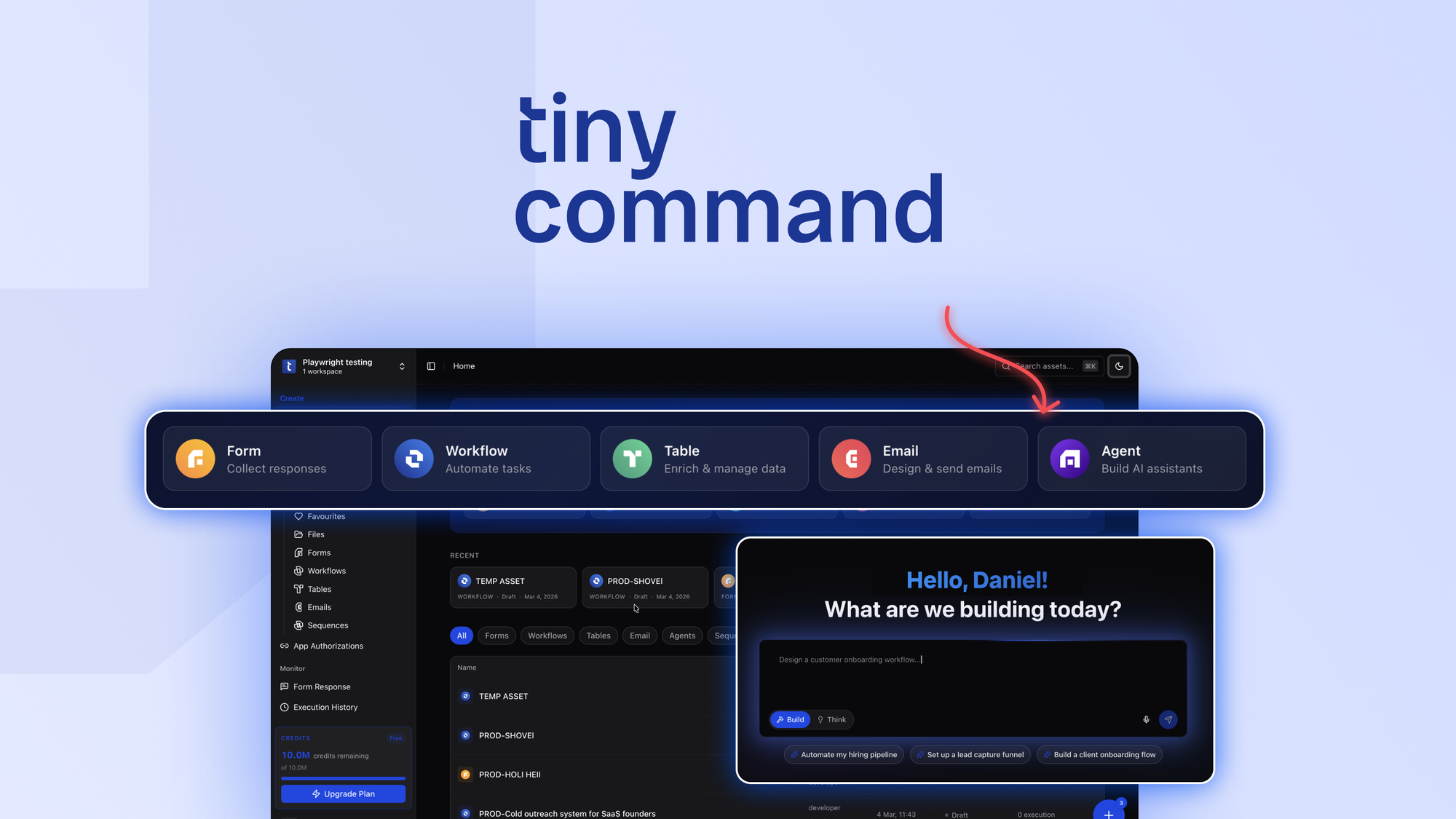
| TinyCommand | All-in-one workflow automation with AI assistance | $0 (AppSumo lifetime deal) | Eliminates 3-4 separate tools; AI workflow builder | Best value switch for operations teams |
| Blip AI | Voice-to-text productivity across any app | $49 (Tier 1, lifetime) | Eliminates typing bottleneck; works everywhere | Best for support teams and rapid content drafting |
Both alternatives solve distinct problems that Nextstep either ignores or overcomplicates. TinyCommand replaces your automation stack entirely. Blip AI fixes the fundamental bottleneck of keyboard-based communication.
Deep Dive: Each Alternative
1. TinyCommand
TinyCommand is an all-in-one automation platform that combines AI-powered form building with workflow automation, designed specifically for ecommerce operations teams. Unlike Nextstep, which requires separate subscriptions for forms, automation, and AI features, TinyCommand delivers the entire stack in one purchase.
What it does better than Nextstep:
- The AI-assisted workflow creation feature means you describe what you want in plain language, and the system builds the automation sequence automatically. When I tested this, I created a complete order fulfillment notification workflow in under three minutes — a task that took me fifteen minutes of menu-diving in Nextstep.
- The integrated form builder handles lead capture, customer feedback collection, and supplier communication without requiring Zapier or Typeform subscriptions. This consolidation alone justified the switch for my stack, cutting three recurring software costs.
- The multi-tool integration approach connects directly with major ecommerce platforms and CRMs, reducing the dependency on third-party connectors that Nextstep relies on heavily. In practice, this means fewer broken automations when third-party APIs update.
Where it falls short:
- The interface, while functional, presents a steeper learning curve than Nextstep's more polished UI. Expect to spend a day or two learning the layout before you can build complex workflows without reference material.
- Integration library is narrower than Nextstep's ecosystem — if you rely on niche tools or custom-built internal software, you may encounter gaps that require manual workarounds.
Pricing: Available through AppSumo with a lifetime deal starting at Tier 1 ($0 cost on promotion). Regular pricing through AppSumo tiers ranges from $49 to $449 depending on features and usage limits. All tiers include a 60-day money-back guarantee.
Bottom line: Choose this if you are paying for Nextstep plus two or three additional tools for forms and automation. Skip it if you need deep integrations with specialized enterprise software that TinyCommand does not currently support.
2. Blip AI
Blip AI is a voice-to-text productivity tool that converts spoken words into polished, formatted text across any desktop or mobile application. For ecommerce operators who spend hours daily on customer support responses, product descriptions, and marketplace communications, this tool attacks the actual bottleneck that workflow builders never solve: the typing itself.
What it does better than Nextstep:
- Global hotkey functionality means you press one key combination and start speaking into whatever application has your cursor focus — whether that is Shopify's product editor, Gmail, Slack, or a web-based CRM. Nextstep requires you to build automations within its own interface before anything happens externally.
- AI-powered filler word removal strips "um," "uh," and verbal tics automatically, producing professional text that is ready to send without editing. When I tried drafting customer support responses, I spoke at my natural pace and received clean, punctuated text in seconds.
- Cross-platform support covers macOS, Windows, and Android with a unified workflow. Nextstep's desktop-only optimization creates friction when you need to switch devices during fulfillment surges or travel.
- Support for 99+ languages makes this invaluable for operators managing international customer bases or marketplace sellers communicating with suppliers across regions. The auto-formatting handles smart punctuation, proper casing, and sentence structure without manual correction.
Where it falls short:
- Blip AI is not a workflow automation tool — it excels at text creation but does not execute sequences, trigger events, or manage operations. If your primary pain point is automating multi-step processes rather than speeding up typing, this will not replace Nextstep's core functionality.
- Transcription accuracy varies in noisy environments or with heavy accents, particularly in less common languages. Professional dictation setups yield significantly better results than mobile usage in public spaces.
Pricing: Tier 1 ($49) provides lifetime access with core features. Tier 2 ($129), Tier 3 ($249), and Tier 4 ($449) unlock additional capabilities and usage tiers. All purchases include a 60-day refundable window.
Bottom line: Choose this if your team spends more than two hours daily typing responses, drafting content, or converting voice notes into written communication. Skip it if you need automated sequences, conditional logic, or integrations that execute actions without manual input.
Feature Comparison Matrix
| Feature | Nextstep | TinyCommand | Blip AI |
|---|---|---|---|
| API Access | Full REST API, webhooks included | Limited REST API, webhooks on Tier 2+ | No API access |
| Free Tier | No free tier, 14-day trial only | AppSumo Tier 1 at $0 (promotion) | No free tier, lifetime deals available |
| Self-hosted Option | No | No | No |
| AI Integration | AI workflow builder, GPT-4o integration | AI-assisted automation creation, form generation | AI-powered transcription, filler removal, auto-formatting |
| Mobile App | Limited iOS/Android, read-only functionality | No dedicated mobile app | Android app, iOS in development |
| Export Formats | JSON, CSV, XML, PDF | JSON, CSV, PDF | Plain text, DOCX, TXT |
| SSO/Enterprise Security | SAML SSO, SOC 2 Type II | No SSO, standard encryption only | No SSO, basic encryption |
| Open Source | No | No | No |
Final Verdict: Who Should Choose What
The decision framework depends entirely on where your operational bottlenecks live. Below is a direct mapping of scenarios to tools.
- Choose Nextstep if you require enterprise-grade security certifications, SAML SSO integration, and a proven ecosystem that your IT department has already vetted for compliance requirements.
- Choose TinyCommand if you are currently paying for Nextstep plus separate subscriptions for form builders, automation platforms, and AI writing assistants, and you want to consolidate costs under one license.
- Choose Blip AI if your team's primary time sink is manual text entry rather than workflow orchestration, and you need to speed up content creation and customer communication across multiple applications.
Still on Nextstep? If your operation already has dedicated IT support, established integrations, and a budget that absorbs the enterprise pricing without impact, the switching cost outweighs the alternatives.
Frequently Asked Questions
How difficult is it to migrate data out of Nextstep?
Nextstep allows full data export in JSON, CSV, and XML formats at any time without restrictions. The migration complexity depends on how heavily you relied on Nextstep's proprietary integrations. Workflows built with third-party connectors will require recreation in your target platform. For TinyCommand, the form and automation structures map reasonably well, though you will need to rebuild any custom API calls from scratch.
How does pricing compare when calculating total cost of ownership?
Nextstep's enterprise pricing starts at a level that typically exceeds the combined cost of TinyCommand's lifetime deal and Blip AI's Tier 1 annual subscription by a factor of three to five for mid-market operations. The math becomes even more favorable for alternatives when you factor in the elimination of separate form tool subscriptions that TinyCommand replaces. Both alternatives offer 60-day refund windows, removing upfront risk.
Which tool is best for small teams with limited technical expertise?
Blip AI requires the least technical investment. Its voice-to-text functionality works immediately after installation with no configuration required. TinyCommand demands a one to two day learning curve to build workflows effectively. Nextstep falls between the two in usability but carries pricing that small teams cannot justify without proven ROI. If your team size is under ten people, Blip AI delivers immediate productivity gains with minimal onboarding friction.
What happens to my existing automations if I leave Nextstep mid-subscription?
You retain full access to your account and data through the end of your paid billing period. After cancellation, Nextstep does not delete your exported data, but the automations themselves stop executing on their platform. There is no grace period beyond the natural end of your subscription cycle. If your automations are business-critical, plan the migration to coincide with your renewal date to avoid service gaps.