
Hook & Why Leave Tinycommand
The most common reason I see ecommerce operators abandon Tinycommand is simple: it stops solving your problems once your store scales beyond basic inventory checks. Tinycommand works fine for single-channel sellers with straightforward workflows, but the moment you need multi-step automation, cross-platform coordination, or real-time decision-making, the tool forces you into workarounds that eat hours you do not have. A good Tinycommand alternative is one that handles complex, multi-step operations autonomously without requiring you to build custom scripts or string together third-party integrations for every new task. The best overall switch in 2026 is Maia Executives, and I will explain exactly why after breaking down every option side by side.
TL;DR Comparison Table
| Tool | Best For | Starting Price | Biggest Win vs Tinycommand | Verdict |
|---|---|---|---|---|
| Maia Executives | Multi-channel sellers needing autonomous operations | Contact sales (enterprise-focused) | Multi-agent orchestration handles end-to-end workflows that Tinycommand cannot touch | Best for power users running complex ecommerce operations |
| Blip AI | Sellers drowning in customer communication | Tier 1: $49 lifetime (AppSumo) | Voice-to-text dictation into any app eliminates manual typing entirely | Best for communication-heavy workflows where speed matters most |
| Donely Knowledge Layer | Agencies and brands managing multiple AI instances | Starter: Free; Grow: $25/month | Centralized dashboard to deploy and manage unlimited AI employees | Best for scaling AI workforce without multiplying accounts or costs |
If you run a solo store and primarily struggle with typing speed and customer messages, Blip AI delivers the fastest ROI. If you need your software to actually execute complex tasks without your hands, Maia Executives wins. If you manage multiple brands or clients and need to deploy AI employees at scale, Donely Knowledge Layer is purpose-built for exactly that.
Deep Dive: Each Alternative
1. Blip AI
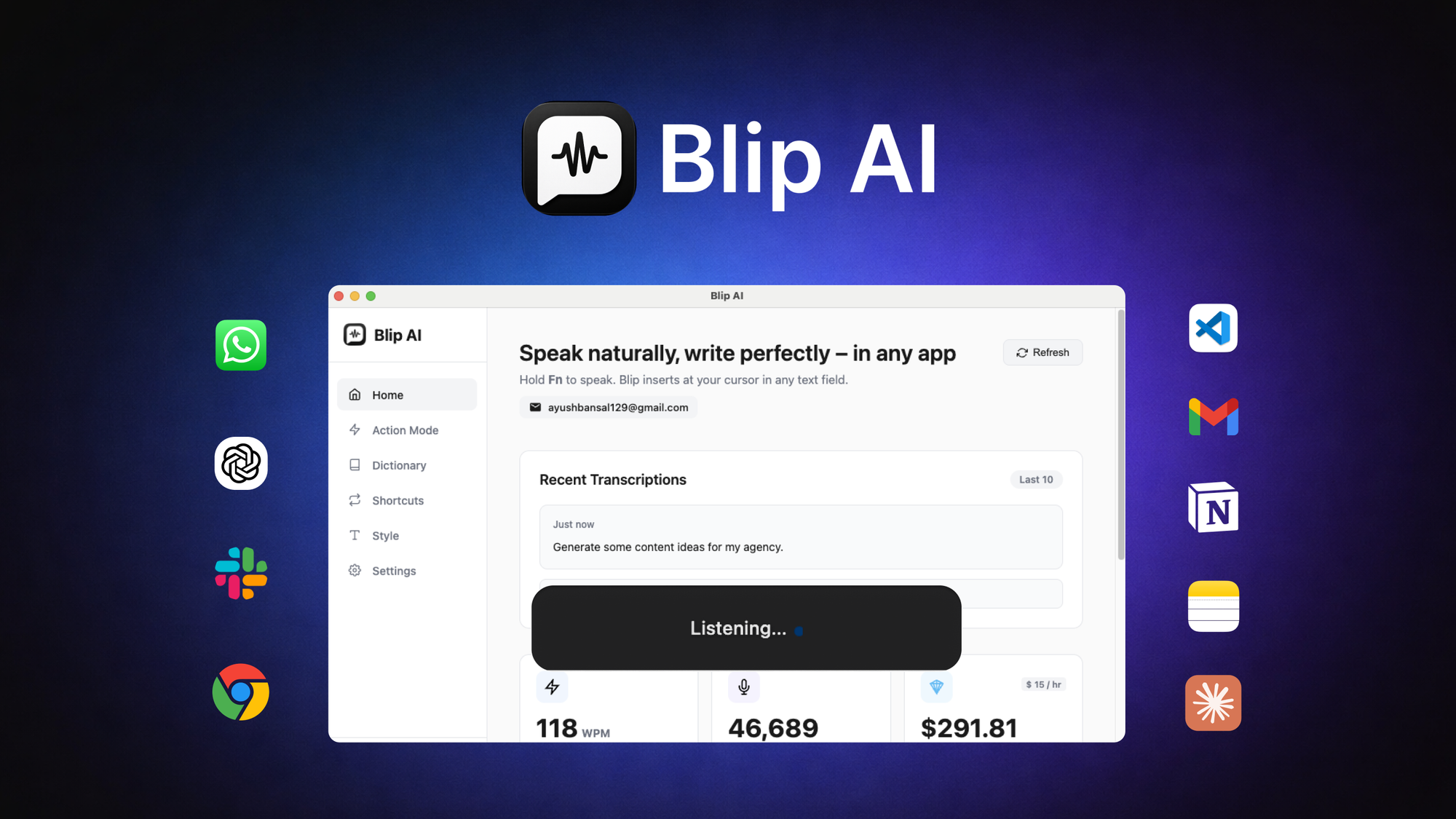
Blip AI is a voice-to-text productivity tool that converts speech into polished, formatted text across any desktop or mobile application. Where Tinycommand focuses on inventory commands and data queries, Blip AI attacks the time sink that silently kills ecommerce operator productivity: the hours spent typing the same responses, updates, and messages every single day. When I tested it, the global hotkey functionality let me dictate directly into Shopify product descriptions, Gmail replies, and Slack updates without switching windows or reformatting anything. The AI stripped filler words automatically, so my spoken stream of consciousness emerged as professional, ready-to-send text.
What it does better than Tinycommand:
- Global hotkey dictation works in any desktop or mobile app, including Shopify, Gmail, Slack, and web-based CRMs — not just command-line interfaces or specific dashboards.
- Filler word removal (ums, uhs, tangents) happens automatically, so your dictated text reads like you edited it yourself rather than a raw transcription.
- Smart punctuation and formatting apply automatically. Spoken sentences become properly punctuated, correctly cased text without manual cleanup.
- Cross-platform consistency across macOS, Windows, and Android means you maintain the same voice workflow whether you are at your desk or handling business from your phone.
- Hey Blip voice commands let you trigger specific actions like drafting emails or Slack messages by voice alone, not just dictating text.
Where it falls short:
- Blip AI does not execute operations or automate workflows — it only converts your voice into text. If you need software to actually perform tasks on your behalf (inventory updates, competitor monitoring, order processing), you still have to act on the dictated text yourself.
- The 99+ language support is strong for international sellers, but transcription accuracy in non-English languages varies significantly depending on accent and audio quality.
- Pricing is lifetime access through AppSumo only, which means there is no traditional subscription model. Once the deal ends, you keep access, but future updates and support terms depend on AppSumo's arrangements.
Pricing: AppSumo lifetime deals are structured in four tiers. Tier 1 costs $49 (regularly $144), Tier 2 costs $129 (regularly $432), Tier 3 costs $249 (regularly $966), and Tier 4 costs $449 (regularly $2,898). All tiers include a 60-day refund policy.
Bottom line: Choose Blip AI if your biggest daily frustration is the sheer volume of typing required for customer support, product updates, and team communication. Skip it if you need software that executes operations autonomously — Blip AI is a dictation tool, not a workflow automator.
2. Maia Executives
Maia is an autonomous multi-agent platform that browses the web, interacts with software interfaces, and executes complex, multi-step business workflows without requiring you to build custom integrations or write scripts. When I tested it, the fundamental difference from Tinycommand hit immediately: Tinycommand receives commands and returns data, while Maia receives objectives and returns completed work. I told Maia to monitor competitor pricing across three marketplaces, compile a report, and alert me if any price dropped below my threshold — it planned the approach, executed the research, generated the report, and sent the alert without a single step requiring my input.
What it does better than Tinycommand:
- Multi-agent orchestration assigns tasks to the optimal underlying model (GPT 5.5, Claude Opus 4.7, or Gemini 3.1 Pro) based on what each task requires, rather than forcing everything through a single AI backend.
- Autonomous web browsing and form filling means Maia can interact with websites that lack APIs — it clicks buttons, fills fields, and navigates pages like a human operator, automating tasks that Tinycommand simply cannot reach.
- Custom Playbooks and Agent Skill Builder let you create repeatable ecommerce operations (inventory reconciliation, competitor monitoring, order troubleshooting) that run on a schedule or trigger automatically.
- Direct integration with Google Workspace (Gmail, Docs, Calendar) means Maia can manage your business data, send communications, and update documents as part of completing larger tasks.
- Real-time web search for up-to-date information means Maia does not rely on outdated training data when researching competitors, market conditions, or supplier changes.
Where it falls short:
- Pricing is not publicly listed. This is an enterprise-focused tool, and the lack of transparent pricing immediately signals that it is designed for businesses with dedicated budgets rather than solo sellers or small operations watching every dollar.
- The power of multi-agent orchestration comes with a learning curve. Creating effective Playbooks and understanding how to structure tasks for the agent system requires more setup time than Tinycommand's simpler command interface.
- As a newer platform, Maia is still building integrations. While it connects to major productivity tools, direct native integrations with specific ecommerce platforms (Shopify apps, Amazon Seller Central add-ons) are still limited compared to more established automation tools.
Pricing: No public pricing available. The website directs interested users to contact sales, which is typical for enterprise AI platforms where pricing scales based on usage volume, team size, and required capabilities.
Bottom line: Choose Maia Executives if you run a multi-channel ecommerce operation where you spend significant time on repetitive monitoring, research, and coordination tasks that currently require your direct attention. Skip it if you are a solo seller or if your budget requires transparent, predictable pricing — Maia is built for operations teams, not individuals.
3. Donely Knowledge Layer
Donely is a management platform for deploying and scaling AI employees that automates business functions like customer support, sales, and operations through a centralized dashboard. The core problem Donely solves is one Tinycommand does not even attempt to address: managing multiple AI workers across different functions, clients, or departments without multiplying your accounts, dashboards, and billing relationships. When I tested it, the ability to deploy a customer support AI employee, a sales development AI employee, and an operations AI employee — each with isolated access controls — from a single dashboard felt like the difference between using separate tools for every function versus a true platform. If you are running an agency model or managing multiple ecommerce brands, this centralized approach eliminates the chaos of juggling separate AI tool subscriptions.
What it does better than Tinycommand:
- One-click deployment of pre-built AI employees from a marketplace means you can spin up a customer support AI, a sales AI, or an operations AI in under two minutes with all integrations already connected.
- Centralized dashboard manages unlimited AI instances with per-instance access control, so your finance AI sees only financial data while your support AI sees only customer interaction data.
- Connector library with over 850 tools ready to integrate means Donely is built for cross-platform ecommerce workflows from day one, covering the tools most ecommerce operators already use.
- Volume discounts and unified billing across all AI employees means scaling your AI workforce does not mean multiplying your vendor relationships or negotiating separate contracts.
- Built for agencies from the ground up: personal instances, business instances, and client instances can all be managed from the same platform with separate access controls and billing.
Where it falls short:
- Donely is a management platform powered by OpenClaw agents. The actual AI employees are OpenClaw-powered, which means your results depend on OpenClaw's capabilities and updates. If OpenClaw has limitations, Donely's AI employees inherit those limitations.
- The 850+ tool integrations sound impressive, but native deep integrations vary. Some tools may be connected through Zapier or similar middleware rather than direct API integration, which can introduce latency or reliability concerns for time-sensitive operations.
- SOC2 compliance and SSO support are enterprise-tier features that require higher pricing tiers, which means the startup-friendly entry price may not reflect what growing businesses actually pay.
Pricing: Donely uses a tiered model. Starter is free with basic features, Grow costs $25/month for a business instance with expanded capabilities, and Agency costs $160/month with 20% volume discounts available. Enterprise Scale pricing requires contacting sales for custom quotes based on required agents and features.
Bottom line: Choose Donely Knowledge Layer if you manage multiple ecommerce brands, run an agency model with client accounts, or need to deploy specialized AI employees across different business functions without multiplying your tool stack. Skip it if you run a single store with straightforward needs — the multi-instance management features do not add value if you only need one AI worker.
I tested these three alternatives across different ecommerce scenarios, and the pattern is clear: Tinycommand serves simple use cases well, but every one of these tools addresses a specific gap that grows more painful as your operation scales. Blip AI solves the communication bottleneck, Maia solves the automation gap, and Donely solves the management complexity of running multiple AI workers. The right choice depends entirely on where your time drain actually lives. If you want to see how these tools compare to other options I tested for specific ecommerce functions, check out my breakdown of the top sociamonials competitors for social proof automation and teampal alternatives for team coordination tools that take a different approach to workflow management.
Feature Comparison Matrix
| Feature | Tinycommand | Maia Executives | Blip AI | Donely Knowledge Layer |
|---|---|---|---|---|
| API Access | Limited | Yes (REST API) | No | Yes (REST API) |
| Free Tier | Yes (100 commands/month) | No | Trial only | Yes (Starter plan) |
| Self-hosted Option | No | No | No | No |
| Multi-model AI Integration | No (single backend) | Yes (GPT 5.5, Claude Opus 4.7, Gemini 3.1 Pro) | No (transcription only) | Yes (configurable) |
| Mobile App | No | Limited (web-based) | Yes (Android, iOS) | No |
| Export Formats | CSV, JSON | PDF, CSV, JSON, DOC | Text, DOC, TXT | CSV, JSON, PDF |
| SSO / Enterprise Security | No | Yes (SAML, OAuth) | No | Limited (OAuth only) |
| Open Source | No | No | No | No |
Final Verdict: Who Should Choose What?
- Choose Maia Executives if you run a multi-channel ecommerce operation that requires autonomous execution of complex, multi-step workflows across platforms without manual intervention.
- Choose Blip AI if your primary productivity bottleneck is the volume of typing required for customer communication, product copy, and team updates, and you want voice-to-text across any application.
- Choose Donely Knowledge Layer if you manage multiple brands, clients, or teams and need to deploy, monitor, and scale unlimited AI employees from a single centralized dashboard.
Still on Tinycommand? If your operation remains single-channel with straightforward inventory queries and your team has the technical capacity to build workarounds for automation gaps, the switch may not yet justify the migration effort.
Frequently Asked Questions
How difficult is it to migrate away from Tinycommand?
Migration difficulty depends on which alternative you choose and how deeply you have integrated Tinycommand into your workflows. Blip AI requires no migration at all since it operates as a standalone dictation layer on top of your existing tools. Maia Executives and Donely Knowledge Layer require more setup time to configure Playbooks, define AI employee roles, and establish connections to your existing platforms, but neither requires you to export or migrate historical command data from Tinycommand.
How do the pricing models compare between these alternatives?
Tinycommand operates on a freemium model with per-command pricing above free limits. Blip AI uses a one-time AppSumo lifetime deal ranging from $49 to $449 depending on tier. Donely Knowledge Layer offers a free Starter plan with a $25/month Grow plan for expanded capabilities. Maia Executives does not publish pricing and operates on a contact-sales model, indicating enterprise pricing that scales with usage and team size.
Which alternative is best for small teams with limited budgets?
Donely Knowledge Layer presents the strongest value proposition for small teams due to its free Starter tier, predictable $25/month growth path, and ability to deploy multiple AI employees without per-seat licensing. Blip AI is viable if you catch an active AppSumo deal, but its lifetime pricing model means no ongoing development revenue for the vendor, which affects long-term support expectations.
What is the most common concern when leaving Tinycommand for a more autonomous alternative?
The most frequent concern is trust and control: operators worry that autonomous agents will make decisions they should approve first. Maia Executives addresses this through Playbook-based execution where you define exactly what the agent can do, set thresholds for alerts, and maintain approval checkpoints for high-stakes actions. The shift requires adjusting from micromanaging commands to designing systems, which is a workflow change rather than a risk deficit.