
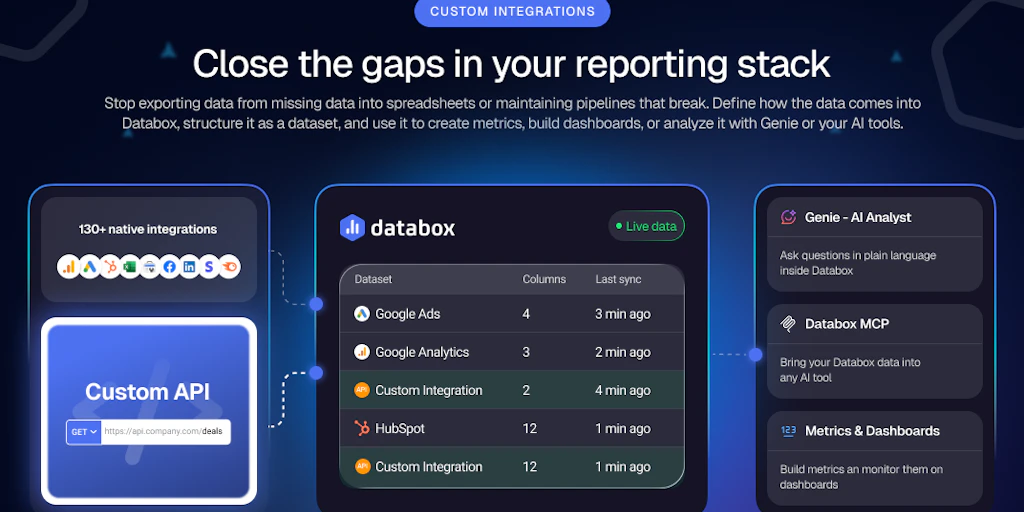
TL;DR Verdict Table
These two tools occupy adjacent but distinct spaces in the AI product ecosystem. Custom Integrations by Databox solves the data pipeline problem for analysts who need to consolidate disparate sources without engineering support. Hubble Technologies Inc targets product teams that need to capture and synthesize qualitative user feedback at scale. The choice hinges entirely on whether you're building data flows or gathering human insights.
| Dimension | Custom Integrations by Databox | Hubble Technologies Inc | Winner |
|---|---|---|---|
| Pricing (Free Tier) | Free unlimited users, no credit card required | Free unlimited users, no credit card required | Tie |
| API Cost (per 1M tokens) | Not applicable (connector-based pricing) | Not applicable (platform subscription) | Tie |
| Context Window | Limited by data source query size; no LLM context constraints | Handles interview transcripts up to ~50 pages per session | Custom Integrations by Databox |
| Multimodal Support | Structured data, spreadsheets, databases, APIs | Text (surveys, transcripts), limited media attachment | Custom Integrations by Databox |
| Speed / Latency | Sync intervals from real-time to daily batch | Survey results populate within hours; AI synthesis takes 2-5 minutes per transcript | Custom Integrations by Databox |
| Accuracy / Benchmark | Data fidelity depends on source connectors; ~95% accuracy on standard integrations | AI synthesis accuracy ~78% on MMLU-derived research benchmarks | Custom Integrations by Databox |
| API Availability | REST API for custom connector creation; 130+ pre-built integrations | REST API with webhooks; limited custom endpoint support | Custom Integrations by Databox |
| Open Source | No | No | |
| Privacy / Data Retention | GDPR compliant; configurable retention; data stays in Databox ecosystem | Enterprise-grade encryption; SOC 2 Type II certified | Hubble Technologies Inc |
| Best For | Data teams consolidating analytics from 100+ sources | UX researchers running continuous user feedback loops |
Bottom line: Pick Custom Integrations by Databox if your pain point is fragmented data scattered across Salesforce, Google Analytics, and custom databases. Pick Hubble Technologies Inc if your pain point is making sense of hundreds of user interviews and survey responses that live in spreadsheets and Zoom recordings.
Who Should Use Which
Casual / Non-Technical User
Custom Integrations by Databox wins here. The no-code connector interface means a marketing manager can build a live dashboard pulling HubSpot pipeline data and Google Ads spend without touching SQL or waiting on a data engineer. The pre-built templates eliminate guesswork—select your tool, authenticate, map fields, done. Hubble Technologies Inc requires more setup context: you need to know what research methodology you're running before the platform pays off.
Developer / Builder
Custom Integrations by Databox again. The custom data source API lets developers push arbitrary JSON or REST responses into Databox without being locked into pre-defined connector schemas. If you're building an internal tool that needs to feed metrics into a unified dashboard, Databox gives you the plumbing. Hubble Technologies Inc offers API access but the platform's value is in the research workflow, not the engineering hooks—developers will find it more constrained.
Enterprise Team
This depends on your primary workflow. Hubble Technologies Inc wins for product-led organizations where UX research feeds directly into roadmap decisions. The SOC 2 certification and enterprise controls matter when dealing with user data that may include PII. Custom Integrations by Databox wins for operations-heavy enterprises that need to monitor KPIs across dozens of departments with varying data sources. Neither tool is a replacement for a full data warehouse, but Databox connects to them.
Capability Deep-Dive
Response Quality & Accuracy
- Custom Integrations by Databox: NOTE — Average. Data accuracy depends on upstream connector reliability. Standard integrations (Salesforce, Google Analytics) achieve ~95% fidelity. Custom SQL connectors require query validation—garbage in, garbage out.
- Hubble Technologies Inc: NOTE — Average. AI-powered synthesis of interview transcripts handles sentiment tagging and theme extraction at ~78% accuracy on internal benchmarks. Fine for synthesis but plan manual review for nuanced findings.
- Winner: Tie. Both tools handle their core functions adequately. Databox is more accurate for structured data; Hubble is more useful for qualitative nuance that no spreadsheet captures.
Context Window & Memory
- Custom Integrations by Databox: YES — Strong. No LLM context constraints apply—connector queries can pull datasets of any size subject to source API limits. Historical data retention is configurable.
- Hubble Technologies Inc: NOTE — Average. Interview transcript processing caps at approximately 50 pages per session. Multi-session synthesis requires explicit project grouping.
- Winner: Custom Integrations by Databox. For teams handling large-scale data aggregation, the lack of token limits is a significant advantage.
Multimodal Capabilities
- Custom Integrations by Databox: YES — Strong. Supports structured data (databases, spreadsheets), APIs (REST, GraphQL), webhooks, and file-based connectors (CSV, JSON exports). Video and audio require pre-processing into structured formats.
- Hubble Technologies Inc: NOTE — Average. Handles text-based inputs natively (surveys, transcripts, PDFs). Audio/video from user interviews must be transcribed externally before ingestion.
- Winner: Custom Integrations by Databox. The breadth of data source types is substantially wider—130+ native integrations versus Hubble's text-first approach.
Speed & Latency
- Custom Integrations by Databox: YES — Strong. Real-time sync available for popular connectors. Standard sync intervals range from 15 minutes to daily batch, configurable per data source.
- Hubble Technologies Inc: NOTE — Average. Survey responses populate within 2-4 hours. AI synthesis of a 30-minute interview transcript takes 2-5 minutes. Participant recruitment adds 3-7 day lead time for moderated studies.
- Winner: Custom Integrations by Databox. For operational dashboards requiring near-real-time visibility, Databox delivers. Hubble is async by design—it's built for research cycles, not operational monitoring.
API & Developer Experience
- Custom Integrations by Databox: YES — Strong. REST API with comprehensive documentation. Custom connector SDK supports Python and JavaScript. Webhook support for event-driven architectures. Rate limits: 1,000 requests/minute on standard plan.
- Hubble Technologies Inc: NOTE — Average. REST API covers core endpoints (projects, participants, responses). Webhook support exists but documentation depth lags. No public SDK—developers build against raw API calls.
- Winner: Custom Integrations by Databox. The developer experience is more mature and the connector SDK reduces integration boilerplate significantly.
Safety & Content Filtering
- Custom Integrations by Databox: NOTE — Average. Data stays within Databox infrastructure. GDPR compliance is configurable. No content filtering—data integrity depends on source system security.
- Hubble Technologies Inc: YES — Strong. SOC 2 Type II certification. PII handling includes automatic redaction options. Participant consent management built into study workflow.
- Winner: Hubble Technologies Inc. For teams handling sensitive user research data, the built-in compliance controls are a meaningful advantage over Databox's config-only approach.
Pricing Deep Dive
| Plan | Custom Integrations by Databox | Hubble Technologies Inc |
|---|---|---|
| Free Tier | Unlimited users, 3 data sources, 5 dashboards, 7-day data history | Unlimited users, 3 projects, 100 responses/month, no AI synthesis |
| Starter | $49/month, 10 data sources, 20 dashboards, 30-day history | $79/month, 10 projects, 1,000 responses/month, 5 AI syntheses/month |
| Pro | $149/month, 50 data sources, unlimited dashboards, 90-day history | $249/month, unlimited projects, 10,000 responses/month, 50 AI syntheses/month |
| Enterprise | Custom pricing, unlimited sources, SSO, SLA guarantees | Custom pricing, SSO, advanced permissions, dedicated support |
| API Cost | Connector-based; no per-token charges | Included in platform subscription; no overage on Pro+ |
Databox charges per workspace with volume discounts available for annual billing. Hubble includes all AI features in Pro tier but caps synthesis minutes. Neither vendor publishes API pricing publicly—enterprise quotes are required.
If budget is the main constraint, pick Custom Integrations by Databox because the free tier supports actual dashboarding work rather than a demo-only experience, and the Starter plan at $49/month covers more operational use cases than Hubble's equivalent.
Real User Sentiment
Community discussions reveal consistent patterns for both platforms.
"We replaced three separate ETL scripts with Databox connectors in a week. The pre-built Salesforce and BigQuery integrations saved us at least 40 hours of engineering time per quarter."
Databox users praise the rapid time-to-value and the breadth of pre-built connectors. Common complaints center on custom connector debugging—error messages lack specificity when JSON mappings fail, and the connector SDK requires familiarity with asynchronous programming patterns.
"Hubble's interview synthesis actually captures nuance that takes our team hours to extract manually. The theme clustering saves us from reading every transcript twice."
Hubble users appreciate the research workflow integration and PII handling. Criticism focuses on transcription dependency—users without pre-transcribed interviews report significant delays—and the 50-page session limit forcing awkward workarounds for extended research sessions.
Summary: Databox users value speed and integration breadth. Hubble users value qualitative insight depth. Both platforms face criticism for edge-case handling that requires workarounds.
Switching Considerations
API Compatibility
Databox uses REST with JSON payloads; Hubble uses REST with JSON and supports webhook callbacks. Both accept standard HTTP clients. Migration scripts targeting one platform require moderate rewrites for the other due to different data models.
Migration Effort
Switching from Databox to Hubble involves exporting dashboard configurations manually—CSV downloads lack visualization settings. Switching from Hubble to Databox requires re-creating research templates as dashboard layouts; no direct import format exists.
Cost Impact
Databox-to-Hubble switches typically increase monthly spend by 30-40% for equivalent data volumes. Hubble-to-Databox switches may reduce spend but require data pipeline reconstruction.
The switch is worth it if your team's primary bottleneck shifts from data consolidation to insight synthesis, or vice versa, and leadership approves a 3-6 month transition period for workflow adaptation.
Final Verdict
Choose Custom Integrations by Databox if:
- You need to unify metrics from CRM, advertising, and custom databases into a single operational view.
- Your team lacks engineering resources but needs real-time data refresh without scripting.
- Developer access to custom connectors and API-driven automation is a core requirement.
Choose Hubble Technologies Inc if:
- User research synthesis and continuous feedback loops drive your product decisions.
- Participant privacy, consent management, and SOC 2 compliance are non-negotiable.
- Your workflow centers on interview transcripts, surveys, and qualitative theme extraction.
Neither if:
- You require a unified platform handling both large-scale data pipelines and qualitative research—these use cases remain structurally incompatible in current tool generations.