
AnyChat vs Pipecat: Which AI Tool Wins for Your Stack in 2026?
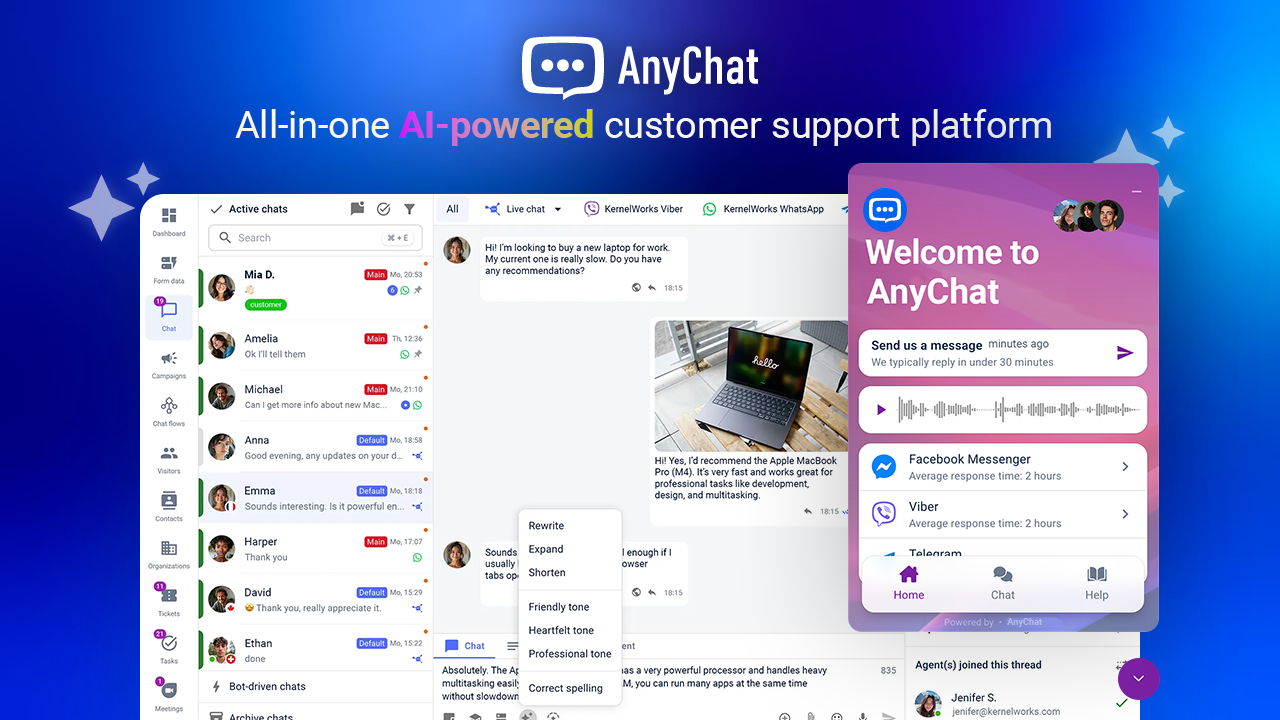
AnyChat is a multi-channel customer messaging hub with built-in AI chatbots. Pipecat is a visual workflow builder for creating custom AI agents via a no-code DAG editor and public API. The core difference: AnyChat targets support teams managing inbound messages; Pipecat targets developers building automated AI pipelines. If you need out-of-the-box customer support, pick AnyChat. If you need to programmatically orchestrate AI logic across multiple services, Pipecat is the right tool.
TL;DR Verdict Table
| Dimension | AnyChat | Pipecat | Winner |
|---|---|---|---|
| Pricing | Commercial (60-day money-back guarantee) | Free tier; Hobby $0/mo | Pipecat — open pricing with no cost to start |
| Free Tier Limits | Trial-based (no permanent free tier specified) | 100 workflow runs/month permanently | Pipecat — always-free entry point |
| Performance / Speed | Cloud-hosted, responsive UI | Parallel node execution; finishes in slowest branch time | Pipecat — concurrent execution beats sequential processing |
| Ease of Setup | No-code dashboard; connect messaging channels | Visual DAG editor; drag-and-drop workflows | Tie — both require minimal technical knowledge |
| Language Support | Omnichannel (WhatsApp, Instagram, Telegram) | Any major LLM (OpenAI, Anthropic, Gemini) | Pipecat — model-agnostic architecture |
| Offline / Self-hosted | Cloud-only SaaS | Open-source option available | Pipecat — self-hosting supported |
| Community Size | 132 reviews (AppSumo) | 100+ workflows built; 15K+ tool calls | Pipecat — developer traction metrics |
| Enterprise Ready | Unified inbox; team support; 4.8/5 rating | 99.9% uptime; API keys; webhook callbacks | Pipecat — programmatic control scales better |
| Open Source | No | Yes | Pipecat — transparent, auditable codebase |
| Best For | Ecommerce support teams | Developers building custom AI agents | Context-dependent — see sections below |
Bottom line: Pick AnyChat if your team spends hours answering repetitive customer questions across WhatsApp, Instagram, and Telegram. Pick Pipecat if you need to programmatically chain AI operations—like combining a web search, order lookup, and email send into a single automated pipeline.
Who Should Use Which
Indie Developer / Solo Hacker
Pick Pipecat. You get permanent free access (100 runs/month), an open-source codebase to audit, and a public API that lets you embed AI workflows into any side project. AnyChat's commercial model doesn't make sense when you're validating ideas and need zero barrier to experimentation. Pipecat's visual DAG editor also means you can build complex automations without spinning up a full backend.
Startup Team (5-20 Engineers)
Pick Pipecat for engineering-heavy teams building AI-native products. The parallel execution model handles high-throughput workflows efficiently, and the webhook/async run support integrates cleanly into your existing microservices. However, if your startup's primary pain point is customer support ticket volume, AnyChat's unified inbox reduces context-switching across channels.
Enterprise (100+ Engineers)
Evaluate both carefully. AnyChat wins on out-of-the-box support team onboarding—no engineering required to deploy. Pipecat wins on extensibility: open-source, self-hosted deployment, and API-first design mean your platform team can integrate AI workflows into proprietary systems. For enterprises with existing chatbot infrastructure, Pipecat's custom agent builder offers more control.
Feature-by-Feature Breakdown
Omnichannel Messaging
- AnyChat: YES — Strong. Native integration with WhatsApp, Instagram, and Telegram. Centralizes all inbound messages into one dashboard.
- Pipecat: NO — Missing. Designed as an AI agent backend, not a messaging aggregator. No native channel connections.
- Winner: AnyChat. If you need to manage customer messages across platforms without building integrations yourself, AnyChat is the only choice here.
AI Chatbot Automation
- AnyChat: YES — Strong. AI-powered automated responses handle FAQs and common inquiries without manual triage.
- Pipecat: YES — Strong. Build custom agents via DAG editor; supports web search, order lookup, email, and custom HTTP tools.
- Winner: Pipecat. AnyChat automates via pre-built templates. Pipecat lets you define exact logic with parallel execution and live debugging.
Visual Workflow Builder
- AnyChat: NOTE — Limited. Dashboard-based configuration; no visual graph editor for chaining operations.
- Pipecat: YES — Strong. DAG editor with real-time canvas; see every node, edge, and execution event as workflows run.
- Winner: Pipecat. The visual graph makes debugging complex multi-step AI logic tangible—nodes with no shared dependencies run concurrently.
API Access / Extensibility
- AnyChat: NOTE — Limited. Focuses on the SaaS dashboard; no documented public API for programmatic invocation.
- Pipecat: YES — Strong. One-click enables POST /flows/{slug}/invoke endpoint; supports sync, async, and SSE stream modes.
- Winner: Pipecat. Pipecat's API-first design lets you call workflows from Shopify, WooCommerce, or custom apps in one curl command.
Parallel Execution / Performance
- AnyChat: NOTE — Unclear. Cloud-hosted SaaS; no documentation on execution model.
- Pipecat: YES — Strong. Parallel execution means a three-branch workflow finishes in the time of its slowest branch, not the sum.
- Winner: Pipecat. For latency-sensitive AI assistants handling concurrent requests, this architecture is a real differentiator.
Self-Hosting / Open Source
- AnyChat: NO — Missing. Cloud-only commercial SaaS; no self-hosted option.
- Pipecat: YES — Strong. Open-source core; deploy on your own infrastructure.
- Winner: Pipecat. Enterprises with data residency requirements or tight security policies need self-hosted control—Pipecat provides it.
Developer Onboarding / Documentation
- AnyChat: NOTE — Limited. Users have reported documentation gaps, especially for mobile app edge cases.
- Pipecat: YES — Strong. Active beta with tutorials, live execution events, and a workflow management interface.
- Winner: Pipecat. Public beta phase means active documentation iteration; AnyChat's mature product shows signs of stagnant docs.
Support Team Collaboration
- AnyChat: YES — Strong. Unified inbox designed for team-based customer support; shared view of conversations.
- Pipecat: NOTE — Limited. Developer-facing tool; no explicit team collaboration features for support agents.
- Winner: AnyChat. If your workflow requires non-technical team members to handle escalated tickets, AnyChat's inbox model is purpose-built for that.
Section 4: Pricing Deep Dive
| Plan | AnyChat | Pipecat |
|---|---|---|
| Free Tier | 60-day trial only; no permanent free access | 100 workflow runs/month permanently |
| Hobby | Not publicly priced | $0/mo |
| Pro | Commercial pricing; 60-day money-back guarantee | Contact sales for volume pricing |
| Enterprise | Custom quote; unified inbox, team features | Self-hosted option; custom SLA |
| API Costs | Not documented separately | Pass-through model; you pay LLM provider directly |
Pipecat's open pricing model lets developers start building immediately without committing budget. AnyChat requires upfront purchase consideration, though its 60-day refund window reduces risk. API costs in Pipecat depend entirely on which LLM you choose—using free-tier OpenAI or Anthropic models keeps marginal costs near zero for low-volume applications. If budget is the main constraint, pick Pipecat because permanent free access removes financial friction for prototyping and validation.
Section 5: Real User Sentiment
AnyChat holds a 4.8/5 rating from 132 AppSumo reviews, indicating strong satisfaction among customers who need immediate omnichannel support without engineering overhead. Users consistently praise the unified inbox for eliminating tab-switching across WhatsApp, Instagram, and Telegram. Common complaints center on documentation gaps—specifically around mobile SDK implementation and advanced automation rules.
Pipecat's community shows developer traction through workflow volume: over 100 workflows built and 15,000+ tool calls executed in beta. Users appreciate the visual DAG editor for debugging complex AI logic and the open-source codebase for security audits. The primary criticism involves beta-phase instability—some users report occasional workflow failures that require manual retry.
Developers building AI-native products value Pipecat's programmatic control and parallel execution model for high-throughput applications.
Support teams favor AnyChat's channel consolidation, though some request more granular automation rules beyond basic FAQ templates.
Section 6: Switching Considerations
Migrating from AnyChat to Pipecat requires rebuilding automation logic in the DAG editor—no direct import utility exists. Prompt templates used in AnyChat's chatbot builder must be rewritten as Pipecat nodes, typically a 1:1 conversion for FAQ workflows but more complex for multi-branch logic. The cost impact depends on your AnyChat subscription versus Pipecat's usage-based model: low-volume support teams may reduce costs significantly; high-volume operations should calculate LLM provider fees carefully.
Switching from Pipecat to AnyChat is operationally simpler if you only need message aggregation—the AnyChat dashboard accepts manual conversation imports and supports channel reconnect without workflow rebuilding. However, any custom Pipecat integrations (webhook callbacks, custom HTTP tools) have no equivalent in AnyChat and would need abandonment.
The switch is worth it if your team has more engineering capacity than support volume, or if compliance requirements mandate self-hosted deployment with auditable code. Avoid switching if you have established AnyChat workflows and limited bandwidth to retrain staff or rebuild automations.
Section 7: Final Verdict
Choose AnyChat if:
- Your primary bottleneck is managing customer messages across WhatsApp, Instagram, and Telegram without engineering involvement
- You need immediate team-based support collaboration with shared inbox features
- Your workflow consists mainly of FAQ automation and triage routing without complex multi-step logic
Choose Pipecat if:
- You need to programmatically orchestrate AI operations across multiple services (search, database lookups, external APIs)
- Self-hosting, open-source deployment, or data residency compliance are non-negotiable requirements
- Your team prioritizes parallel execution performance and API-first extensibility over out-of-the-box support features
Neither if:
- Your organization requires a turnkey solution requiring zero technical expertise while simultaneously demanding deep custom AI pipeline control—these use cases represent fundamentally different tool categories and a single platform rarely satisfies both without significant compromise