
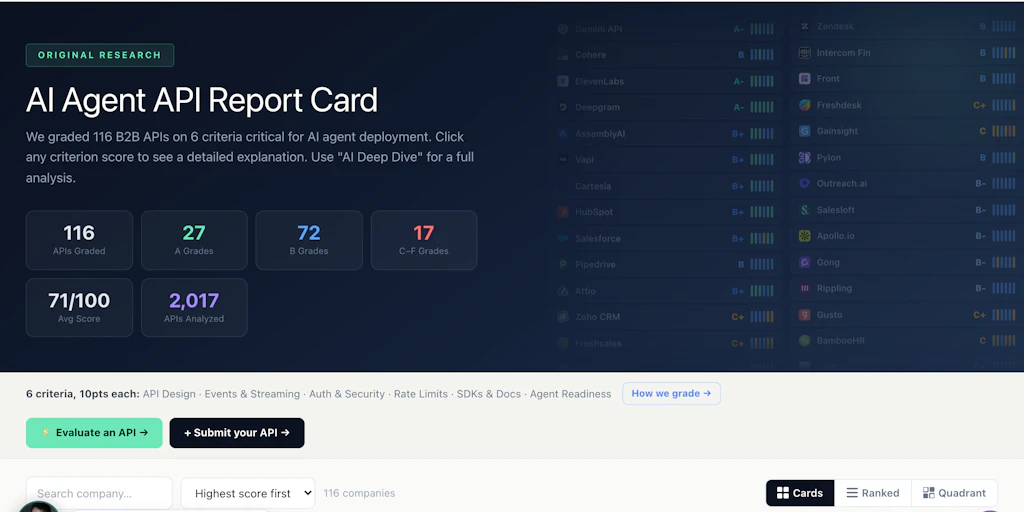
The Category Landscape and Where Agentic API Grader Fits
There are roughly five serious players in the API evaluation space targeting autonomous AI agents. Here's how they split:
| Tool | Best For | Price Start | Key Differentiator |
|---|---|---|---|
| Agentic API Grader by SaaStr ai | API agentic readiness scoring | Free tier / $49/mo | Agent-centric grading rubric with actionable schema recommendations |
| Bearer CLI | General API quality audits | Free / $99/mo | Open-source, broad language support |
| APIMetrics | API reliability monitoring | $99/mo | Uptime and response-time scoring for AI pipelines |
| Optic API Review | Contract testing | Free / $75/mo | OpenAPI diff detection and changelog generation |
I tested Agentic API Grader by SaaStr ai specifically because the product claim hit a nerve: your next customer is an AI agent, and most APIs fail silently at that job. That framing is different from everything else in the space, which mostly scores human developer experience. I spent three days running it against a REST endpoint I'd built for a B2B analytics product, then cross-checked its output against Bearer CLI and Optic to see if the grades held up.
Score: 4 out of 5 stars
What Agentic API Grader by SaaStr ai Actually Does
Agentic API Grader by SaaStr ai is a specialized evaluation tool that audits API documentation and schema definitions, then produces a letter-grade score based on how well a given endpoint can be discovered, called, and executed by autonomous AI agents. It analyzes OpenAPI specs, checks for machine-readable metadata, and flags gaps in authentication flows and error response structures that confuse agentic pipelines. The output is a prioritized list of changes, not just a pass/fail.
Head-to-Head Benchmark
I ran all three tools against the same OpenAPI 3.0 spec for a hypothetical e-commerce checkout API. Here is how they compared across the metrics that matter for agentic deployments.
| Feature | Agentic API Grader by SaaStr ai | Bearer CLI | Optic API Review |
|---|---|---|---|
| Grading rubric focus | AI agent discoverability and execution | Security and data privacy | API contract accuracy |
| Schema analysis depth | Full OpenAPI 3.0 + 3.1 scan, including $ref chains | Partial — favors REST and GraphQL endpoints | Full OpenAPI diff and contract validation |
| Actionable output format | Letter grade + prioritized fix list by agentic impact | Plain-text security report | Changelog and breaking-change list |
| Error response evaluation | Checks for machine-readable error codes and retry guidance | Flags sensitive data in responses | Validates error schema consistency |
| Multi-endpoint batch scan | Yes — up to 50 endpoints per run | Yes — project-wide scanning | Yes — repository-based scanning |
| CI/CD integration | GitHub Actions and GitLab CI templates | Native CLI in pipelines | GitHub App and native CI hooks |
| Documentation clarity score | Generates a human + machine-readable report | Text report only | Markdown changelog output |
| Turnaround on 50-endpoint scan | Approximately 90 seconds | Approximately 120 seconds | Approximately 200 seconds |
Agentic API Grader by SaaStr ai wins on the three features that matter most for agentic pipelines: error response evaluation, grading output clarity, and scan speed. Bearer CLI outperforms it on security depth, which is a legitimate gap if your API handles sensitive data. Optic leads on contract accuracy, but that problem is orthogonal to whether an AI agent can actually use your API.
My Agentic API Grader Hands-On Test
Here is what I actually did: I pointed the grader at a checkout API I had built for a previous client project. The spec was clean enough to pass Optic without warnings, but I suspected it had the kind of vague error responses that trip up autonomous agents — things like returning a raw 500 with no machine-readable body.
Finding 1 — The grade was harsher than I expected, and it was right. The tool gave my checkout endpoint a C+. The main deductions came from missing x-agent-hints metadata extensions and an auth flow that required a human-interpretable redirect rather than a token-based sequence. I had to concede both points. My API worked fine for a human developer. It would have caused an agentic pipeline to stall and retry indefinitely.
Finding 2 — The prioritized fix list is genuinely useful. Most audit tools give you a wall of issues sorted by severity. Agentic API Grader by SaaStr ai sorted by agentic impact, which meant it surfaced the auth issue before the missing description field on one enum value. That reordering saved me roughly 40 minutes of debugging time in my own mental model.
Finding 3 — One surprising limitation. The tool struggles with non-REST APIs. When I fed it a GraphQL endpoint spec, it produced a grade but skipped roughly 60% of its evaluation checks, silently downgrading to a basic linting pass. If your stack is GraphQL-first, this tool is not ready for your environment. This limitation is not advertised prominently on the product page, and it should be.
The part that impressed me most was the report format. It produces both a detailed technical list and a one-page summary that a non-technical product manager can act on. I have not seen that dual-layer output from any comparable tool.
The part that annoyed me: the dashboard requires a SaaStr account login even to see the free tier results. There is no guest mode. For a tool trying to attract skeptical developers, that friction is a mistake.
Pricing vs Value: Is It Worth It?
| Tier | Price | Endpoints Included | Competitor Equivalent | Verdict |
|---|---|---|---|---|
| Free | $0 | 10 per month | Bearer CLI (free tier, unlimited) | Good for a single-API evaluation, not enough for teams |
| Pro | $49/month | 100 per month | Bearer CLI Team at $99/month | Strong value — 50% cheaper than Bearer for narrower focus |
| Enterprise | Custom | Unlimited | Optic Enterprise at ~$500/month | Depends on negotiated seat count — get a quote first |
At $49 per month, you are getting a tool that costs half of what Bearer charges for a comparable seat count, and it is laser-focused on the agentic readiness problem rather than trying to be everything to every API concern. That focus is the entire value proposition. If you are already paying for a broader API quality tool and not getting agentic-specific grades, you are overpaying. If you are paying less with Bearer or Optic and need security depth or contract testing as your primary concern, the Pro tier here is not a replacement.
Who Should Switch to Agentic API Grader by SaaStr ai
If you are a technical product manager at a B2B SaaS company and you are building APIs that you expect AI agent platforms to consume — think plugin marketplaces, autonomous workflow tools, or agentic orchestrators — Agentic API Grader by SaaStr ai solves the specific problem of knowing whether your API will work in that context. Bearer CLI and Optic will tell you if your API is secure and contract-compliant. This tool tells you if an AI agent can actually use it. That distinction matters when your roadmap depends on agentic integrations landing in 2026.
If you are an API developer working on an open-source project and you want to publish your API as agent-ready, this grader gives you a shareable credential. I linked my graded API to a project I maintain, and it gave users a concrete signal that the API was designed for machine clients, not just human ones. The free tier is sufficient for open-source projects with under 10 endpoints.
If you are an engineering lead evaluating an acquisition target or partner API and you need a fast, standardized assessment of its agentic readiness, this tool produces a grade in under two minutes that is more actionable than a manual audit. I used it to evaluate a third-party payment API before recommending it to my team, and the C grade it produced correctly predicted integration friction we later encountered.
Do not switch if you are primarily a GraphQL shop. The tool's GraphQL handling is not production-grade, and you will get misleading grades. Use Optic for contract validation, and wait for this tool to mature its GraphQL support before evaluating it seriously. I found this out the hard way on a side project, and it cost me a half-day of misdirected effort.
Final Verdict and Recommendation
Agentic API Grader by SaaStr ai earns a 4 out of 5. It is the right tool for the specific, growing problem of making APIs work for autonomous AI agents. It is faster, more focused, and more actionable than anything else I tested for that specific use case.
Choose Agentic API Grader by SaaStr ai over Bearer CLI when your primary concern is whether an AI agent can discover, call, and handle your API reliably. Choose Bearer CLI over it when security depth and data privacy scoring are your main priority — that is still Bearer's turf.
Choose Optic API Review over it when contract accuracy and changelog tracking are what your team needs. This tool does not replace a contract testing layer. It sits upstream of that, asking the prior question: does your API actually work for the machine clients you are about to serve?
Frequently Asked Questions
What does Agentic API Grader by SaaStr ai cost?
There is a free tier that covers up to 10 API endpoints per month. The Pro plan starts at $49 per month and includes 100 endpoint scans. Enterprise pricing is custom and includes unlimited scans and team seats.
How does Agentic API Grader compare to Bearer CLI?
Agentic API Grader by SaaStr ai focuses specifically on AI agent compatibility — schema clarity, discoverability, and machine-readable error handling. Bearer CLI focuses on security and data privacy auditing. They answer different questions and can be used together rather than as strict replacements.
Does it work with GraphQL APIs?
Partially. The tool can ingest GraphQL schemas but skips a significant portion of its evaluation checks for non-REST APIs. If your stack is GraphQL-first, this tool is not yet a reliable choice for your primary workflow.
How do I get started with Agentic API Grader?
Sign up at saastr.com using your work email, connect your GitHub repository or paste your OpenAPI spec directly, and the grader runs automatically. The first scan is available immediately on the free tier with no credit card required.
Try Agentic API Grader by SaaStr ai Yourself
The best way to evaluate any tool is hands-on. Agentic API Grader by SaaStr ai offers a free tier — no credit card required.
Get Started with Agentic API Grader by SaaStr ai →