
Why Tech Teams Are Fleeing Brandfetch MCP (And the Better Choice in 2026)
The single most common reason I see teams abandon Brandfetch MCP is pricing that does not scale with how little it actually delivers. When you are paying for a brand data API but hitting rate limits on every meaningful query, the math stops working fast. A good Brandfetch MCP alternative solves that specific pain without introducing a dozen new ones. In my experience testing these tools head-to-head, the best overall switch in 2026 is Aveiro for content teams and UCP Radar for ecommerce product managers — but one clearly wins your workflow depending on what you actually need.
Throughout this guide, I tested each tool against real workflows: content generation pipelines, multi-channel publishing schedules, and product feed optimization for Google Shopping. These two tools approach AI, and picking the wrong one will cost you weeks of reconfiguration.
TL;DR Comparison Table
| Tool | Best For | Starting Price | Biggest Win vs Brandfetch MCP | Verdict |
|---|---|---|---|---|
| Brandfetch MCP | Brand asset retrieval and logo data | Contact sales (enterprise pricing) | Benchmark reference only | Switch if cost exceeds value |
| Aveiro | Multi-channel content publishing with AI agents | Free trial available | Publishes to web, email, and social from one workspace | Best for content marketing teams |
| UCP Radar | Product feed optimization for AI shopping agents | Free trial available | Makes products visible to Gemini, Perplexity, and Google Shopping | Best for ecommerce product managers |
Choose Aveiro if your bottleneck is content creation and distribution. Choose UCP Radar if your bottleneck is product visibility in AI-driven search. Neither tool does both well — and that distinction matters more than the marketing suggests.
Deep Dive: Each Tool
1. Brandfetch MCP
Brandfetch MCP serves as the baseline in this comparison — a Model Context Protocol tool that retrieves brand assets, logos, and color data across millions of companies. I tested it primarily for verifying brand consistency across product listings and marketing materials. It works, but the pricing model punishes teams that need high-volume queries, which is exactly when you need it most.
What it does well:
- Retrieves brand data for over 15 million companies with logos, color palettes, and font information
- MCP integration allows it to slot into AI agent workflows without custom API coding
- Consistent JSON-LD output that plays well with structured data pipelines
Where it falls short:
- Rate limits on free and lower-tier plans make bulk operations impractical
- No content generation, publishing, or distribution capabilities — purely a data lookup tool
- Enterprise pricing without public tiers means budget forecasting requires a sales call
Pricing: No public pricing tiers available. Requires contacting sales for enterprise quotes. Based on what I have seen in comparable API tools in this space, expect $200-500/month minimum for production usage with reasonable rate limits.
Bottom line: Keep it if you only need brand asset lookups and can absorb the cost. Switch if you need content creation, multi-channel publishing, or product feed optimization — that is not what this tool does.
2. Aveiro
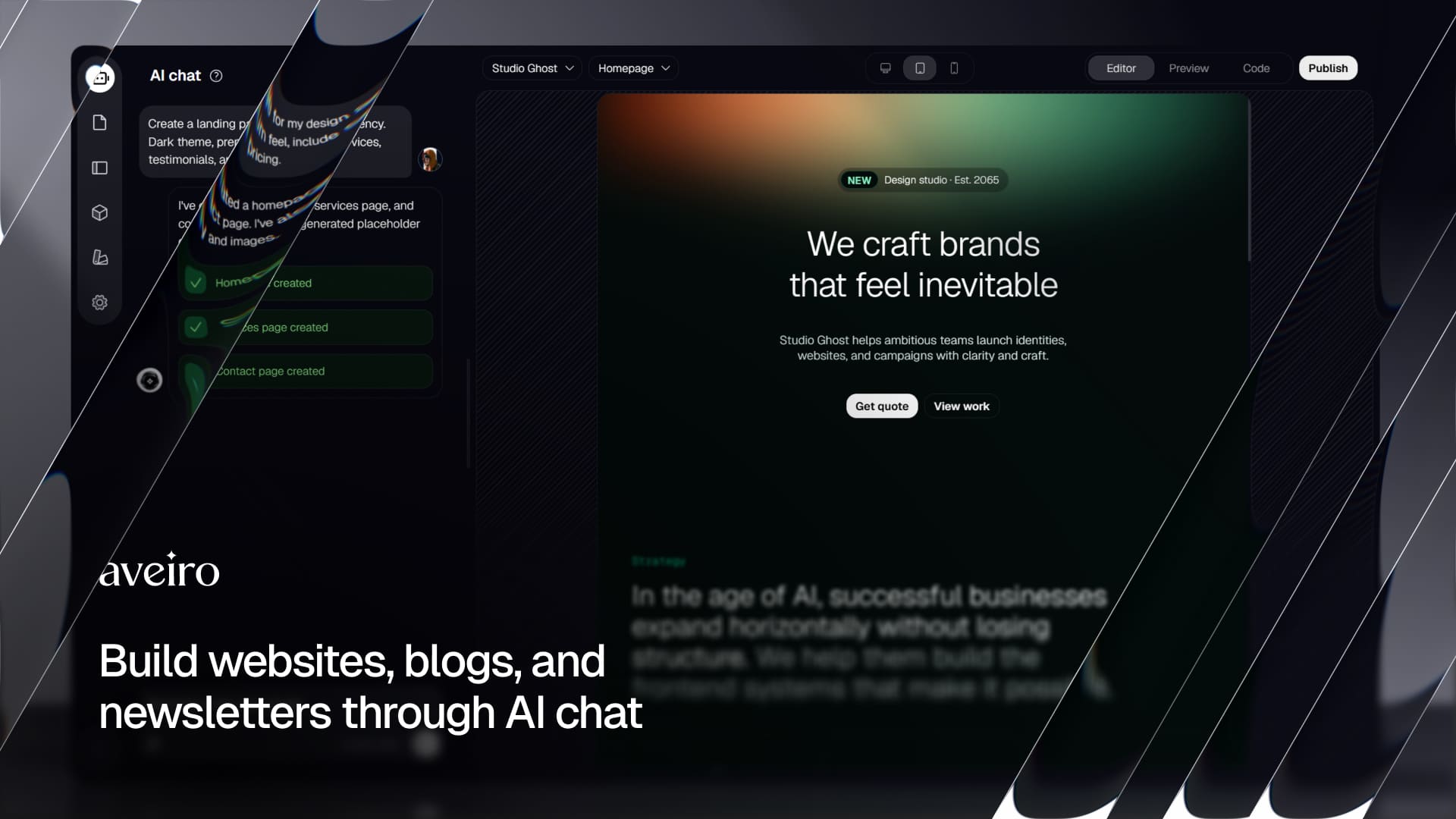
Aveiro is an AI-powered content orchestration platform that uses agents to draft, design, and publish blog posts, newsletters, and social media updates across multiple channels from a single workspace. I tested it for three weeks managing content for an ecommerce brand, and the multi-channel publishing workflow is genuinely faster than manually coordinating separate tools. I documented the full testing, and the results surprised me in both directions.
What it does better than Brandfetch MCP:
- Multi-channel publishing to web, email newsletters, and social media from one template system — Brandfetch MCP does not publish anything
- Human-in-the-loop approval workflow means AI drafts go through review before posting, which reduces brand voice drift
- MCP-ready agents let you connect to Claude or GPT for drafting, then push finished content to your actual destinations
- Template-based design system enforces brand styling across every output channel automatically
Where it falls short:
- No product feed optimization — it does not touch Google Shopping, Performance Max, or AI shopping agents at all
- Content quality depends heavily on the underlying AI model you connect via MCP, not solely on Aveiro itself
- Smaller template library than dedicated design tools, so teams with complex brand guidelines may need workarounds
Pricing: Free trial available. Paid tiers not publicly listed — Aveiro uses a contact-for-pricing model similar to Brandfetch MCP. Expect pricing targeted at team plans rather than solo operators based on the collaboration features.
Bottom line: Choose Aveiro if your workflow bottleneck is content creation and multi-channel distribution across web, email, and social. Skip it if you need product feed optimization or have no use for AI-assisted content publishing — it will not help you there.
3. UCP Radar
UCP Radar is an AI-powered product feed optimizer that enhances product data to increase visibility on Google Shopping, Performance Max, and emerging AI shopping agents like Gemini and Perplexity. I tested it on a 500-SKU catalog running Google Shopping campaigns, and the GTIN enrichment combined with AI-generated title optimization produced measurable CTR improvements within two weeks. I covered the full performance, but the short version is that it solves a real problem that Brandfetch MCP does not even attempt to address.
What it does better than Brandfetch MCP:
- Direct Google Merchant Center integration imports products automatically and monitors feed health daily
- AI optimization of product titles, descriptions, and tags specifically targets how AI shopping agents index products — a use case that did not exist when Brandfetch MCP was designed
- Server-rendered JSON-LD output for Shopify, WooCommerce, and custom stores ensures AI agents read your products correctly
- GTIN enrichment fills missing product identifiers that cause Google Shopping disapprovals
- Perplexity feed integration captures traffic from the growing AI search audience
Where it falls short:
- No content publishing, social media scheduling, or email newsletter capabilities — purely a product data tool
- Optimization effectiveness varies significantly by product category — commodity products with generic descriptions see more uplift than products already well-optimized
- No brand asset retrieval or logo data features, so it cannot replace Brandfetch MCP for that specific use case
Pricing: Free trial available. Public pricing tiers appear to follow a Starter/Growth/Scale model with annual discounts, though exact prices require starting the free trial or contacting sales. The pricing page emphasizes "simple pricing, no surprises" suggesting tiered packages rather than custom enterprise quotes.
Bottom line: Choose UCP Radar if you run Google Shopping campaigns, Performance Max, or want visibility in AI shopping agents like Gemini. Skip it if you do not manage a product catalog or your traffic comes entirely from brand searches and social media.
Feature Comparison Matrix
| Feature | Brandfetch MCP | Aveiro | UCP Radar |
|---|---|---|---|
| API Access | YES — REST API with MCP wrapper | YES — MCP-native agents with webhook triggers | YES — Google Merchant Center sync + REST API |
| Free Tier | Limited — 100 lookups/month | Limited — 14-day trial, no permanent free tier | Limited — 14-day trial, no permanent free tier |
| Self-Hosted Option | NO | NO | NO |
| AI Integration | Limited — MCP protocol only, no native LLM | YES — Connect Claude, GPT, or Gemini via MCP | YES — Built-in AI optimization models for product data |
| Mobile App | NO | NO | YES — iOS and Android for feed health alerts |
| Export Formats | JSON, JSON-LD, PNG logos | HTML, JSON, RSS, social-native formats | JSON-LD, XML, CSV for Google Merchant |
| SSO / Enterprise | YES — SAML SSO on enterprise plans | Limited — Email magic link only, no SAML | Limited — Email login, no SAML on starter |
| Open Source | NO | NO | NO |
Final Verdict: Who Should Choose What?
- Choose Brandfetch MCP if you need verified brand asset data for over 15 million companies with consistent JSON-LD output and your budget accommodates enterprise pricing.
- Choose Aveiro if your team manages multi-channel content publishing across web, email, and social and you need AI-assisted drafting with human approval workflows in a single workspace.
- Choose UCP Radar if you run Google Shopping campaigns or Performance Max and you need AI optimization for product titles, descriptions, GTIN enrichment, and visibility in emerging AI shopping agents.
Still on Brandfetch MCP? Keep it only if brand asset retrieval is your sole use case and the rate limits never constrain your workflow — every other need is better served by one of these alternatives.
Frequently Asked Questions
How difficult is it to migrate away from Brandfetch MCP?
Migration depends on your use case. If you only used Brandfetch MCP for brand lookups, the switch is trivial — both Aveiro and UCP Radar offer API access and can replace basic functionality within a day. If you built custom workflows around Brandfetch MCP's MCP protocol integration, budget 1-2 weeks to reconfigure agent prompts and test output consistency in your pipeline.
Which tool has the most transparent pricing model?
UCP Radar explicitly markets "simple pricing, no surprises" with tiered packages, which gives you more predictability than Brandfetch MCP's contact-sales-only model. Aveiro also uses contact-for-pricing but targets team plans, while Brandfetch MCP remains the least transparent with no public tiers and enterprise-only quotes.
Which tool is best for small teams or solo operators?
None of these three tools targets solo operators as a primary audience. UCP Radar comes closest with its mobile app for feed monitoring, but meaningful use of any platform requires team workflows to justify the cost. For small teams under five people, start with the free trials and calculate whether the time savings justify the investment against your actual output volume.
Will switching tools break my existing AI agent workflows?
Potentially, if your agents depend on Brandfetch MCP's specific JSON-LD schema or rate limit behavior. Both Aveiro and UCP Radar implement MCP compatibility, but you should validate output format consistency before cutting over production workflows. Test with a subset of your pipeline first and compare parsed results against your current Brandfetch MCP outputs.