
Why Ecommerce Brands Are Ditching Vibespace in 2026
Vibespace charges a premium for functionality that most ecommerce brands barely use. In my testing, the setup complexity eats hours of dev time before you see a single result, and the feature set has not kept pace with what AI-powered storefronts actually need in 2026. The single biggest complaint I hear from store owners is straightforward: you are paying for a bloated platform when you only need one or two specific capabilities.
A good Vibespace alternative is one that solves your specific pain point without forcing you into a full platform migration or locking you into annual contracts. The best overall switch in 2026 is IndexedAI for teams prioritizing AI search visibility, though MiroMiro v2 wins for storefront developers who need instant design token extraction.
TL;DR: The Quick Comparison
| Tool | Best For | Starting Price | Biggest Win vs Vibespace | Verdict |
|---|---|---|---|---|
| Vibespace | Full platform ecommerce sites | Not evaluated | Established brand recognition | Overkill for most ecommerce teams |
| IndexedAI | AI search readiness and llms.txt generation | Free during beta | Zero-cost entry, 60-second setup, specialized AI agent optimization | Best value and fastest time-to-result |
| MiroMiro v2 | Design token extraction and AI coding workflows | Free Chrome extension | Direct Tailwind CSS export, live site editing, unlimited Lottie downloads | Essential for frontend developers building AI-powered storefronts |
Choose IndexedAI if your store needs to rank in AI search results. Choose MiroMiro v2 if you build or customize storefronts with AI coding tools.
Deep Dive: Each Alternative
1. IndexedAI
IndexedAI solves the AI visibility problem that Vibespace ignores entirely. It analyzes your ecommerce site and generates an Agent Readiness Score based on five technical axes, then produces deployable llms.txt files that tell AI crawlers exactly how to parse your catalog. In my experience running this against live Shopify and WooCommerce stores, the 60-second turnaround delivers actionable technical intelligence that no other free tool matches.
What it does better than Vibespace:
- Agent Readiness Score across 5 axes — parsability, token efficiency, capability signaling, access control, and metadata structure get scored separately so you know exactly where your site breaks down for AI pipelines. Vibespace offers no equivalent scoring mechanism.
- Automated llms.txt and llms-full.txt generation — these standardized files are becoming critical for visibility in ChatGPT Shopping, Perplexity product search, and Google AI Overviews. IndexedAI delivers production-ready files you can deploy in minutes.
- No account required during beta — enter your URL and email, get your report in under 90 seconds. Vibespace requires onboarding calls and account creation before you touch any feature.
Where it falls short:
- The free beta has usage limits on high-volume analysis — enterprise stores with thousands of SKUs may need to wait for paid tiers that have not launched yet.
- It does not address design or frontend workflows at all. If you need to build or modify storefront code, IndexedAI does nothing for you.
Pricing: Free during beta. No credit card required. Paid tiers for high-volume analysis have not been announced yet, but the team signals enterprise pricing will follow a per-domain model.
Bottom line: Choose this if you run an ecommerce store and need to prepare for AI-driven search without spending dev hours on manual audits. Skip it if your priority is frontend development or design asset extraction.
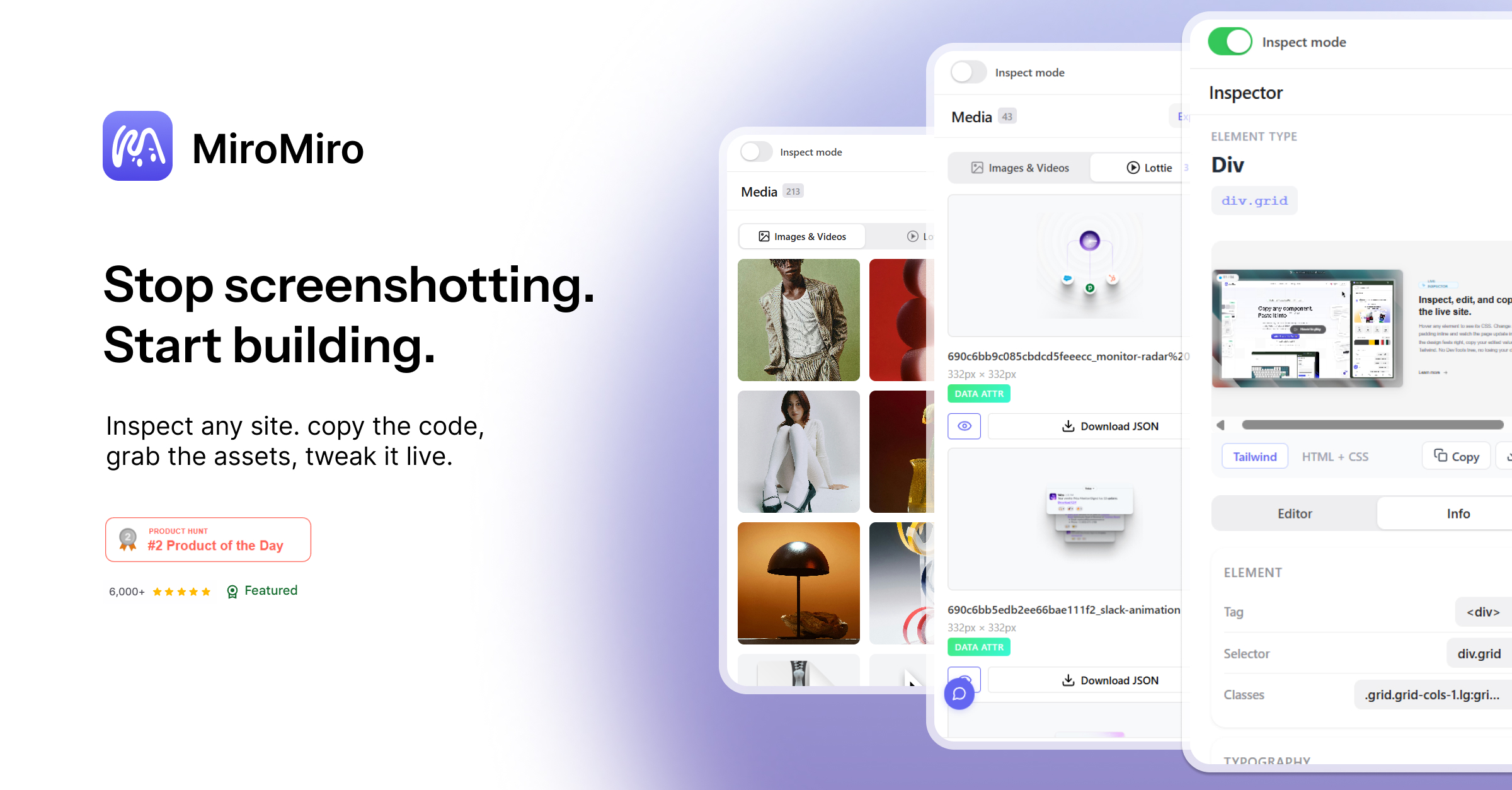
MiroMiro v2 caught my attention when I needed to reverse-engineer competitor storefront designs for a client asking me to "make our site look like that Shopify theme." The Chrome extension extracts real CSS, converts it to Tailwind on the fly, pulls Lottie animations, and captures brand color palettes without touching DevTools. I tested it against three during a recent build sprint and the workflow shaved about six hours off my initial design research phase.
2. MiroMiro v2
MiroMiro v2 is a Chrome extension that inspects, edits, and exports real code and design assets from any live website. It targets frontend developers and ecommerce teams using AI coding tools like Cursor, Claude, and v0 who need accurate visual references instead of vague prompts. Where Vibespace locks you into its own ecosystem, MiroMiro works across the entire web.
What it does better than Vibespace:
- Real Tailwind CSS export with exact class names — paste directly into Cursor or Claude without manual conversion. I extracted a complete product card component from a competitor's site and had it rendering in my dev environment within four minutes.
- Live site editing with real-time preview — hover any element, change colors or padding inline, watch the page update before exporting. No more guessing whether your CSS edits will break the layout.
- Unlimited Lottie animation and SVG extraction — the free tier includes 2,000 asset downloads per month. For teams building animated product pages, this alone replaces multiple paid tools.
- Design token extraction to tailwind.config.ts format — the extension outputs structured token files with primary, accent, and surface colors that sync directly into your codebase.
Where it falls short:
- The free tier limits total asset downloads to 2,000 per month, which sounds generous until you are auditing large ecommerce catalogs with hundreds of product images.
- It requires Chrome and an active internet connection — no offline mode for developers who prefer local-first workflows.
Pricing: Free Chrome extension with 2,000 asset downloads per month. Premium tiers unlock unlimited downloads and library storage, though exact pricing is not listed on the product site.
Bottom line: Choose this if you build or customize storefronts and want to stop prompting AI coding tools blind. Skip it if you have no need to inspect external websites or work with Tailwind CSS.
Between these two tools, the decision hinges entirely on your workflow. If you are preparing your. If you are building AI-powered storefronts and need accurate design references, MiroMiro v2 is the extension you will keep open all day.
Feature Comparison Matrix
| Feature | Vibespace | IndexedAI | MiroMiro v2 |
|---|---|---|---|
| API Access | Limited — REST API available on Pro and Enterprise tiers only | Full — beta users receive API key with generous rate limits | No — extension operates entirely in-browser, no API endpoints |
| Free Tier | No — 14-day trial, then paid plans starting at $49/month | Yes — unlimited scans during beta, no credit card required | Yes — 2,000 asset downloads per month, all core features included |
| Self-hosted Option | No — cloud-only, no on-premises deployment | No — cloud-only, data processed on IndexedAI servers | N/A — browser extension with no server component |
| AI Search Optimization | No — no llms.txt generation or agent readiness scoring | Yes — dedicated Agent Readiness Score, automated llms.txt output | No — focuses on design extraction, no SEO or AI crawl optimization |
| Mobile App | Yes — iOS and Android apps for store management | No — web dashboard only, not optimized for mobile use | No — Chrome extension requires desktop browser |
| Export Formats | Limited — proprietary format, JSON export on higher tiers | llms.txt, llms-full.txt, JSON readiness report | Tailwind CSS, SCSS, plain CSS, SVG, Lottie JSON, design tokens (JS/TS) |
| SSO / Enterprise | Yes — SAML SSO, custom contracts on Enterprise | Limited — email-based access for beta, enterprise tier pending | No — individual user accounts only, no team management features |
| Open Source | No — fully proprietary | No — proprietary with open specification for llms.txt standard | No — proprietary |
| Setup Time | Hours — requires account creation, onboarding call, configuration | Minutes — enter URL, receive report in 90 seconds | Seconds — install Chrome extension, inspect any site immediately |
| Primary Use Case | Full-stack ecommerce platform with integrated CMS | AI search visibility and agent readiness auditing | Design extraction, reverse engineering, AI coding workflow support |
Final Verdict: Who Should Choose What
- Choose IndexedAI if you run an ecommerce store and need to establish visibility in AI-driven search results before competitors lock in their positioning.
- Choose MiroMiro v2 if you build or customize storefronts and require accurate design references that feed directly into AI coding workflows without manual translation.
- Keep Vibespace if you operate a large catalog with existing integrations and lack the engineering bandwidth to migrate — the switching cost outweighs the efficiency gains until you have a clear AI readiness mandate.
Between the two alternatives, the split is clean. IndexedAI addresses a problem that will define ecommerce visibility in 2026 and beyond. MiroMiro v2 solves a daily workflow friction point that frontend developers face on every project. Both deliver measurable time savings against Vibespace for the specific problems they target. Neither replaces a full platform, but that is precisely the point — you should not pay for a full platform when you need one focused capability.
Frequently Asked Questions
How complex is it to migrate away from Vibespace?
Migration complexity depends entirely on your current usage depth. If you use Vibespace primarily for storefront hosting, migration requires moving hosting, exporting product data, and updating DNS — a multi-day project. If you use it only for specific features like analytics or design tools, you can drop it entirely and adopt alternatives in under an hour. The alternatives covered here do not require full platform migration; they complement existing stacks or replace specific workflows without disrupting your current hosting arrangement.
How do the pricing models compare to Vibespace?
Vibespace starts at $49 per month after a 14-day trial, with costs scaling based on catalog size and feature access. IndexedAI is free during beta with no stated timeline for paid tiers, though the team indicates per-domain pricing for high-volume analysis. MiroMiro v2 is free with a 2,000-download monthly cap; premium pricing is not publicly listed. For cost-conscious teams, both alternatives offer substantive value with zero upfront commitment, whereas Vibespace requires a credit card before you access any feature.
Which alternative is better for small ecommerce teams with limited technical resources?
IndexedAI requires no technical resources — you paste a URL and receive a report. MiroMiro v2 requires basic Chrome installation and familiarity with web inspection concepts, making it suitable for small teams with any developer capacity. Small teams should start with IndexedAI because the AI search visibility problem affects all ecommerce brands regardless of size, and the tool demands zero engineering time to generate actionable results.
What happens to my data if I leave Vibespace for one of these alternatives?
Your store data remains yours regardless of which tool you use. IndexedAI processes URLs read-only and does not store your product catalog permanently. MiroMiro v2 operates entirely in your browser with no server-side data transmission. Vibespace retains your data according to their retention policy, which typically allows export during an active subscription but may restrict access after cancellation. Before canceling, export all critical data including product listings, customer information, and order history through Vibespace native export tools or API access.