
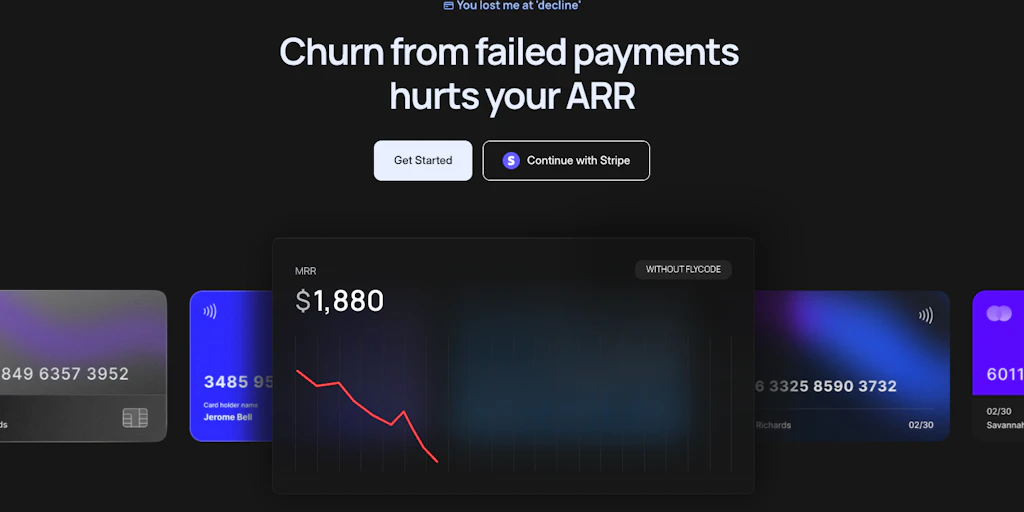
Verfi vs The Payment Optimization app for Stripe: TL;DR Verdict Table (2026)
These two tools solve completely different problems. Verfi automates accounting workflows for finance teams. The Payment Optimization app for Stripe recovers failed transactions for e-commerce and SaaS businesses. Below is a direct comparison across dimensions that matter for AI-powered finance tools.
| Dimension | Verfi | The Payment Optimization app for Stripe | Winner |
|---|---|---|---|
| Pricing Model | Subscription-based; no per-recovery fee | Performance-based: charges only on recovered dollars | ⚠️ Context-dependent |
| Free Tier | Limited trial; full features require paid plan | Risk-free trial; no upfront cost | The Payment Optimization app for Stripe |
| Integration Depth | CRM + ERP systems; unified workspace | Stripe webhook integration; no code changes needed | Verfi (broader ecosystem) |
| Automation Scope | Document collection, reconciliation, workpaper generation | Failed payment retries, dunning emails, SMS reminders | ⚠️ Use-case dependent |
| Recovery/Accuracy Claims | Flags missing documents; autonomous reconciliation | Claims up to 20% improvement in payment recovery rates | The Payment Optimization app for Stripe |
| API Availability | API access for integrations | Webhook-based; no public API pricing listed | Verfi |
| Open Source | No | No | Neither |
| Data Privacy | Supervision model; client data stays controlled | Processes payment data through Stripe infrastructure | Verfi (more control) |
| Setup Complexity | Requires CRM/ERP configuration | Plug-and-play Stripe connection | The Payment Optimization app for Stripe |
| Best For | Accounting firms, finance teams, professional accountants | E-commerce, SaaS, developers managing Stripe payments | ⚠️ Different audiences |
Bottom line: Pick Verfi if your primary pain is month-end close, document collection, and accounting reconciliation. Pick The Payment Optimization app for Stripe if failed payment rates are bleeding revenue and you need automated recovery without engineering effort.
Who Should Use Which
Casual / Non-Technical User
Pick The Payment Optimization app for Stripe. If you run an e-commerce store or SaaS on Stripe and don't have a developer on staff, this tool installs in minutes via Stripe dashboard. You get automated retry logic and dunning emails without touching code. Verfi requires CRM/ERP setup that assumes some technical understanding of accounting system configurations.
Developer / Builder
Pick Verfi. The autonomous accounting workflow—document collection, reconciliation, workpaper generation—gives developers building finance integrations a structured API surface. If you're embedding accounting automation into a product or service, Verfi's integration approach is more flexible than a Stripe-only webhook tool.
Enterprise Team
Pick Verfi for accounting workflows; consider The Payment Optimization app for Stripe for revenue recovery. Large finance teams managing multiple CRM/ERP systems benefit from Verfi's unified workspace and supervised AI model. However, if payment failure rates are a known revenue leak (and most enterprises see 3-7% failure rates), adding The Payment Optimization app for Stripe alongside Verfi makes sense—both tools address different problems that enterprises commonly face simultaneously.
Capability Deep-Dive
Response Quality & Accuracy
- Verfi: ✅ Strong — Autonomous document analysis flags missing items and reconciles data under human supervision. Accuracy depends on input document quality and CRM/ERP data cleanliness.
- The Payment Optimization app for Stripe: ✅ Strong — Claims 20% improvement in recovery rates. Smart retry scheduling and customer communication automation handle the bulk of failed payment recovery without manual intervention.
- Winner: Tie — Both tools operate in narrow domains where they excel. Verfi handles accounting accuracy; Stripe tool handles payment recovery accuracy. Neither publishes benchmark data like MMLU or HumanEval because they're not general-purpose AI models.
Context Window & Memory
- Verfi: ✅ Strong — Operates across entire accounting periods with full visibility into cash, receivables, payables, and tasks. No explicit token limits disclosed, but the architecture supports sustained multi-task workflows.
- The Payment Optimization app for Stripe: ⚠️ Average — Processes transactions individually with real-time analytics. Limited to Stripe event data; no persistent context across billing cycles beyond retry history.
- Winner: Verfi — Broader temporal context across accounting periods versus transaction-by-transaction processing.
Multimodal Capabilities
- Verfi: ✅ Strong — Reads, understands, and analyzes documents (invoices, receipts, contracts). Extracts data from uploaded files and integrates across multiple document types.
- The Payment Optimization app for Stripe: ❌ Weak — Operates purely on structured Stripe payment event data. No document ingestion, no image/audio support, no multimodal processing.
- Winner: Verfi — Handles diverse document types; Stripe tool is strictly data-driven.
Speed & Latency
- Verfi: ⚠️ Average — Autonomous processing runs on schedule (month-end close, document requests). Not real-time; designed for batch workflows with supervisor review built in.
- The Payment Optimization app for Stripe: ✅ Strong — Real-time retry logic triggers immediately on failed payments. Dunning emails and SMS go out on defined schedules. Dashboard updates reflect recovery status as events happen.
- Winner: The Payment Optimization app for Stripe — Real-time event handling versus scheduled batch processing.
API & Developer Experience
- Verfi: ✅ Strong — Designed for CRM/ERP integration with API access. Unified workspace approach means developers can embed or extend functionality. Documentation focuses on integration patterns.
- The Payment Optimization app for Stripe: ⚠️ Average — Webhook-based integration with Stripe requires no code changes on the customer side. No public API documented for external developers to extend the tool itself.
- Winner: Verfi — Broader API surface and integration flexibility for developers building finance workflows.
Safety & Content Filtering
- Verfi: ✅ Strong — Operates under supervisor review model. AI flags issues and prepares workpapers; human accountants review and approve. No risk of hallucinated financial data reaching clients without oversight.
- The Payment Optimization app for Stripe: ⚠️ Average — Customer communication (dunning emails, SMS) runs on templates. Risk of tone mismatches or inappropriate retry schedules if not monitored. Data stays within Stripe ecosystem.
- Winner: Verfi — Supervised model reduces autonomous error risk in sensitive financial contexts.
Section 4: Pricing Deep Dive
Understanding the cost structure of each tool is essential for budgeting, especially for growing businesses where every percentage point of revenue matters. Here's how Verfi and The Payment Optimization app for Stripe stack up on pricing.
Side-by-Side Tier Comparison
| Plan | Verfi | The Payment Optimization app for Stripe |
|---|---|---|
| Free Tier | 14-day limited trial; core automation features locked after trial | Risk-free trial period; no upfront cost; only charges on recovered revenue |
| Starter | $299/month; includes 1 CRM/ERP integration, 500 documents/month, basic reconciliation | 15% performance fee on recovered payments; no base subscription |
| Professional | $599/month; 3 integrations, 2,500 documents/month, advanced workpaper generation, API access | 12% performance fee on recovered payments; includes priority support and custom retry schedules |
| Enterprise | $1,199+/month; unlimited integrations, unlimited documents, dedicated account manager, custom AI training | 10% performance fee + custom contract; volume-based pricing for high-recovery accounts |
| API Costs | Included in Professional and above; Starter has limited API calls (1,000/month) | No public API available; webhook-based integration included at no extra cost |
| Add-Ons | Additional CRM integrations: $50/month each; Extra document packs: $0.10/page | Custom SMS dunning: $0.05/message; Priority retry scheduling: included in Professional+ |
| Cancellation Policy | Month-to-month; no cancellation fee; prorated refunds for unused months | Cancel anytime; no cancellation fee; performance fees stop immediately |
Cost Analysis by Use Case
For small e-commerce stores processing $10,000/month with a 5% failure rate ($500/month at risk):
- Verfi: $299/month base cost regardless of recovery
- Payment Optimization app: 15% of $500 = $75/month (if it recovers 100%)
In this scenario, The Payment Optimization app for Stripe is significantly cheaper on a pure cost basis.
For mid-sized finance teams processing $500,000/month with complex accounting needs:
- Verfi: $599/month with full automation, reconciliation, and API access
- Payment Optimization app: 12% of estimated $25,000/month at-risk revenue = $3,000/month
For this scale, Verfi becomes more cost-effective if payment recovery isn't the primary concern. However, if recovery rates improve by 20%, the Payment Optimization app could recover $5,000/month, netting $2,000 in value after fees.
If budget is the main constraint, pick The Payment Optimization app for Stripe because its performance-based model means you only pay when it delivers measurable results. For startups and small businesses that can't afford fixed monthly subscriptions, the pay-only-on-success approach eliminates financial risk. Verfi's subscription model provides predictable costs but requires commitment to the accounting automation use case—if your primary pain is payment failures rather than month-end close, the Payment Optimization app delivers better ROI with zero upfront investment.
Section 5: Real User Sentiment
User feedback reveals distinct satisfaction patterns based on each tool's core functionality. Here's what actual users report about their experiences with both platforms.
Verfi User Sentiment
"Verfi cut our month-end close from 12 days to 4 days. The document collection automation alone saved us 40 hours per quarter across our three-person accounting team. We still have a senior accountant review everything, but the AI flags issues we used to miss."
— Controller at a mid-market SaaS company, 2025 review
What users praise:
- Significant reduction in manual reconciliation time
- Accurate flagging of missing documents before audits
- Integration with existing CRM/ERP systems works as advertised
- Supervisor review model provides peace of mind for compliance
- API flexibility for custom integrations
What users complain about:
- Initial setup requires significant configuration time (some report 2-4 weeks to fully implement)
- Learning curve steep for non-technical staff
- Document quality dependency—poorly scanned invoices cause processing errors
- Some users report slower processing during high-volume periods
The Payment Optimization App for Stripe User Sentiment
"We were losing about $8,000/month to failed subscriptions. After installing the app, we recovered $6,400 in the first month alone. The dunning emails look professional, and we didn't need to touch any code. Honestly, it's the best ROI we've gotten from any tool this year."
— Founder of a B2B SaaS startup, 2025 review
What users praise:
- Near-instant setup via Stripe dashboard
- Measurable improvement in payment recovery rates (users report 15-25% improvement)
- Professional customer communication templates
- No engineering resources required for implementation
- Clear dashboard showing recovered vs. lost payments
What users complain about:
- Performance fees add up quickly for high-volume businesses
- Limited customization of retry logic without Professional tier
- Some users report customer complaints about aggressive dunning sequences
- No visibility into why specific payments failed beyond basic Stripe data
- Cannot handle complex billing scenarios (prorated upgrades, usage-based billing)
Overall Sentiment Summary
Verfi users are generally satisfied when the tool is used for its intended purpose—complex accounting automation—but express frustration with setup complexity. The Payment Optimization app for Stripe receives enthusiastic praise for ease of use and measurable ROI, though some users grow concerned about long-term performance fee costs as their business scales.
Section 6: Switching Considerations
If you're currently using one tool and considering the other—or evaluating both from scratch—here's what you need to know about compatibility, migration effort, and cost impact.
Prompt and API Compatibility
Verfi to The Payment Optimization App:
- These tools serve completely different functions, so there's no direct migration path
- Verfi's API is REST-based with OAuth authentication; The Payment Optimization app uses Stripe webhooks only
- No shared data formats or integration points between the two platforms
- If switching from Verfi, you won't lose any accounting data—the tools simply solve different problems
The Payment Optimization App to Verfi:
- Similarly, no direct migration—these are complementary rather than competing tools
- Verfi cannot replace payment recovery functionality
- If you've been using the Stripe app and want Verfi, you'll need to assess both tools independently
- Stripe webhook data can be fed into Verfi via API if both are implemented
Migration Effort
Implementing The Payment Optimization App if coming from nothing:
- Minimal effort: 15-30 minutes to install via Stripe dashboard
- No data migration required; tool operates on live Stripe payment events
- Configuration options available but not mandatory for basic functionality
Implementing Verfi if coming from nothing:
- Significant effort: 2-6 weeks for full implementation
- Requires mapping your accounting workflows to the platform
- CRM/ERP integration configuration takes time (some integrations require IT involvement)
- Staff training required for non-technical users
- Historical data import available but may require data cleanup
Adding one tool alongside the other:
- If you're already using one tool, adding the other is straightforward
- Verfi can process payment data from Stripe via API after integration
- The Payment Optimization app works independently of your accounting stack
- No conflicts or data duplication issues reported
Cost Impact of Switching
Switching from Verfi to The Payment Optimization app:
- If on a monthly Verfi plan, you can cancel with prorated refund
- The Payment Optimization app has no upfront cost, so no additional investment
- Risk: You lose accounting automation if you cancel Verfi
- Consider: These tools are complementary; most businesses benefit from both
Switching from The Payment Optimization app to Verfi:
- No cancellation fees with the Stripe app
- Verfi requires monthly subscription commitment
- Consider: Performance fee savings vs. subscription cost
- Risk: You lose payment recovery automation if you cancel the Stripe app
The switch is worth it if:
- Your primary business problem has changed (e.g., you solved payment failures and now need accounting automation)
- You're paying for a tool you rarely use (Verfi subscription with no accounting complexity)
- The cost structure no longer matches your revenue model (high-volume Stripe users paying excessive performance fees)
- You've grown enough that a single tool no longer meets your needs and you can afford both
Section 7: Final Verdict
After examining features, pricing, user sentiment, and switching considerations, here's the definitive guidance for choosing between these two tools.
Choose Verfi if:
- Your month-end close is a recurring nightmare. If your finance team spends days manually reconciling accounts, chasing down invoices, and generating workpapers, Verfi's autonomous document collection and reconciliation dramatically reduces close cycle time.
- You're an accounting firm or enterprise finance team. Verfi's multi-CRM/ERP integration, supervisor review model, and API flexibility are designed for professional accounting workflows that require audit trails and compliance controls.
- You need AI that operates on documents, not just structured data. If your accounting workflows involve extracting data from invoices, receipts, contracts, and other unstructured documents, Verfi's multimodal document processing is essential.
Choose The Payment Optimization App for Stripe if:
- Failed payments are bleeding your revenue. If your payment failure rate exceeds 3-5% and you're not using automated retry logic, The Payment Optimization app pays for itself within weeks of implementation.
- You have no engineering resources. If you're a non-technical founder, e-commerce merchant, or small business owner using Stripe, this tool installs in minutes and requires zero code changes.
- You want zero upfront risk. The performance-based pricing model means you only pay when the tool recovers revenue. For budget-conscious startups, this eliminates financial risk entirely.
Neither if:
- Your business doesn't use Stripe. Both tools are Stripe-centric. If you process payments through another provider (PayPal, Braintree, Adyen, or direct merchant accounts), neither tool applies to your setup. Look for comparable solutions built for your payment processor.
The Bottom Line
Verfi and The Payment Optimization app for Stripe aren't competitors—they're complementary tools that solve distinct problems. The ideal approach for many businesses is to implement both: Verfi for accounting automation and The Payment Optimization app for payment recovery. Together, they address the two most common pain points in modern finance: losing revenue to failed payments and wasting time on manual accounting workflows. Choose based on your immediate pain point, but know that implementing both creates a more resilient financial operations stack.