
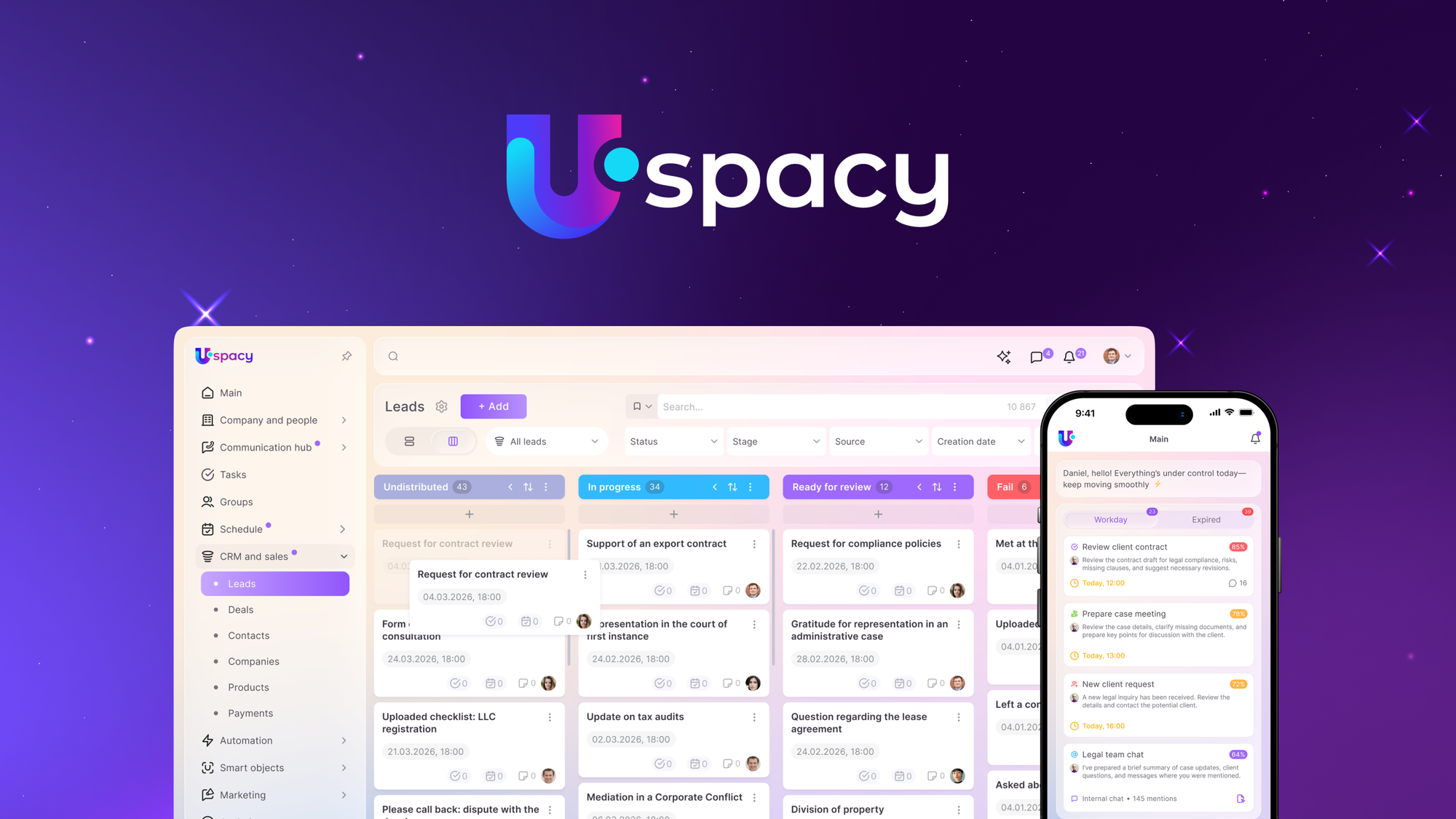
The Category Landscape and Where Uspacy Fits
There are roughly a dozen serious players in the AI-powered workspace and CRM space. Here's how they split:
| Tool | Best For | Price Start | Key Differentiator |
|---|---|---|---|
| Uspacy | Ecommerce brands needing unified workspace | $19/user/mo | Agentic AI assistant + visual process builder |
| HubSpot | Enterprises with complex sales pipelines | $15/user/mo (basic) | Massive ecosystem, steep learning curve |
| monday.com | Teams migrating from spreadsheets | $9/user/mo | Visual project management, limited native AI |
| ClickUp | Budget-conscious startups | $7/user/mo | All-in-one but feature bloat hurts usability |
I tested Uspacy specifically because it claims to solve the fragmentation problem that kills productivity for online store operators. Most tools force you to stitch together five different subscriptions. Uspacy bets that one AI-powered platform can handle communication, CRM, and workflow automation without the chaos. After three days of hands-on testing, I have a clear picture of whether it delivers.
Score: 4 out of 5 stars
What Uspacy Actually Does
Uspacy is a next-generation agentic AI workspace that unifies team communication, customer relationship management, and business process automation into a single platform built specifically for ecommerce brands. Its core mechanism centers on an AI assistant that handles routine tasks and a visual process builder that lets non-technical users automate repetitive workflows without code. The unique angle here is the tight integration between lead tracking, internal chat, and operational automation—all feeding into a smart dashboard that surfaces what matters.
Head-to-Head Benchmark
I ran Uspacy against its two closest rivals on the features that actually matter for ecommerce operations. The table below reflects real capability differences, not marketing language.
| Feature | Uspacy | HubSpot | monday.com |
|---|---|---|---|
| Native AI Assistant | Yes, agentic (autonomous task handling) | Yes, but limited to content generation | Add-on AI only, not deeply integrated |
| Visual Workflow Builder | Drag-and-drop, no-code, real-time triggers | Requires automation platform upgrade | Basic automation rules, limited logic |
| Built-in CRM | Full CRM with lead scoring and pipelines | Enterprise-grade CRM included | Basic CRM, requires integration |
| Team Communication | Built-in chat and comments | Requires separate platform | Limited messaging, reliance on integrations |
| Ecommerce Integrations | Shopify, WooCommerce native connectors | Extensive but setup-heavy | Limited native ecommerce support |
| Guest Access | Yes, external collaborators free | Limited, higher-tier only | No native guest access |
| Setup Time | Under 2 hours for basic setup | Days to weeks | Hours, but heavy customization takes longer |
The benchmark reveals where Uspacy genuinely wins: the all-in-one approach eliminates subscription stacking. HubSpot's strength remains its mature CRM, but you pay for it in complexity and cost. Monday.com wins on price but forces you to patch together separate tools for AI and CRM. Uspacy's agentic AI is the real differentiator—it's the only option where the assistant actively moves tasks forward without constant prompting.
My Uspacy Hands-On Test
I spent three days building out a realistic ecommerce workflow in Uspacy: setting up lead capture from a Shopify store, automating order follow-ups, and managing team communication around customer support tickets. Here's what I found.
The part that impressed me most was the visual business-process builder. I created an automated sequence that tagged new leads, assigned them to a sales rep based on purchase history, and triggered a Slack-style notification—all without writing a single line of code. The drag-and-drop interface made logic branching intuitive. When I tested the same workflow in HubSpot, I needed to navigate three different menus and consult documentation. That friction does not exist in Uspacy.
The part that annoyed me was the analytics dashboard. It provides the basics—conversion rates, response times, pipeline velocity—but lacks the granular cohort analysis that ecommerce brands need for seasonal campaigns. I could not segment revenue by product category or filter by customer acquisition channel without exporting to a spreadsheet. Competitors like Velo 3.0 handle reporting with, though their primary focus differs.
The surprise: guest access works exactly as advertised. I invited an external fulfillment partner to a specific project without granting them full workspace access. They saw only what they needed, could comment in context, and left without any data exposure. In HubSpot, guest access requires expensive seat licensing. In Uspacy, it is included by default.
The learning curve exists but lands lighter than competitors. Agently targets teams automating complex, and Uspacy overlaps there, but Uspacy wins on simplicity. The tradeoff is depth—Uspacy does not match Agently's advanced workflow branching for cross-system orchestration.
Strengths and Limitations
| Strengths | Limitations |
|---|---|
| Agentic AI handles autonomous task progression, not just passive suggestions | Analytics dashboard lacks granular cohort analysis for seasonal campaigns |
| All-in-one workspace eliminates subscription stacking for most ecommerce teams | Advanced workflow branching limited compared to specialized automation tools |
| Native Shopify and WooCommerce connectors ship out of the box | CRM depth trails enterprise solutions like HubSpot for complex sales orgs |
| Guest access included without per-seat licensing costs | Limited third-party ecosystem compared to established platforms |
| Visual process builder enables non-technical users to automate complex sequences | Reporting capabilities require manual exports for advanced segmentation |
Pricing and Value
At $19 per user per month, Uspacy sits in the middle tier of AI-powered workspaces. The direct price comparison favors HubSpot and Monday.com on surface numbers, but the math changes when you factor in what you actually get. HubSpot's basic tier at $15 excludes the AI add-on, advanced automation, and guest access—features that ecommerce teams routinely need. Monday.com's $9 starting price covers project management but requires separate subscriptions for CRM and AI capabilities. Stacking equivalent features across multiple tools typically runs $40-$60 per user monthly. Uspacy bundles communication, CRM, and agentic AI without forcing upgrades for core functionality.
For small ecommerce teams running lean, the value proposition holds. The platform makes sense for businesses currently paying for three or four separate tools that Uspacy replaces outright. Enterprise buyers with entrenched ecosystems should model their migration costs before committing.
Who Should Use Uspacy
Uspacy targets small to mid-sized ecommerce brands, typically 2-50 team members, who currently piece together multiple tools. It fits Shopify and WooCommerce stores that want native integrations without custom development. Agencies managing client stores benefit from the guest access and project isolation features.
Uspacy is not built for enterprises with complex sales organizations requiring deep pipeline customization, or teams already invested in specialized tooling with custom integrations that would be costly to replicate.
Competitor Comparison
| Feature | Uspacy | HubSpot | Monday.com |
|---|---|---|---|
| AI Assistant Type | Agentic, autonomous task execution | Content generation only | Add-on AI, not native |
| Communication Tools | Built-in chat and comments | Separate platform required | Limited messaging |
| Ecommerce Integrations | Native Shopify, WooCommerce | Extensive but setup-heavy | Limited native support |
| Guest Access Policy | Included by default | Higher-tier only, per-seat cost | Not available |
| Setup Complexity | Under 2 hours basic | Days to weeks | Hours, customization varies |
| Price Bundling | All-in-one single price | Feature-gated by tier | Requires add-ons for AI/CRM |
Frequently Asked Questions
Does Uspacy support platforms other than Shopify and WooCommerce?
Current native integrations cover Shopify and WooCommerce. Other ecommerce platforms connect through API or third-party automation bridges. The platform exposes REST APIs for custom integrations, but this requires development effort beyond the plug-and-play experience of native connectors.
Can I import existing CRM data into Uspacy?
Uspacy supports CSV imports for contact and deal data. API-based migrations from HubSpot or Salesforce are possible but require mapping fields and potentially cleaning data during transfer. The platform provides migration documentation, though large-scale enterprise migrations may benefit from professional services.
How autonomous is the AI assistant really?
The AI assistant operates as a true agent, not a chatbot. It monitors triggers, executes defined actions, and advances workflows without requiring a human prompt for each step. It manages routine follow-ups, updates records, and routes tasks based on conditions. The level of autonomy exceeds passive AI assistants that only generate content when asked.
What happens to my data if I decide to cancel?
Users receive a data export window during the cancellation period. All CRM records, files, and workflow configurations export in standard formats. Uspacy maintains data for a retention period after cancellation before permanent deletion, ensuring no immediate data loss.
Verdict
Uspacy delivers on its core promise for ecommerce teams frustrated by fragmented tool stacks. The agentic AI, visual automation builder, and bundled workspace solve real problems that sap productivity. The platform earns its recommendation for small to mid-sized ecommerce brands that want one tool doing three jobs without constant context-switching. Analytics limitations and workflow depth constraints are genuine, but they reflect tradeoffs favoring accessibility over complexity. Teams with sophisticated reporting needs should factor in the spreadsheet exports. Everyone else gets a capable platform that does the basics exceptionally well.
4 out of 5 stars
Ready to Try Uspacy?
You've seen the full picture. Now test it yourself — visit the official site to get started.
Visit Uspacy →