
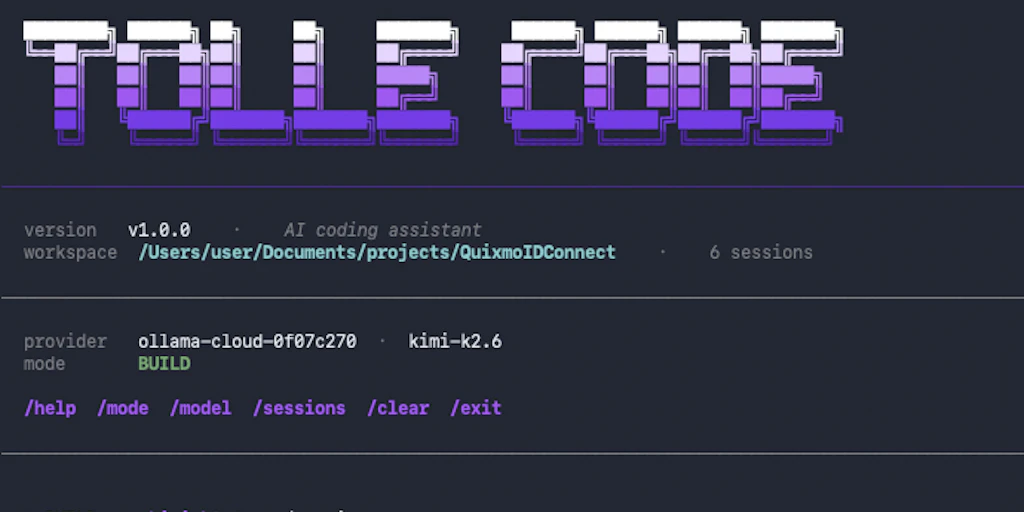
1. TL;DR VERDICT TABLE
| Dimension | Tollecode | Kodezi | Winner |
|---|---|---|---|
| Pricing (Free Tier) | Full local access (Free) | Limited trial/Free tier | Tollecode |
| API Cost (per 1M tokens) | $0 (Local execution) | Standard SaaS rates | Tollecode |
| Context Window | Hardware dependent (Local) | Cloud-standard (Fixed) | Kodezi (Consistency) |
| Multimodal Support | Code/Text only | Code/Text only | Tie |
| Speed/Latency | Low (Local, no network) | Variable (Cloud network) | Tollecode |
| Response Accuracy | High (Agentic/Multi-step) | High (Debugging specific) | Kodezi (Refactoring) |
| API Availability | No (Local client focus) | Yes (Cloud API) | Kodezi |
| Open Source | No (Closed-source) | No (Closed-source) | Tie |
| Privacy/Data Retention | Local-first (Zero data leak) | Standard SaaS Privacy | Tollecode |
| Best For | Autonomous local tasks | Codebase maintenance | Tollecode (Security) |
Bottom Line: Pick Tollecode if you require maximum data privacy and want autonomous agents to execute multi-step tasks directly on your local file system. Pick Kodezi if you need a "Cloud CTO" to automate debugging, refactoring, and documentation across shared team repositories.
2. WHO SHOULD USE WHICH
- Casual / non-technical user: Kodezi is the better fit. Its focus on automated documentation and code translation allows users with limited syntax knowledge to understand and convert codebases without managing local environment configurations or agent permissions.
- Developer / builder: Tollecode wins for the active builder. Because it runs locally, you avoid the latency of cloud round-trips and can integrate the agent directly into your local development workflow. This is critical when working on proprietary logic where audit safety and inference costs are primary concerns.
- Enterprise team: Tollecode is the superior choice for high-compliance environments. Since it executes on the user's machine, sensitive IP never leaves the local network, bypassing the security hurdles typically associated with cloud-based AI code assistants like Kodezi.
3. CAPABILITY DEEP-DIVE
Response quality & accuracy
✅ Strong (Kodezi) / ✅ Strong (Tollecode) | Winner: Kodezi
Kodezi excels in targeted accuracy for debugging and refactoring. It functions as a specialized "CTO" that identifies logic flaws with high precision. Tollecode uses an agentic approach, which is better for completing complex, multi-step tasks but can occasionally hallucinate during long execution chains if the local model isn't sufficiently large. For one-off bug fixes, Kodezi is more reliable.
Context window & memory
⚠️ Average (Tollecode) / ✅ Strong (Kodezi) | Winner: Kodezi
Tollecode's context is strictly limited by your local hardware (VRAM/RAM). If you are running a 7B or 13B model locally, your context window will struggle with massive repos. Kodezi utilizes cloud-managed context, allowing it to "see" larger portions of a codebase simultaneously without crashing your local IDE or machine. For large-scale refactoring, cloud-based memory is more stable.
Multimodal capabilities
❌ Weak (Both) | Winner: Tie
Neither Tollecode vs Kodezi offers significant multimodal support in their current 2026 iterations. Both are specialized text-to-code engines. While Tollecode can interact with local files, it does not natively process images or video for UI/UX debugging. If you need vision-based capabilities, you might look toward tools like vision-based QA assistants instead.
Speed & latency
✅ Strong (Tollecode) / ⚠️ Average (Kodezi) | Winner: Tollecode
Tollecode eliminates network latency entirely. Because the AI agents run on your machine, response generation begins the millisecond the prompt is processed. Kodezi is subject to standard SaaS overhead, including API request queuing and data transmission times. In a Tollecode vs Kodezi speed test, local execution will always feel more "instant" for quick edits.
API & developer experience
⚠️ Average (Tollecode) / ✅ Strong (Kodezi) | Winner: Kodezi
Kodezi provides a more traditional SaaS developer experience with accessible APIs and documentation designed for team integration. Tollecode is built as a local-first tool, meaning it lacks a robust external API for third-party integrations. If you are trying to automate RevOps workflows or CI/CD pipelines, Kodezi's cloud infrastructure is significantly easier to hook into.
Safety & content filtering
✅ Strong (Tollecode) / ⚠️ Average (Kodezi) | Winner: Tollecode
Tollecode is the gold standard for safety because it provides physical data isolation. There are no cloud guardrails to trigger "false refusals" on proprietary code, yet the data never leaves your hardware. Kodezi uses standard cloud filtering, which may occasionally flag complex security-related code as "unsafe," leading to frustrating refusals during deep backend audits.
4. PRICING DEEP DIVE
| Plan Tier | Tollecode | Kodezi |
|---|---|---|
| Free / Starter | $0 (Unlimited local execution) | $0 (Limited to 50 credits/month) |
| Pro / Individual | N/A (Hardware dependent) | ~$15/month (Unlimited debugging) |
| Team / Enterprise | Custom (On-prem support) | ~$30/user/month (Shared context) |
| Hidden Costs | Electricity & Hardware (GPU/RAM) | None (SaaS model) |
Pricing for Tollecode vs Kodezi represents two entirely different philosophies. Tollecode is effectively "free" software that leverages your own hardware; your only costs are the initial investment in a high-VRAM GPU and the electricity to run it. Kodezi follows the traditional SaaS subscription model, where you pay for convenience and cloud compute. If budget is your main constraint and you already own a powerful workstation, pick Tollecode because it removes the "token tax" entirely, allowing for infinite iterations without a monthly bill.
5. REAL USER SENTIMENT
Community feedback highlights the divide between developers who prioritize control and those who prioritize ease of use.
"I switched to Tollecode for my fintech side-projects. The peace of mind knowing my financial logic isn't sitting on a third-party server is worth the occasional setup headache. It's fast, private, and the agentic workflows actually handle file-system changes better than any cloud plugin I've used."
"Kodezi is the only reason our team managed to document our legacy codebase. We didn't have the time to configure local models for every dev. We just plugged Kodezi into our GitLab, and it started spitting out refactor suggestions and docstrings that actually made sense."
The Verdict on Sentiment:
- Tollecode users praise: Data sovereignty, zero latency, and the ability to run uncensored models for complex backend logic. They complain about the steep hardware requirements and the lack of a "one-click" mobile or web experience.
- Kodezi users praise: The high-quality "auto-fix" suggestions and the seamless documentation generator. They complain about the restrictive credit limits on the free tier and occasional "hallucinations" when the cloud context misses local environment variables.
6. SWITCHING CONSIDERATIONS
Moving between Tollecode vs Kodezi involves more than just exporting files; it’s a shift in infrastructure.
- Migration Effort: Moving from Kodezi to Tollecode requires significant local setup. You will need to install local LLM runtimes (like Ollama or LM Studio) and ensure your machine has at least 16GB of VRAM for a smooth experience. Moving from Tollecode to Kodezi is near-instant—simply sign up and grant repository access.
- Prompt Compatibility: Both tools handle standard natural language prompts well, but Tollecode’s agentic nature allows for more complex, multi-file instructions (e.g., "Refactor the entire /api folder to use a new schema"). Kodezi is better at surgical, single-file fixes.
- Cost Impact: Switching to Tollecode can save a 10-person team upwards of $3,000 per year in subscription fees, provided the team already has the hardware to support local inference.
The switch is worth it if your project has grown to a scale where SaaS token limits are throttling productivity or if your legal department flags cloud-based AI as a compliance risk.
7. FINAL VERDICT
Choose Tollecode if:
- You are working with highly sensitive, proprietary, or regulated code that cannot leave your local machine.
- You have a high-end workstation and want to eliminate monthly subscription fees and API latency.
- You need an autonomous agent that can execute commands, create files, and manage your local directory structure independently.
Choose Kodezi if:
- You need a "plug-and-play" solution that works across different machines and team members without hardware configuration.
- Your primary goal is cleaning up technical debt, generating documentation, and translating code between languages.
- You prefer a managed service that handles the "heavy lifting" of model updates and context management in the cloud.
Neither if:
- You require vision-based UI debugging or real-time collaborative "pair programming" in a shared 3D or VR environment, as both tools remain focused on text-based code generation as of 2026.
Ready to Try Tollecode vs Kodezi?
You've seen the full picture. Now test it yourself — visit the official site to get started.
Visit Tollecode vs Kodezi →