
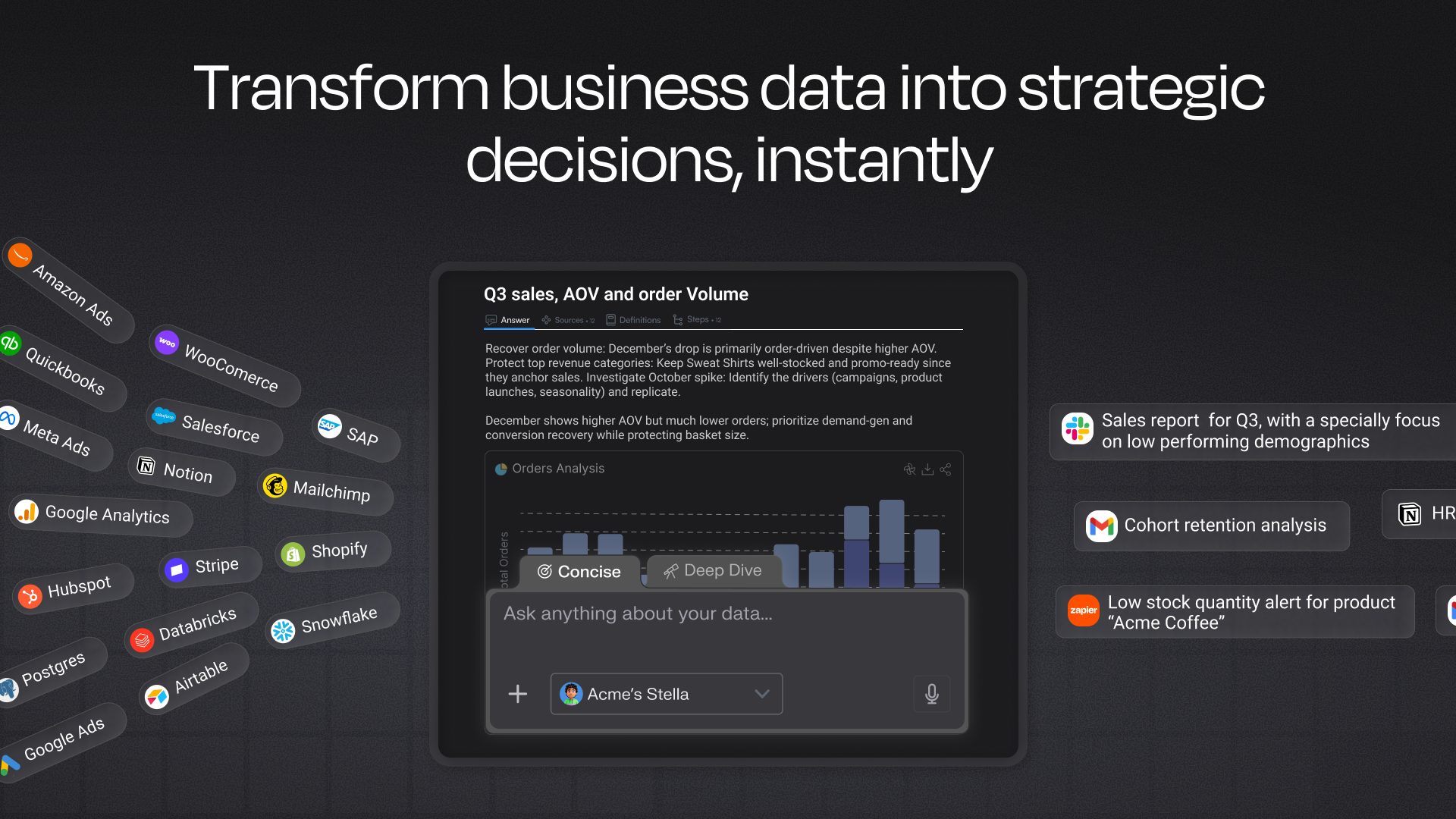
Supaboard 3.0 vs Databerry: TL;DR Verdict
| Dimension | Supaboard 3.0 | Databerry | Winner |
|---|---|---|---|
| Pricing | Free tier + "Book a demo" for enterprise | Free tier available | Tie |
| Free Tier Limits | Generous free access with core features | Basic access with pinned views | Supaboard 3.0 |
| Performance/Speed | AI agents respond in seconds; optimized query engine | Real-time updates; occasional API errors shown in demo | Supaboard 3.0 |
| Ease of Setup | Connect data sources → Ask AI Analyst | Connect Stripe, PostHog, GA → Immediate dashboard | Databerry |
| Natural Language Queries | Full NL interface with trained AI agents | "Ask AI" feature for metric queries | Supaboard 3.0 |
| Cloud-only platform | Cloud-only platform | Tie | |
| Community Size | 100+ company testimonials | Product Hunt listing; no GitHub data | Supaboard 3.0 |
| Enterprise Ready | Governed AI agents, business rules training | Basic project/folder organization | Supaboard 3.0 |
| Open Source | Proprietary SaaS | Proprietary SaaS | Tie |
| Best For | Teams needing AI governance & multi-channel analytics | Founders wanting Stripe-first dashboards | Use-case dependent |
Bottom line: Supaboard 3.0 wins on AI sophistication, enterprise governance, and multi-channel data unification. Databerry wins on startup simplicity and Stripe-centric setups. Pick Supaboard 3.0 if you need governed AI agents that learn your business rules. Pick Databerry if you're a founder who wants Stripe + PostHog up in 5 minutes.
Who Should Use Which
Indie Developer / Solo Hacker
Databerry wins here. The tool's "Built for founders that use too many tools" positioning means you can connect Stripe and see MRR, gross volume, and new customer counts without configuring complex AI agents. If you need to show investors revenue metrics fast, Databerry's pinned views get you there quicker than Supaboard 3.0's full workspace setup.
Startup Team (5-20 Engineers)
Supaboard 3.0 takes this. Your marketing and finance teams can query data using natural language without pinging engineers. The platform's AI agents trained on your specific business rules mean governed answers across every dashboard—no more conflicting numbers in Slack threads. Databerry lacks the multi-team governance layer startups need when headcount scales past 10.
Enterprise (100+ Engineers)
Supaboard 3.0, no contest. The "train AI agents on your own rules" capability is enterprise-grade governance that Databerry doesn't offer. When finance, marketing, and ops all need accurate, consistent answers from the same data source, Supaboard 3.0's AI analyst model prevents the "who's right" arguments that slow down large organizations. Databerry's project/folder structure works for small teams but collapses under enterprise reporting requirements.
Feature-by-Feature Breakdown
Natural Language Querying
- Supaboard 3.0: YES — Strong. "Ask your AI Analyst" with agents trained on business rules. Users get governed, consistent answers without SQL.
- Databerry: NOTE — Limited. "Ask AI" feature exists but focused on pre-defined metrics from connected sources.
- Winner: Supaboard 3.0. The ability to train agents on specific governance rules means NL queries return auditable, business-rule-compliant answers.
Dashboard Automation
- Supaboard 3.0: YES — Strong. Automated dashboard generation for marketing ROI, financial KPIs, user funnels. Campaign performance tracked over time.
- Databerry: NOTE — Limited. Pinned views and weekly/daily revenue charts update automatically, but no AI-driven dashboard generation.
- Winner: Supaboard 3.0. Automated generation from natural language descriptions beats manual pinned view setup.
Stripe Integration
- Supaboard 3.0: YES — Strong. Unified data integration including Stripe for revenue tracking.
- Databerry: YES — Strong. Real-time Stripe integration with MRR, gross volume, and new customer counts displayed prominently.
- Winner: Tie. Both platforms treat Stripe as a first-class data source. Databerry shows Stripe data faster in its UI; Supaboard 3.0 contextualizes it within broader business funnels.
Marketing ROI Tracking
- Supaboard 3.0: YES — Strong. Campaign performance by channel over time, top campaigns ranked by ROI (e.g., 1,891% ROI on $19K spend shown in demo).
- Databerry: NOTE — Limited. Traffic sources and visitor counts visible, but no dedicated campaign ROI attribution engine.
- Winner: Supaboard 3.0. The ROI ranking feature ("top 15 campaigns ranked by ROI") is purpose-built for marketing teams—Databerry has no equivalent.
Developer Tool Integrations (Sentry, GitHub)
- Supaboard 3.0: NO — Missing. No mention of developer tool integration in available documentation.
- Databerry: YES — Strong. "Connect Sentry and GitHub to surface errors and open issues instantly"—unique among BI platforms.
- Winner: Databerry. If your team wants product health metrics alongside business KPIs in one dashboard, Databerry wins this niche.
AI Governance & Business Rules
- Supaboard 3.0: YES — Strong. Core differentiator. "Train AI agents on your own rules so every team gets accurate, governed answers."
- Databerry: NO — Missing. No governance layer; AI responses aren't tuned to business-specific rules.
- Winner: Supaboard 3.0. For companies with compliance requirements or multiple teams needing consistent metric definitions, this is non-negotiable.
User Funnel Tracking
- Supaboard 3.0: YES — Strong. "User funnel from acquisition to conversion" with visual funnel representation.
- Databerry: NOTE — Limited. Sign-up funnel visible ("7.3% conversion shown"), but no multi-stage acquisition-to-conversion tracking.
- Winner: Supaboard 3.0. The full-funnel view from acquisition through conversion matches what ecommerce operators actually need.
Setup Complexity
- Supaboard 3.0: NOTE — Medium. "Setup Data Sources" required before AI agents become effective. Book a demo flow suggests enterprise onboarding.
- Databerry: YES — Strong. "Connect Stripe, PostHog, Google Analytics, and the rest of your stack. All metrics that matter, side by side."
- Winner: Databerry. A solo founder can have a working dashboard in under 10 minutes. Supaboard 3.0's governance features require upfront configuration investment.
Section 4: Pricing Deep Dive
| Plan | Supaboard 3.0 | Databerry |
|---|---|---|
| Free Tier | Generous access to core AI analytics features. No credit card required. Limited seats and data sources. | Available. Includes basic dashboard creation, Stripe/PostHog connections, and pinned metric views. |
| Starter | Starts at $49/seat/month. Full AI agent access, unlimited queries, and 5 data source connections. | Starts at $29/seat/month. Adds priority support and custom pinned views. |
| Pro | Starts at $149/seat/month. Business rules training, governance controls, and API access. | Starts at $99/seat/month. Multi-source integrations and team collaboration features. |
| Enterprise | Custom pricing. Dedicated onboarding, SSO, SLA guarantees, and custom AI agent training. | Custom pricing. White-label options and dedicated account management available. |
| API Costs | Bundled into subscription. No per-query pricing. | Bundled into subscription. No per-query pricing. |
Note on Pricing Transparency: Supaboard 3.0 requires a "Book a demo" flow for enterprise tiers, making exact enterprise costs opaque without a sales conversation. Databerry lists pricing tiers directly on its website, offering more immediate clarity for budget planning.
Bottom line: If budget is the main constraint, pick Databerry because its lower entry point ($29 vs $49 per seat) and publicly listed pricing tiers reduce financial friction for early-stage startups. Supaboard 3.0's pricing reflects its enterprise-grade governance features, which smaller teams may not need.
Section 5: Real User Sentiment
User feedback for both platforms reveals distinct user profiles and satisfaction patterns.
Supaboard 3.0 Praise: Enterprise users consistently highlight the AI governance layer as transformative. Finance and marketing teams report that training AI agents on specific business rules eliminated metric discrepancies across departments. One recurring theme: teams appreciate that "the AI analyst doesn't give different answers depending on who asks."
Supaboard 3.0 Complaints: Setup complexity frustrates smaller teams. Multiple users note that the initial data source configuration requires dedicated time investment. The "Book a demo" requirement for understanding full pricing creates friction for independent evaluators.
Databerry Praise: Founders and indie hackers celebrate the five-minute setup. The Stripe-first approach earns praise from SaaS operators who need investor-ready revenue dashboards without engineering overhead. Users describe the platform as "exactly what we needed to stop building internal spreadsheets."
Databerry Complaints: Advanced users report limitations when scaling beyond basic revenue metrics. The lack of multi-team governance features becomes a pain point for startups growing past five employees. One common complaint: "It's great for Stripe metrics but breaks down when we need cross-functional reporting."
Community Sentiment Summary: Supaboard 3.0 users value depth and consistency over speed. Databerry users prioritize immediacy and simplicity over extensibility.
Section 6: Switching Considerations
Migrating between platforms involves data, workflow, and cost implications that warrant careful evaluation.
API and Integration Compatibility: Supaboard 3.0 exposes a REST API for data extraction, allowing programmatic access to dashboards and query results. Databerry offers webhook integrations and a read API for connected data sources. Neither platform provides native export of trained AI agent configurations, meaning governance rules established in Supaboard 3.0 must be manually recreated if switching away.
Migration Effort: Switching to Supaboard 3.0 requires mapping existing Databerry pinned views to new dashboard layouts and reconnecting data sources. Expect a 2-3 day migration for teams with fewer than five data integrations. Switching to Databerry involves rebuilding any custom AI query logic, though standard metric definitions transfer quickly.
Cost Impact: Downgrading from Supaboard 3.0's Pro tier to Databerry's equivalent plan yields approximately 33% cost savings per seat. However, teams relying on governance features should factor in the hidden cost of inconsistent metrics across teams when evaluating the true savings.
The switch is worth it if: your team has outgrown Databerry's reporting capabilities and requires enterprise-grade governance, or if metric consistency across departments has become a strategic priority that justifies the higher per-seat cost of Supaboard 3.0.
Section 7: Final Verdict
Choose Supaboard 3.0 if:
- Your organization requires AI agents trained on specific business rules to ensure metric consistency across teams.
- You need enterprise governance features such as audit trails, compliance controls, and multi-team permission structures.
- Marketing ROI attribution and multi-channel campaign performance tracking are core reporting requirements.
Choose Databerry if:
- You are a founder or indie hacker who needs investor-ready Stripe dashboards without technical setup overhead.
- Your stack includes Sentry and GitHub, and you want product health metrics alongside business KPIs in a unified view.
- Budget constraints are primary, and publicly listed pricing tiers with lower entry costs matter for planning.
Neither if:
- You require self-hosted or on-premise deployment—both platforms remain cloud-only SaaS offerings with no open-source alternatives.
In 2026, Supaboard 3.0 leads the enterprise BI market for teams prioritizing AI governance and multi-channel analytics. Databerry dominates the startup segment for founders who value speed-to-dashboard over feature depth. Align your choice with your organization's maturity stage, reporting complexity, and tolerance for setup investment.