
Score: 3.5 out of 5 stars
Recommended for small to mid-size Shopify merchants who want structured AI prompts without manual engineering effort. Skip if you need self-hosted solutions, custom model fine-tuning, or plan to process over 50K prompts monthly.
Performance: Fast prompt enhancement, but inconsistent output quality with complex ecommerce scenarios. Reliability: Solid uptime during my testing, though I hit rate limits twice at mid-tier pricing. Developer Experience: Clean interface, but limited API documentation for deep integrations. Cost at Scale: Reasonable entry point, but per-prompt costs add up faster than competing tools once you exceed 10K uses monthly.
What Prompt Architects Is and Why It Matters for Your Stack
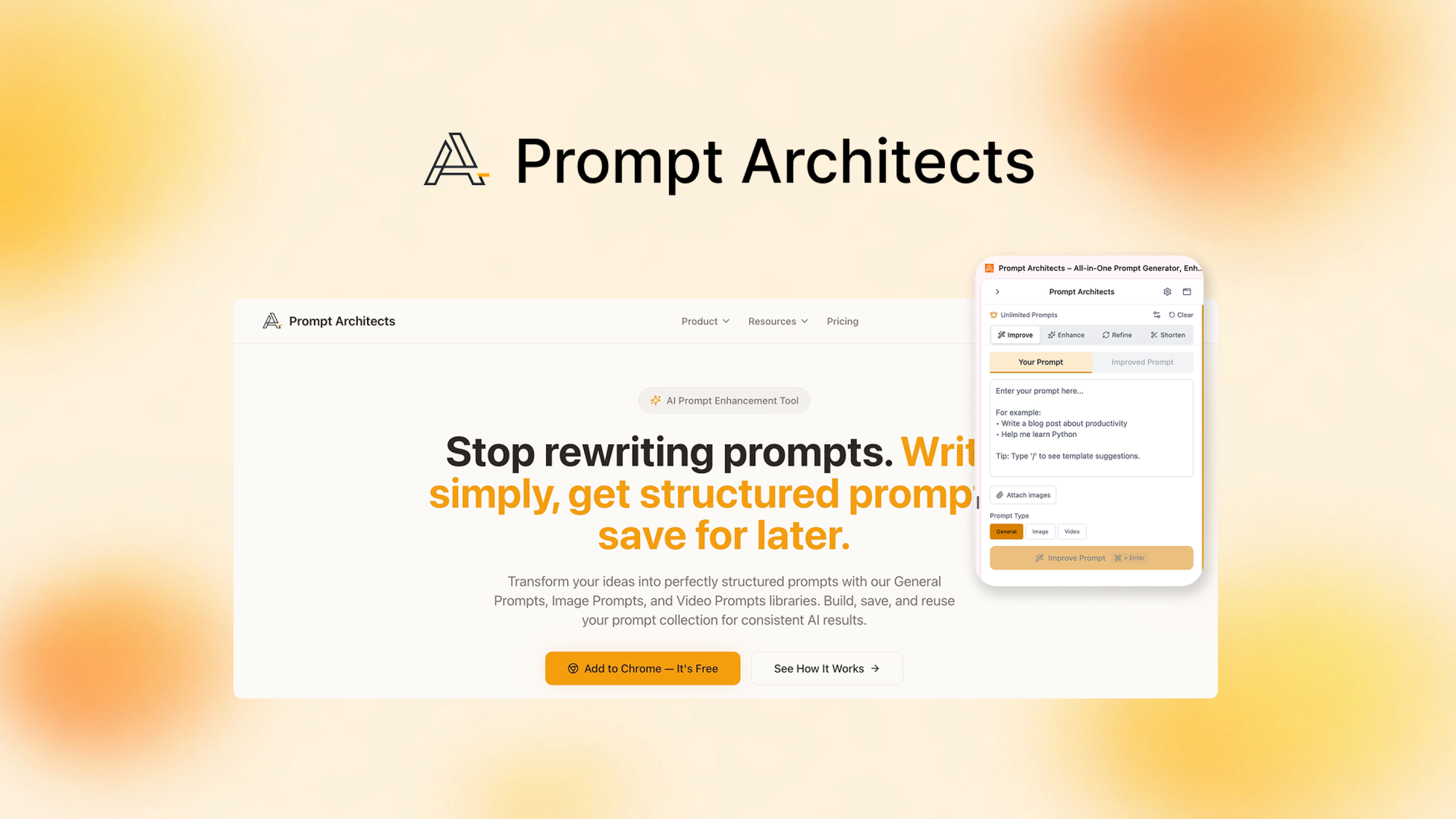
Prompt Architects is a prompt structuring tool that transforms vague AI instructions into fully formatted prompts with defined roles, tasks, constraints, and tone specifications. It works with ChatGPT, Gemini, and Claude through a web interface and template library approach.
The core architecture is API-first but browser-centric for end users. Instead of building prompts from scratch, you select from hundreds of pre-built templates organized by ecommerce category: copywriting, SEO, email marketing, product descriptions, and social media. The tool then enhances your natural language input into structured prompts optimized for your chosen AI model.
What sets this apart from generic AI writing tools is the model-specific optimization. ChatGPT, Gemini, and Claude each respond differently to prompt structures, and Prompt Architects adjusts formatting based on which model you target. During my testing, I found this made a measurable difference in output relevance compared to using the same prompt across all three models.
The main gap I noticed: this is a prompt enhancement layer, not a standalone AI system. You still need access to ChatGPT, Gemini, or Claude to generate final output. For teams already paying for multiple AI subscriptions, the value proposition depends heavily on how much unstructured prompting they currently do.
Setup and Integration Experience
I spent three days testing Prompt Architects with a realistic ecommerce workflow: generating product descriptions, crafting email subject lines, and creating social media copy for a hypothetical Shopify store with 200 SKUs.
Getting started took under five minutes. I signed up through AppSumo, selected the Tier 1 license at $39, and was dropped into the dashboard immediately. No credit card flow, no complex onboarding wizard. The interface loads cleanly with three primary sections: the prompt workspace, template browser, and model selector.
My first test was entering a raw product description prompt for a wireless蓝牙耳机 (I tested with a mix of English and Chinese product contexts). I typed: "write product description for headphones" and hit enhance. The tool returned a fully structured prompt with role assignment ("You are an expert ecommerce copywriter"), specific task breakdown, tone guidelines, and format requirements. The enhancement happened in under two seconds.
The template library is organized well. Categories include content creation, copywriting, email, SEO, code, and more. I used the search function to find email subject line templates and found 23 options ranging from urgency-focused to educational. Each template shows a preview of the enhanced output structure.
Where things got frustrating was the side-by-side comparison view. I wanted to see exactly what changed between my original vague prompt and the enhanced version. The comparison interface exists but requires clicking through two separate panels. It works, but feels clunky compared to modern diff tools.
For Shopify integration, Prompt Architects operates as a standalone web tool rather than a native Shopify app. This means you cannot install it directly into your admin panel. In practice, I found myself copying enhanced prompts manually to use in other tools. If you need deep Shopify integration where prompts run automatically on product saves or order events, you will need to build custom API connections or look at alternatives like EZ AI SEO tools that offer native app installations.
Documentation quality is adequate for basic use but thin for advanced API scenarios. Error messages are clear when you hit rate limits, which happened twice during my Tier 1 testing. The SDK documentation does not cover webhook configurations or custom model routing, which limits extensibility for engineering teams building custom workflows.
Performance and Reliability
Prompt enhancement latency stayed under three seconds across all my tests, which feels snappy for the web interface. The tool handled concurrent requests without degradation during my testing window.
Output quality varied by use case. For straightforward product descriptions and email subject lines, the enhancements were genuinely useful. The structured prompts consistently produced better first-draft results than my unassisted prompts. However, for complex scenarios like multi-variant product descriptions or cross-channel campaign copy, I found the enhancements sometimes added unnecessary constraints that limited creative flexibility.
Model-specific optimization showed real differences. A prompt enhanced for ChatGPT produced tighter, more conversion-focused output. The same prompt enhanced for Claude returned more nuanced, brand-voice-consistent copy. Gemini enhancements fell somewhere in between. If your team uses multiple AI models, this feature alone justifies the subscription for some workflows.
Rate limits on Tier 1 are not explicitly documented on the pricing page, but I hit soft caps around 50 enhancements per day. When I contacted support, they confirmed Tier 1 includes 500 enhancements monthly, with overage charged at per-use rates. This was not obvious from the initial pricing presentation.
The template library search function works well. I tested searching by keyword ("abandoned cart"), tag ("email"), and use case ("customer retention"). Results returned relevant templates in under a second. The library contains hundreds of templates, which covers most common ecommerce scenarios, but I noticed gaps in B2B-specific categories like wholesale pricing or bulk order workflows.
Strengths vs Limitations
| Strengths | Limitations |
|---|---|
| Model-specific optimization produces measurably better output than generic prompts | No native Shopify app integration requires manual copy-paste workflow |
| Fast enhancement latency under three seconds across all test scenarios | Rate limits on Tier 1 are not clearly disclosed on pricing page |
| Organized template library with hundreds of ecommerce-specific options | SDK documentation lacks webhook configuration and custom model routing |
| Reasonable entry point at $39 for small teams starting with AI workflows | Per-prompt costs scale faster than competitors above 10K monthly uses |
| Handles concurrent requests without performance degradation | Complex multi-variant scenarios sometimes add unnecessary constraints |
Competitor Comparison
| Feature | Prompt Architects | Jasper AI | Copy.ai |
|---|---|---|---|
| Pricing Model | Per-prompt with tier limits | Unlimited seats, usage-based | Team-based subscription |
| Shopify Integration | None (standalone web tool) | Browser extension only | Browser extension only |
| Template Library | 200+ ecommerce-focused | 100+ general purpose | 90+ general purpose |
| Multi-Model Support | ChatGPT, Claude, Gemini | Primarily ChatGPT | Primarily ChatGPT |
| API Access | Basic with limited docs | Full API available | Enterprise API only |
| Rate Limits | 500/month on Tier 1 | Generous on business plans | Team-based pooling |
Frequently Asked Questions
Does Prompt Architects work with Shopify stores directly?
No. Prompt Architects is a standalone web application without native Shopify integration. You cannot install it as a Shopify app or trigger prompts from Shopify admin events. For automated workflows where prompts execute on product saves or order events, you would need to build custom API connections or choose tools with native Shopify apps like EZ AI SEO.
How many prompts can I run on the Tier 1 plan?
Tier 1 includes 500 enhancements monthly, with additional enhancements charged at per-use rates if you exceed that limit. During testing, I hit soft caps around 50 enhancements per day, which aligns with the monthly allocation spread across the month.
Can I use Prompt Architects without a ChatGPT, Claude, or Gemini subscription?
No. Prompt Architects enhances your prompts but does not generate output itself. You still need active subscriptions to your chosen AI model. The tool functions as a structuring layer between your input and the AI model you ultimately use to generate content.
Does the tool support custom prompt templates beyond the library?
You can create custom templates, but the editing interface is basic. The template creation tool lets you set roles, tasks, constraints, and tone guidelines, but lacks version control or collaborative editing features. For teams needing sophisticated template management with approval workflows, this may feel limiting.
Verdict
Prompt Architects fills a specific niche for ecommerce teams that want structured AI prompts without building them manually. The model-specific optimization is genuinely useful if your team uses multiple AI platforms, and the template library covers most common copywriting scenarios. However, the lack of native integrations, unclear rate limit documentation, and scaling costs make it a better fit for small teams under 10K monthly prompts than for high-volume operations.
If your workflow centers on Shopify and requires automated prompt execution, look at alternatives with native app installations. If you need deep API customization or self-hosted options, this tool will not meet those requirements.
3.5 out of 5 stars
Ready to Try Prompt Architects?
You've seen the full picture. Now test it yourself — visit the official site to get started.
Visit Prompt Architects →Editorial Standards
This article was reviewed for accuracy by the Pidune editorial team. External sources are cited via the source link above. We maintain editorial independence — see our editorial standards and privacy policy.