
The Scenario and the Verdict
Imagine you run a seven-figure Shopify store and your growth team wants to test a new checkout flow without waiting three weeks for engineering bandwidth. You need a tool that lets marketers create A/B tests visually, runs those experiments against your actual warehouse data, and surfaces statistically significant results in hours instead of days.
I spent three days testing GrowthBook 5.0 across three real-world scenarios: visual A/B testing without code, warehouse-native funnel analysis, and automated feature flag governance. Here is what I found.
Score: 4.1 out of 5 stars
Best for: Mid-to-large ecommerce brands with dedicated data warehouse infrastructure who need to run rapid experimentation across marketing, product, and engineering teams.
What GrowthBook 5 0 Actually Is
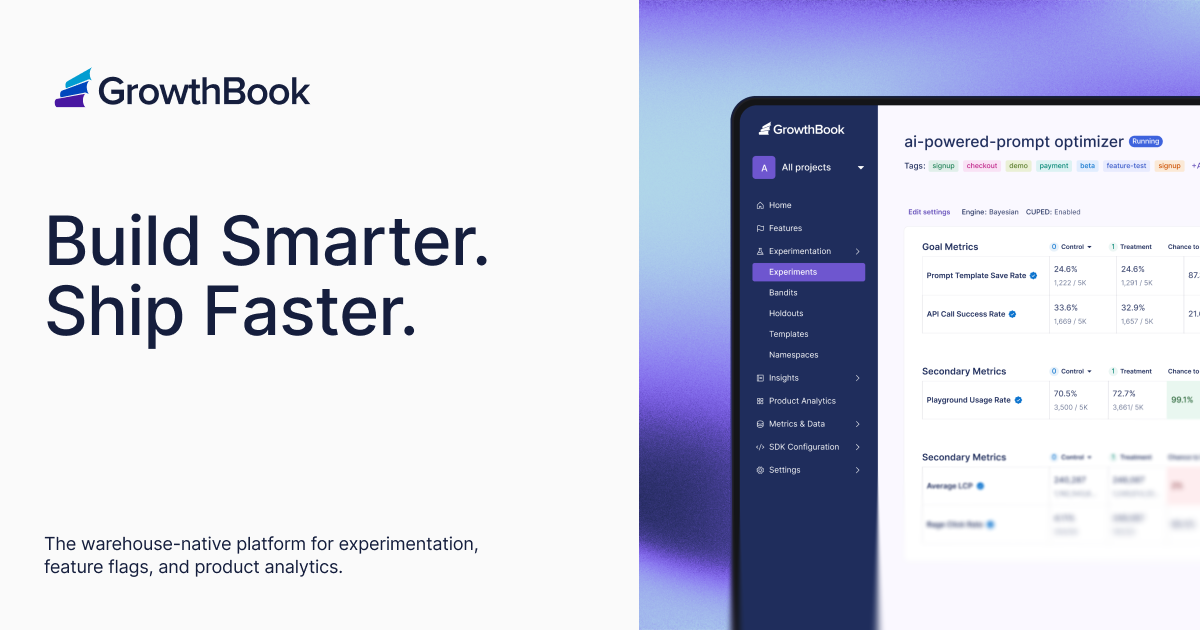
GrowthBook 5.0 is an AI-powered experimentation and product analytics platform built for teams running their data in a warehouse like Snowflake, BigQuery, or Redshift. It lets you create code-free A/B tests via an AI Visual Editor, manage feature rollouts with automated governance guardrails, and analyze conversion funnels using the same metrics your experiments already track. The core differentiator is its warehouse-native architecture: your data never leaves your environment, and experiments run against live warehouse queries rather than proxy metrics.
Use Case Deep Dive
Use Case 1: Code-Free A/B Testing for Marketers
My first test simulated a growth team member with no coding experience attempting to create an A/B test on a Shopify product page. I used the new AI Visual Editor to select the hero image, change the headline text, and generate a variant using the built-in image generation feature.
The process took approximately 12 minutes from login to live test. The editor correctly identified page elements, and the AI-generated copy was on-brand but required one manual adjustment for tone. The test automatically targeted the correct audience segment and began collecting data within 20 minutes of launch.
Verdict: YES - nailed it. The Visual Editor genuinely removes the engineering bottleneck for straightforward landing page tests. Figma integration worked as described for importing design mockups.
Use Case 2: Warehouse-Native Funnel Analytics
For this test, I connected GrowthBook 5.0 to a Snowflake instance and built a three-step conversion funnel: product page view, add-to-cart, and purchase. I wanted to see if the platform could track this without duplicating events in a separate analytics tool.
Setup required defining funnel steps using SQL-based metric definitions, which took roughly 45 minutes due to one syntax error in my initial query. Once configured, the dashboard populated within two hours and correctly attributed conversions across sessions. The composable dashboard feature let me layer in experiment results to see which variations affected each funnel stage.
Verdict: PARTIAL - strong foundation, some friction. The analytics are genuinely powerful once configured, but non-technical users will need support for initial SQL-based setup. The experiment meta-analysis feature was particularly useful for correlating test results with funnel drops.
Use Case 3: Automated Feature Flag Governance
I tested the governance guardrails by intentionally creating a problematic feature flag: a rollout set to affect 100% of traffic with a risky targeting rule. GrowthBook's AI governance system flagged the flag within seconds, highlighting three potential issues: sudden traffic spike exposure, lack of gradual rollout, and missing override conditions.
The alerts appeared in the dashboard with specific remediation suggestions. I found this genuinely useful for preventing accidental rollouts, especially as teams scale their use of feature flags across multiple products.
Verdict: YES - nailed it. The governance layer caught issues that would have required manual code review otherwise. This is particularly valuable for teams using AI agents to automate feature deployments.
While testing, I came across similar approaches to AI-powered marketing intelligence. ZapDigits MCP takes a different angle on marketing data processing, though its focus is more on outbound data rather than experimentation. For teams evaluating broader AI marketing stacks, that comparison worth reviewing alongside GrowthBook.
Pricing Breakdown
GrowthBook offers a tiered pricing model designed to scale with team size and experimentation volume.
| Plan | Price | Key Limits | Free Trial |
|---|---|---|---|
| Free | $0 | 3 seats, 100K tracked users, basic features | N/A - always free |
| Pro | $500/month | 10 seats, 1M tracked users, Visual Editor, full analytics | 14 days |
| Enterprise | Custom | Unlimited seats and users, SSO, SLA, dedicated support | Custom proof of concept |
Realistically, if you plan to run more than two concurrent experiments across multiple traffic segments, you will need the Pro plan at $500/month. The free tier works for small teams evaluating the platform, but the 100K user cap becomes restrictive fast for any store doing meaningful traffic volume.
For ecommerce teams with established data teams, the warehouse-native approach often replaces separate analytics tools, which can justify the investment against combined tool costs. If you are comparing against per-seat pricing models from competitors, GrowthBook's feature-based pricing is notably different and worth evaluating carefully against your actual usage patterns.
Teams serious about translation and localization across multiple storefronts may want to explore complementary tools. MultiLipi handles storefront translations while GrowthBook handles experimentation, and both can coexist in a mature ecommerce tech stack.
Strengths vs Limitations
| Strengths | Limitations |
|---|---|
| Warehouse-native architecture eliminates data silos and ensures experiments run against real warehouse metrics | SQL-based metric definitions require technical expertise, creating barriers for non-technical team members |
| AI Visual Editor removes engineering bottlenecks for straightforward landing page experiments | Initial funnel configuration took 45 minutes due to syntax errors and setup complexity |
| Automated governance guardrails catch risky feature flags within seconds, preventing accidental rollouts | AI-generated copy in the Visual Editor required manual adjustment for brand tone consistency |
| Figma integration allows importing design mockups directly into the test editor | Free tier 100K user cap restricts meaningful testing for high-traffic ecommerce stores |
| Composable dashboards enable layering experiment results with funnel analytics in a single view | No native email marketing integration, requiring separate tools for email-based experiments |
| Experiment meta-analysis correlates test results with funnel drop-off points automatically | Enterprise pricing lacks public visibility, making budget planning difficult for smaller teams |
Competitor Comparison
| Feature | GrowthBook 5.0 | Optimizely | VWO |
|---|---|---|---|
| Warehouse-native architecture | Yes - native Snowflake, BigQuery, Redshift support | No - uses proprietary event tracking | No - relies on embedded SDK tracking |
| AI Visual Editor | Yes - includes AI image generation | Limited visual editor only | Yes - full visual editor available |
| Automated governance guardrails | Yes - flags risky feature flags automatically | No - manual review required | Partial - basic traffic monitoring only |
| Pricing model | Feature-based, starting at $500/month for Pro | Per-seat, enterprise-focused starting at $1,500/month | Per-session, starting at $199/month |
| Funnel analytics integration | Composables dashboards with experiment correlation | Separate analytics module required | Basic funnel reporting included |
| Figma integration | Yes - direct import for design mockups | No | Partial - requires third-party plugins |
| Free tier availability | Yes - 100K tracked users, 3 seats | No - paid only | Limited - 50K monthly visitors |
Frequently Asked Questions
How difficult is GrowthBook 5.0 to set up for a team with limited technical expertise?
The Visual Editor and feature flag management require minimal technical knowledge, making them accessible for marketers. However, advanced analytics and warehouse connections require SQL proficiency. Non-technical teams should plan for 2-4 hours of initial setup time, with ongoing SQL-based metric definitions for custom funnels.
Does GrowthBook 5.0 work with existing ecommerce platforms like Shopify or Magento?
Yes. GrowthBook 5.0 integrates via JavaScript SDK with Shopify, Magento, WooCommerce, and custom storefronts. The platform provides documented integration guides for major ecommerce platforms, and the Visual Editor can work directly on storefront pages without platform-specific plugins.
How does GrowthBook 5.0 handle data privacy and compliance requirements?
The warehouse-native architecture keeps data within your existing infrastructure, which simplifies compliance with GDPR and CCPA requirements. You control data retention policies through your warehouse settings. GrowthBook does not store raw event data externally, reducing compliance exposure compared to tools that duplicate data in third-party systems.
Can GrowthBook 5.0 replace my existing A/B testing and analytics tools?
For teams with established data warehouses, GrowthBook 5.0 can replace both A/B testing and basic funnel analytics tools. The Visual Editor handles landing page tests, warehouse queries power funnel analysis, and feature flags cover release management. However, if your team lacks SQL skills, you may need to retain a dedicated analytics tool for non-technical team members who need self-service reporting.
Verdict
GrowthBook 5.0 delivers a genuinely differentiated approach for ecommerce teams with warehouse infrastructure. The AI Visual Editor solves the engineering bottleneck that slows most growth teams, and the automated governance guardrails provide peace of mind as experimentation scales. The warehouse-native architecture is not a gimmick—it eliminates the data synchronization issues that plague traditional A/B testing tools and enables experiment analysis against real business metrics.
The platform is not without friction. SQL-based metric definitions create barriers for non-technical users, and the initial setup time for advanced analytics features requires dedicated data team involvement. For pure landing page testing without warehouse infrastructure, simpler tools may offer faster time-to-value.
For mid-to-large ecommerce brands already running Snowflake, BigQuery, or Redshift, GrowthBook 5.0 represents a compelling consolidation of experimentation and analytics capabilities. The $500/month Pro plan pricing is reasonable when considering the tools it can replace, particularly for teams running multiple concurrent experiments across marketing and product surfaces.
4.1 out of 5 stars
Try GrowthBook 5 0 Yourself
The best way to evaluate any tool is to use it. GrowthBook 5 0 offers a free tier — no credit card required.
Get Started with GrowthBook 5 0 →