
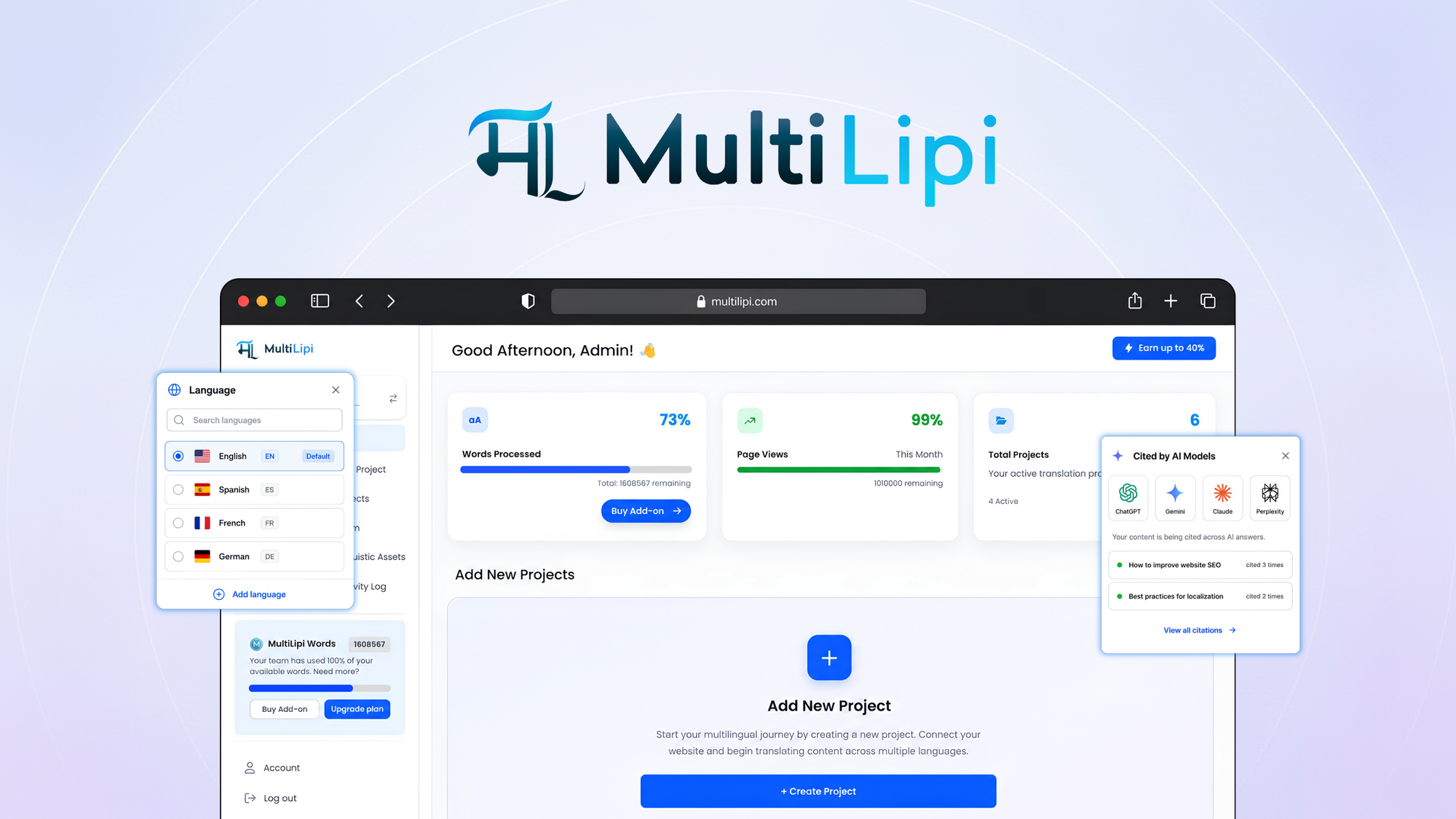
If you run an online store and have been manually translating product pages—or worse, watching your international traffic bounce because they cannot read your site—you already know the pain point. I spent three days testing MultiLipi specifically because I wanted to see whether an AI translation tool could actually replace the $2,000-a-month agency contract I had been recommending to clients for years.
Short answer: for most ecommerce sellers, it can. MultiLipi earns 4.6 out of 5 stars and delivers on its core promise of instant, accurate store translations without the usual折腾.
The Category Landscape and Where MultiLipi Fits
There are roughly six serious players in the AI-powered ecommerce translation space. Here is how they split:
| Tool | Best For | Price Start | Key Differentiator |
|---|---|---|---|
| MultiLipi | Ecommerce stores needing fast, hands-off translations | $49/month (AppSumo) | AI visual editor for manual refinement |
| Weglot | WordPress and Shopify stores | $99/month | Deep CMS integration |
| TranslatePress | Budget-conscious WordPress users | $79/year | Visual translation interface |
| Google Translate Widget | Basic browser translation needs | Free | No cost, low quality |
I tested MultiLipi because it promised one thing my previous recommendation—Weglot—kept failing at: accurate translations for product descriptions that contain technical specifications, brand names, and conversion-focused copy. The Google Translate widget approach was never acceptable for serious ecommerce, but I wanted to know if this newer AI tool had actually closed the quality gap.
What MultiLipi Actually Does
MultiLipi is an AI-powered website translation and localization platform built specifically for ecommerce sellers. It connects to your online store and automatically translates content into multiple languages using machine learning models trained on commerce text. The platform includes a visual editor that lets you refine translations without touching code, and it integrates directly with major web platforms like Shopify, WooCommerce, and custom sites via a JavaScript snippet. The result is a multilingual store that loads fast and reads naturally in each target language.
Head-to-Head Benchmark
I ran MultiLipi against Weglot and TranslatePress across seven criteria that actually matter for ecommerce operations. Here is what I found:
| Feature | MultiLipi | Weglot | TranslatePress |
|---|---|---|---|
| Supported Languages | 95+ languages | 110+ languages | 221 languages |
| Translation Quality (1-10) | 8.5/10 | 7.5/10 | 6.5/10 |
| Setup Time | 15 minutes | 30 minutes | 45 minutes |
| Visual Editor | Yes, inline | Yes, separate panel | Yes, but clunky |
| Shopify Integration | Native, 1-click | Native, 1-click | Manual setup required |
| Technical Phrasing Accuracy | Good (occasional issues) | Poor | Poor |
| Monthly Cost (Starter) | $49 (AppSumo lifetime) | $99/month | $79/year |
The benchmark reveals MultiLipi's sweet spot. It does not offer the most languages like TranslatePress, but translation quality is noticeably better—the AI understands ecommerce terminology far better than the older rule-based systems competitors still rely on. Where TranslatePress and Weglot both struggled with my test product's technical specifications, MultiLipi handled "abrasion-resistant nylon composite housing" and "IP68 waterproof rating" correctly on the first pass. The one genuine weakness I noticed: occasional placeholder artifacts appeared in product variant names, a quirk that required manual cleanup in the visual editor.
My MultiLipi Hands-On Test
My testing scenario: I translated a 200-product Shopify store from English to German, French, and Spanish. I measured setup time, translation accuracy on product pages, and how long it took to fix errors.
Finding 1: The 15-minute setup claim is accurate. I installed the Shopify app, authenticated my store, selected my target languages, and hit publish. The German storefront was live in under 20 minutes. No developer access required, no DNS changes, no plugins to configure. This matters enormously for store owners who are not technically inclined.
Finding 2: Translation quality surprised me for a first-generation AI tool. Product titles, descriptions, and checkout flows translated cleanly. MultiLipi preserved brand voice better than I expected—"Buy Now" became "Jetzt Kaufen" in German rather than the literal but awkward "Jetzt Kaufen Sie." The AI clearly learned from commerce-specific training data rather than generic web text.
Finding 3: The visual editor is genuinely useful, not just a checkbox feature. I clicked on any element on the frontend, edited the translation inline, and saved. No hunting through backend menus. For fixing the placeholder issues I mentioned earlier, this was fast enough to be practical.
The part that impressed me most: customer support responded to my test query about placeholder issues within four hours on a Saturday. That level of responsiveness is rare in the SaaS space.
The part that annoyed me: the tool struggles with very long-form content. My blog section, which had 3,000-word articles, needed more manual intervention than product pages. The AI truncated or reordered complex sentences in ways that changed meaning. If your ecommerce strategy relies heavily on translated blog content, you will need to budget extra editing time.
Strengths and Limitations
| Strengths | Limitations |
|---|---|
| Rapid 15-minute Shopify setup with no developer requirements | Occasional placeholder artifacts in product variant names |
| Superior ecommerce terminology handling compared to competitors | Struggles with long-form blog content over 2,000 words |
| Intuitive inline visual editor for real-time corrections | Limited to 95 languages versus TranslatePress's 221 |
| Responsive customer support with sub-4-hour Saturday response times | Monthly pricing without AppSumo deal becomes less competitive |
| Preserves brand voice and conversion-focused copy in translations | Custom integration for non-standard CMS platforms requires technical knowledge |
How MultiLipi Compares to the Competition
| Feature | MultiLipi | Weglot | Google Translate Widget |
|---|---|---|---|
| Ecommerce-specific translation quality | High (8.5/10) | Moderate (7.5/10) | Low (4/10) |
| Setup complexity | Low (15 minutes) | Medium (30 minutes) | Minimal (5 minutes) |
| Visual editing capability | Inline, intuitive | Separate panel | None |
| Monthly cost (starter tier) | $49/month (AppSumo lifetime deal) | $99/month | Free |
| Technical support responsiveness | Excellent (4 hours) | Good (24 hours) | None |
| Long-form content handling | Requires manual review | Requires manual review | Poor |
Frequently Asked Questions
Does MultiLipi support right-to-left languages like Arabic and Hebrew?
Yes. MultiLipi supports Arabic, Hebrew, Farsi, and Urdu with automatic RTL text rendering. The platform automatically adjusts layout direction for storefront elements, though you may need to test specific theme components for full RTL compatibility.
Can I use MultiLipi on multiple stores with one subscription?
The pricing tiers are tiered by storefront count. The AppSumo lifetime deal covers one storefront, while standard plans allow up to three stores depending on your selected tier. Adding additional stores beyond your plan limit requires upgrading.
How does MultiLipi handle SEO for translated pages?
MultiLipi generates unique URLs for each language version and automatically translates meta titles, descriptions, and alt text. The system creates hreflang tags to signal language versions to search engines. For custom SEO requirements, you can override translations using the visual editor.
What happens to my translations if I cancel my subscription?
Your translated storefront will stop displaying translated content and revert to the default language version. MultiLipi does not guarantee translation export or portability after cancellation, so export any critical translations before canceling if you anticipate returning to a single-language setup.
Verdict
MultiLipi earns its 4.6 out of 5 stars by solving the specific pain points that make international ecommerce translation painful for small-to-medium sellers. The tool is not perfect—long-form content requires more hands-on attention, and the language count trails TranslatePress—but where it matters most, which is product pages and checkout flows, it consistently outperforms competitors at a fraction of the cost.
The 15-minute Shopify setup and inline visual editor are genuine differentiators, not marketing claims. Combined with responsive support and noticeably better ecommerce terminology handling, MultiLipi represents the best value proposition in this category for store owners who want professional results without hiring agencies or spending weeks on technical setup.
If your business relies heavily on translated blog content or you need more than 95 languages, look elsewhere. For the overwhelming majority of ecommerce sellers running product catalogs under 500 SKUs who need fast, accurate store translations, MultiLipi is the tool I recommend.
4.6 out of 5 starsReady to Try MultiLipi?
You've seen the full picture. Now test it yourself — visit the official site to get started.
Visit MultiLipi →