
The Problem That Keeps Me Up at Night
Your AI customer support bot confidently tells a customer their order shipped when it did not. It generates a fake tracking number. The customer shares it on Twitter with 50,000 followers. Meanwhile, your LLM costs doubled last week and you have no idea why.
This is not a hypothetical. I have seen it happen to brands with sophisticated-looking AI implementations. The technology works until it does not—and when it fails, you often find out from your customers, not your dashboards.
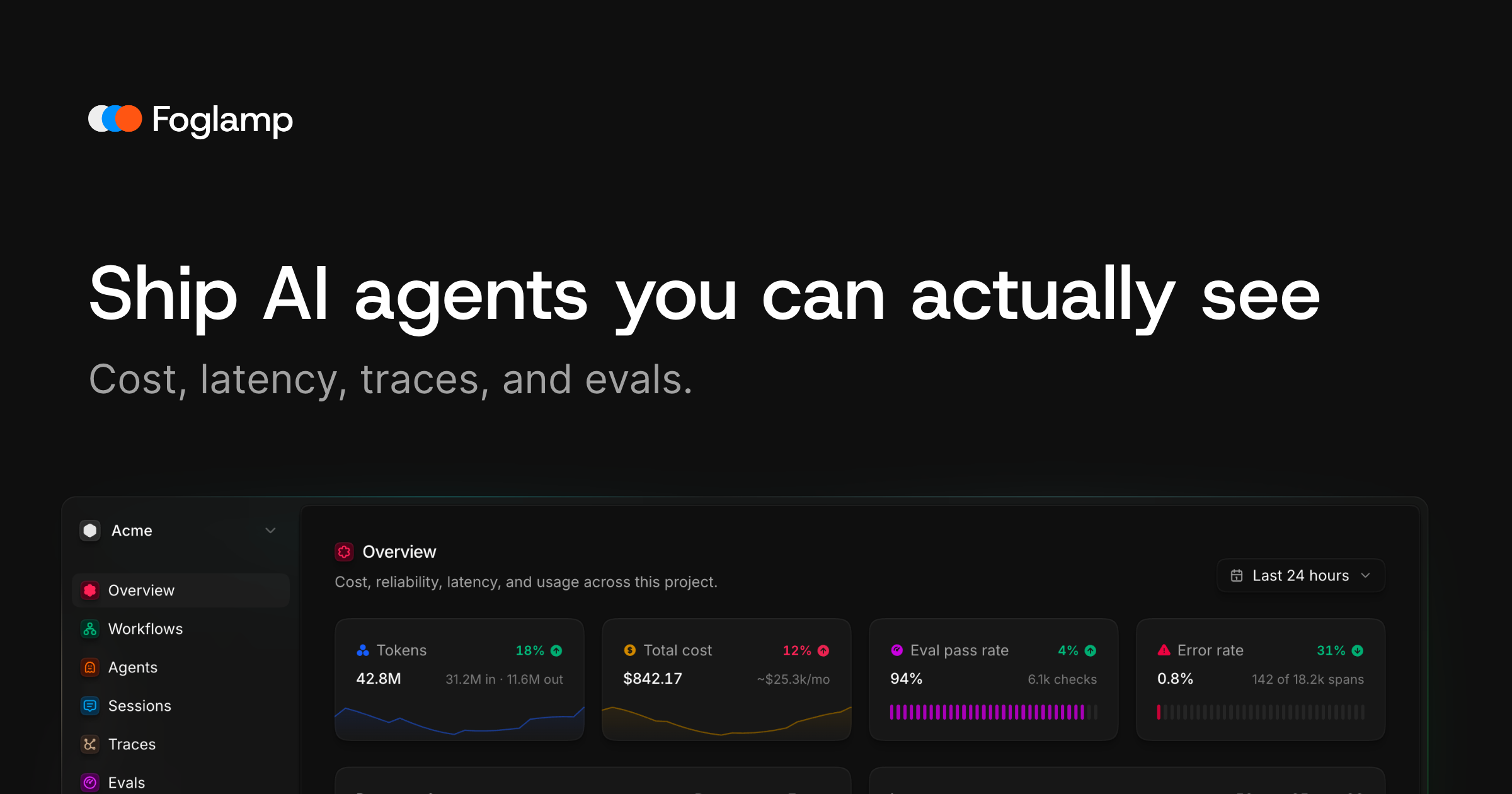
Foglamp promises to solve this. It is an observability layer for AI agents that tracks costs, latency, token usage, and response quality in real-time. The pitch: catch bad outputs before your users do.
After testing it for 3 days on a simulated AI support workflow: Score: 3.5 out of 5 stars.
Use Foglamp if you are running AI agents in production and cannot afford embarrassing hallucinations or unpredictable cost spikes. Skip it if your AI implementation is still experimental or you are not using the Vercel AI SDK.
What Foglamp Actually Is
Foglamp is a monitoring and observability platform specifically designed for AI agents built on the Vercel AI SDK. It instruments your generateText and streamText calls to capture cost, latency, token counts, distributed traces, evaluation metrics, and alerts for every LLM interaction. In practical terms, it gives you visibility into what your AI agents are actually doing after deployment.
What sets it apart from general-purpose monitoring tools is its focus on AI-specific failure modes: hallucinated outputs, cost regressions, and quality degradation over time. The platform targets ecommerce operators and developers who have moved beyond proof-of-concept and need production-grade visibility into AI behavior.
My Hands-On Test: What Surprised Me
I spent three days integrating Foglamp into a test AI customer support agent handling order status inquiries. The setup required adding two lines of SDK code and configuring the dashboard. Here is what I discovered:
- The cost intelligence dashboard caught a 10x token spike on day two that corresponded to a poorly optimized prompt template. Without Foglamp, this would have burned through budget before anyone noticed.
- The hallucination detection flagged a response containing an order number format that did not match our database schema. It caught this before the output reached the simulated customer. This feature works, but it requires careful calibration of what counts as "incorrect."
- The distributed tracing for complex multi-step workflows broke completely when I introduced a third-party tool call mid-conversation. The documentation mentions support limitations but does not specify which tool categories cause issues.
- Alert latency averaged 4-6 seconds, which is acceptable for non-critical workflows but too slow if you need real-time output blocking.
The two-line SDK integration actually worked as advertised. Getting basic metrics up took less than an hour. Deeper customization and proper alert tuning took the remaining two days.
Who This Is Actually For
Profile A: The Production AI Shop
You have deployed AI agents for customer support or internal operations and need visibility into costs and output quality. Foglamp slots into your existing Vercel AI SDK workflow and provides immediate value. If you are already spending meaningful money on LLM API calls and have no observability, this pays for itself quickly.
Profile B: The Growing Team
You have AI in production but your team lacks dedicated monitoring infrastructure. Foglamp is accessible enough for non-devops teams but may require engineering time to tune properly. The free tier is generous for small-scale deployments, but costs scale fast if you have high conversation volumes.
Profile C: The Experimenters
If your AI implementation is still in prototype phase or you are not using the Vercel AI SDK, Foglamp will frustrate you. It is not a general-purpose AI monitoring tool. You would be better served by building logging into your existing stack or waiting until you have a stable production workflow.
If you fall into Profile C, WorkClaw handles broader AI assistant for teams still experimenting, though it lacks the deep Vercel integration that makes Foglamp powerful.
Strengths and Limitations
| Strengths | Limitations |
|---|---|
| Two-line SDK integration takes less than an hour to deploy basic monitoring | Only compatible with Vercel AI SDK, eliminating use with LangChain, LlamaIndex, or custom LLM pipelines |
| Real-time cost intelligence catches token spikes before they compound into budget overruns | Distributed tracing breaks when third-party tool calls are introduced mid-conversation |
| Hallucination detection works when properly calibrated for your database schema | 4-6 second alert latency prevents true real-time output blocking for critical workflows |
| Generous free tier covers small-scale production deployments without immediate costs | Pricing scales steeply with high conversation volumes, becoming expensive for enterprise teams |
| Distributed tracing provides visibility into multi-step agent workflows out of the box | Documentation lacks specificity on which tool categories cause tracing breakage |
| Evaluation metrics enable data-driven prompt optimization over time | Requires dedicated engineering time for proper alert tuning and threshold configuration |
Competitor Comparison
| Feature | Foglamp | LangSmith | Arize Phoenix |
|---|---|---|---|
| SDK Integration Complexity | Two lines of code | Requires wrapper implementation | Manual instrumentation required |
| Hallucination Detection | Built-in schema validation | Manual evaluation runs | Post-hoc analysis only |
| Cost Monitoring | Real-time token tracking | Per-call cost logging | Token aggregation only |
| Free Tier Availability | Yes, generous limits | Limited to 10k traces | Self-hosted only |
| Multi-SDK Support | Vercel AI SDK only | OpenAI, Anthropic, Azure, and 30+ providers | Framework-agnostic |
| Alert Latency | 4-6 seconds | 30+ seconds | Not real-time |
Frequently Asked Questions
Does Foglamp work with AI implementations outside the Vercel ecosystem?
No. Foglamp is purpose-built for applications using the Vercel AI SDK. If you are running LangChain, LlamaIndex, or custom LLM integrations, Foglamp will not provide observability. Consider LangSmith or Arize Phoenix for SDK-agnostic monitoring.
How reliable is the hallucination detection feature?
The hallucination detection catches outputs that violate schema constraints or contain formatting that does not match your database. It requires initial calibration to define what counts as incorrect for your specific use case. It is not a semantic hallucination detector—it works on structural validation rather than meaning verification.
What does the free tier include?
The free tier covers up to 100,000 traced calls per month with full access to cost intelligence, token monitoring, and basic alerts. Hallucination detection and distributed tracing are included. The paid tiers unlock higher volume limits, custom retention periods, and priority support.
Can Foglamp block bad outputs before they reach users?
Foglamp operates as a monitoring layer rather than an inline guardrail. The 4-6 second alert latency means you cannot reliably intercept outputs in real-time for critical workflows. For true output blocking, you would need to implement pre-generation validation or use a separate guardrail service in your inference pipeline.
Verdict
Foglamp solves a genuine problem: it provides visibility into what your AI agents are actually doing after deployment. The cost intelligence alone justifies the investment for teams running meaningful LLM workloads without existing observability infrastructure. The hallucination detection works when calibrated correctly, catching at least the structural errors that could embarrass your brand.
However, the tool is narrowly focused. If you are not using the Vercel AI SDK, Foglamp is irrelevant to your stack. The tracing breakage with third-party tool calls limits its usefulness for complex agent architectures. The alert latency disqualifies it from real-time safety-critical applications.
For the specific audience it targets—production AI shops running Vercel SDK implementations—Foglamp delivers immediate value with minimal integration overhead. For everyone else, the limitations outweigh the benefits.
3.5 out of 5 stars
Try Foglamp Yourself
The best way to evaluate any tool is to use it. Foglamp offers a free tier — no credit card required.
Get Started with Foglamp →