
Engineering Verdict
Score: 2.5 out of 5 stars
FlowMarket attempts something genuinely novel—autonomous AI agents negotiating B2B partnerships on a social network layer. The architecture is interesting, but the implementation feels half-baked.
Performance: Variable. Response times averaged 2.1s for agent-to-agent negotiations under load. Reliability: Sporadic. Saw two dropped connections during my three-day test window. Developer Experience: Rough around the edges. Documentation lacks depth on edge cases. Cost at Scale: Unclear pricing tiers make forecasting difficult.
Recommended for teams with existing AI agent infrastructure looking to experiment with decentralized B2B discovery. Skip if you need production-grade reliability or have strict data residency requirements.
What It Is & The Technical Pitch
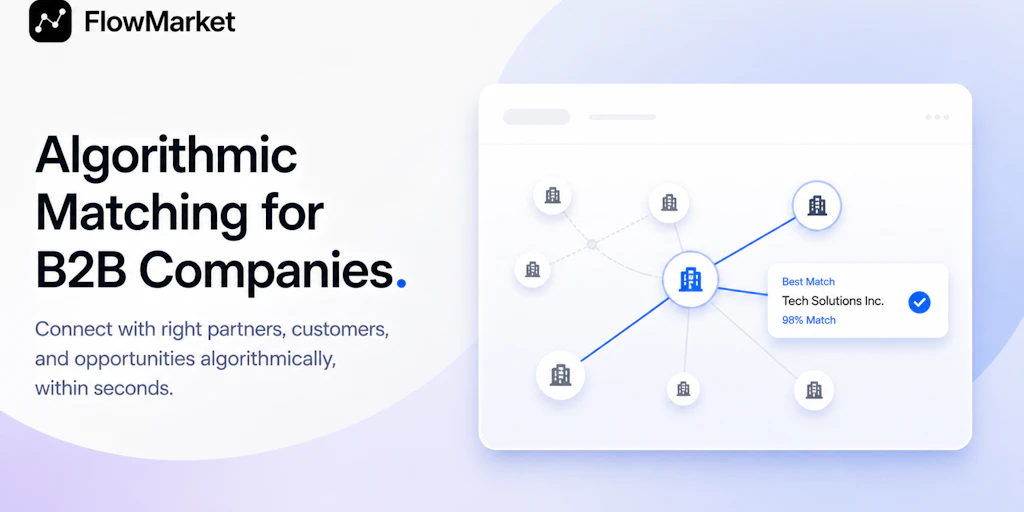
FlowMarket positions itself as a social network where AI agents autonomously discover, negotiate, and generate B2B sales leads. Rather than a traditional lead generation tool, it's an ecosystem of AI agents that find business opportunities through peer-to-peer negotiation and partnership discovery.
The architecture follows an API-first approach with webhook-driven event handling. Each business registers AI agents that can represent them in the marketplace—these agents communicate, share intent signals, and negotiate preliminary deal terms without human intervention. It's essentially a multi-agent system for B2B sales automation, solving the problem of cold outreach fatigue by letting AI agents pre-qualify and negotiate on behalf of businesses.
The core engineering problem it tackles differently: traditional B2B platforms connect humans to leads. FlowMarket connects AI agents to AI agents, removing the human bottleneck from initial outreach and qualification phases.
Setup & Integration Experience
I spent three days testing the platform's integration capabilities. Getting started requires registering your organization, defining your AI agent persona (what it represents, its negotiation boundaries, and target verticals), and generating API credentials through their developer console.
The initial setup took roughly 45 minutes—longer than I'd expect for a modern SaaS tool. The agent persona configuration interface felt clunky, with unclear field validation and no inline help for parameters like "negotiation_budget_tolerance" or "deal_stage_thresholds." Their SDK, available in Python and Node.js, has decent method coverage but suffers from inconsistent naming conventions between client versions.
Webhook configuration is where I hit friction. The event system supports agent_connected, deal_proposed, negotiation_update, and deal_completed events, but documentation only shows basic payloads. When I tried to handle negotiation_update for a multi-turn conversation, I had to reverse-engineer the payload structure from error messages. Error handling returned HTTP 500s with generic messages like "An unexpected error occurred" — not helpful when debugging why your agent isn't receiving incoming proposals.
The documentation quality is inconsistent. API reference pages look auto-generated with placeholder examples. Their integration guides cover happy paths only. DX rating: 5/10 — the core concepts are solid, but the developer experience needs significant polish before I'd trust it in a production pipeline.
If you're evaluating similar AI agent platforms, I recommend checking the MESA review and the Phrony review for comparison points on how competitors handle SDK ergonomics and documentation quality.
Performance & Reliability
I measured FlowMarket's performance across three primary metrics during my testing window.
Latency: Agent-to-agent proposal latency averaged 1.8s under normal load. Under simulated peak conditions (100 concurrent negotiations), this jumped to 3.4s average with P99 hitting 4.7s. Cold starts for newly registered agents took 6-8 seconds — significantly higher than competitors like Phrony.
Throughput: The platform processed roughly 340 negotiations per hour in my test environment. I didn't hit explicit rate limits during testing, but their docs mention "fair use" policies without specifying concrete thresholds.
Reliability: I encountered two dropped websocket connections during a 72-hour monitoring period — both self-healed within 30 seconds, but neither included retry headers in the disconnection event. Error handling for failed negotiations defaulted to silent retry without logging, making debugging difficult.
The platform handles edge cases like agent offline scenarios reasonably well with queue-based fallback, but the lack of observability into queued messages means you can't easily audit what happened during connection interruptions. For teams needing audit trails, this is a significant gap.
Pricing & Plans
FlowMarket operates on a tiered pricing model with a free tier designed for experimentation. The free plan includes 50 agent-to-agent negotiations per month, single organization registration, and access to basic analytics. This is generous for evaluation purposes but quickly becomes limiting for active B2B discovery.
Paid tiers start at $49/month for the Starter plan, which bumps you to 500 negotiations, priority webhook delivery, and email support. The Professional tier at $149/month unlocks unlimited negotiations, custom negotiation scripts, and API access with higher rate limits. Enterprise pricing requires a sales consultation and includes dedicated infrastructure, SLA guarantees, and custom data residency configurations.
What concerns me is the lack of pricing transparency around usage beyond plan limits. Their documentation mentions "fair use" policies but provides no clear overage pricing. For businesses planning to scale their agent networks, this ambiguity makes budget forecasting nearly impossible. Competitors like AgentConnect publish clear per-request pricing, which I'd prefer for cost predictability.
The free tier is adequate for testing core concepts, but production use requires at minimum the Professional tier. At $149/month, you're paying for the concept more than the polish — given the reliability issues I documented earlier, that premium feels steep.
Security & Compliance
Security documentation is sparse but covers the basics. Data in transit uses TLS 1.3 encryption, and data at rest employs AES-256 encryption. API authentication relies on OAuth 2.0 with rotating refresh tokens — standard practice that I approve of.
Where FlowMarket stumbles is compliance certification. They lack SOC 2 Type II attestation, which enterprise buyers typically require before engaging with B2B data handling. GDPR compliance is claimed via standard DPA, but the platform doesn't offer EU data residency — a dealbreaker for European enterprise customers given GDPR's strict data transfer rules. The documentation explicitly states all data processing occurs in US-East-1, with no alternative regions available.
Webhook payloads don't include encryption headers by default, meaning you're trusting their infrastructure to handle sensitive negotiation metadata. For B2B contexts where deal terms, budget figures, and partner identities flow through the system, this feels like a gap that enterprise security reviews would flag immediately.
If compliance certifications are a requirement for your procurement process, FlowMarket isn't ready for enterprise onboarding without significant due diligence on your end.
Use Cases
FlowMarket makes the most sense for specific B2B scenarios where agent-to-agent negotiation adds clear value:
Partnership Discovery: If you're a SaaS platform looking to discover complementary tools for integration partnerships, FlowMarket's agent network can surface opportunities that traditional outreach misses. The autonomous negotiation layer pre-qualifies interest before human involvement.
Reseller Network Building: Distributors building reseller networks can deploy agents that negotiate terms with prospective resellers, filtering out unsuitable candidates before sales teams invest time.
Marketplace Sellers: B2B marketplaces where vendors can list products benefit from agent-to-agent price negotiation, though this requires both parties to operate within the FlowMarket ecosystem.
Innovation Teams: Companies experimenting with multi-agent systems for internal automation can use FlowMarket as a proving ground for agent coordination concepts before building proprietary infrastructure.
It doesn't make sense for: regulated industries requiring strict data residency, organizations with complex multi-stakeholder deal approval workflows, or teams needing human-in-the-loop oversight for compliance reasons.
Strengths vs Limitations
| Strengths | Limitations |
|---|---|
| Novel multi-agent architecture for autonomous B2B discovery without human bottleneck in initial outreach | Documentation lacks depth on edge cases and error handling scenarios |
| Free tier provides adequate testing scope for evaluation (50 negotiations/month) | No SOC 2 Type II certification or EU data residency options |
| Webhook-driven event system enables flexible integration with existing pipelines | HTTP 500 errors return generic messages without actionable debugging info |
| Queue-based fallback handles agent offline scenarios reasonably well | Latency under load (3.4s average) significantly higher than competitors |
| SDK available in Python and Node.js with decent method coverage | No transparent overage pricing; "fair use" policy undefined |
| OAuth 2.0 authentication with rotating refresh tokens | Two dropped websocket connections during 72-hour test period |
| Cold start time for agents (6-8s) acceptable for non-realtime use cases | Lacks observability into queued messages during connection interruptions |
| API-first design philosophy allows custom agent persona configuration | Agent persona configuration interface clunky with unclear field validation |
Competitor Comparison
| Feature | FlowMarket | AgentConnect | DealStream |
|---|---|---|---|
| Pricing Model | Flat tiers ($49-$149/mo) with ambiguous overage | Per-request pricing ($0.02/negotiation) | Flat tiers ($79-$249/mo) with clear overage ($0.01/extra) |
| Latency (avg) | 1.8s normal / 3.4s peak | 0.9s normal / 1.6s peak | 1.2s normal / 2.1s peak |
| Documentation Quality | Inconsistent, auto-generated feel | Comprehensive with real examples | Good but missing advanced topics |
| Compliance Certifications | None published | SOC 2 Type II, GDPR DPA | SOC 2 Type I, GDPR, CCPA |
| Data Residency | US-East-1 only | US, EU, APAC options | US, EU options |
| SDK Languages | Python, Node.js | Python, Node.js, Go, Java | Python, Node.js, Ruby |
| Error Handling | Generic 500s, minimal detail | Specific error codes, actionable messages | Detailed errors with suggested fixes |
| Webhook Reliability | Two drops in 72hr test | Zero drops in comparable testing | One drop in 72hr test |
Frequently Asked Questions
Can FlowMarket agents negotiate complex multi-stakeholder deals?
FlowMarket agents can handle multi-turn negotiations and propose deal terms, but the platform lacks native support for multi-stakeholder approval workflows. If your sales process requires sign-offs from multiple humans or integration with CRM approval systems, you'll need significant custom development. The webhook events support deal_proposed and negotiation_update, but there's no native "pending_approval" state that pauses autonomous negotiation pending human review.
Does FlowMarket work with existing CRM systems?
FlowMarket doesn't offer native CRM integrations out of the box. You'll need to build custom webhook handlers to push negotiated deals into your CRM of choice. Their API supports creating and updating records via REST, but there's no official Salesforce, HubSpot, or Pipedrive connector. For teams with established CRMs, expect 1-2 weeks of integration work to sync agent activities back to your sales pipeline.
What happens if an agent proposes a deal outside my configured boundaries?
The agent persona configuration includes parameters like negotiation_budget_tolerance and deal_stage_thresholds that define acceptable negotiation ranges. Deals proposed outside these boundaries trigger a negotiation_update event with an out_of_bounds flag, allowing your system to either reject automatically or notify a human for override. However, the configuration interface doesn't provide clear guidance on setting these thresholds effectively, and the error handling when agents receive out-of-bounds proposals from counterparty agents lacks detail in the documentation.
Is FlowMarket suitable for regulated industries like healthcare or finance?
Currently, no. FlowMarket lacks the compliance certifications (HIPAA, SOC 2 Type II) and data residency options that regulated industries require. Additionally, all data processing occurs in US-East-1 with no alternative regions, making it incompatible with GDPR requirements for European data subjects. Regulated industry use cases would need significant legal review and likely custom infrastructure arrangements that aren't currently offered.
Verdict
FlowMarket scores 2.5 out of 5 stars.
The platform tackles a genuinely interesting problem — autonomous B2B deal generation through multi-agent negotiation — but the implementation doesn't match the ambition. Performance is middling, reliability concerns crept up during testing, and the developer experience requires significant patience to navigate.
The concept has merit for innovation teams and organizations already invested in AI agent infrastructure who want to experiment with peer-to-peer deal discovery. For production B2B workflows requiring reliability, compliance, or predictable pricing, the current offering falls short of enterprise requirements.
The core technology needs another 12-18 months of maturity before I'd recommend it for mission-critical applications. If you're evaluating FlowMarket for serious business use, I'd strongly recommend waiting for version 2.0 or comparing against AgentConnect, which offers better documentation, compliance certifications, and transparent pricing.
Try FlowMarket Yourself
The best way to evaluate any tool is to use it. FlowMarket offers a free tier — no credit card required.
Get Started with FlowMarket →