
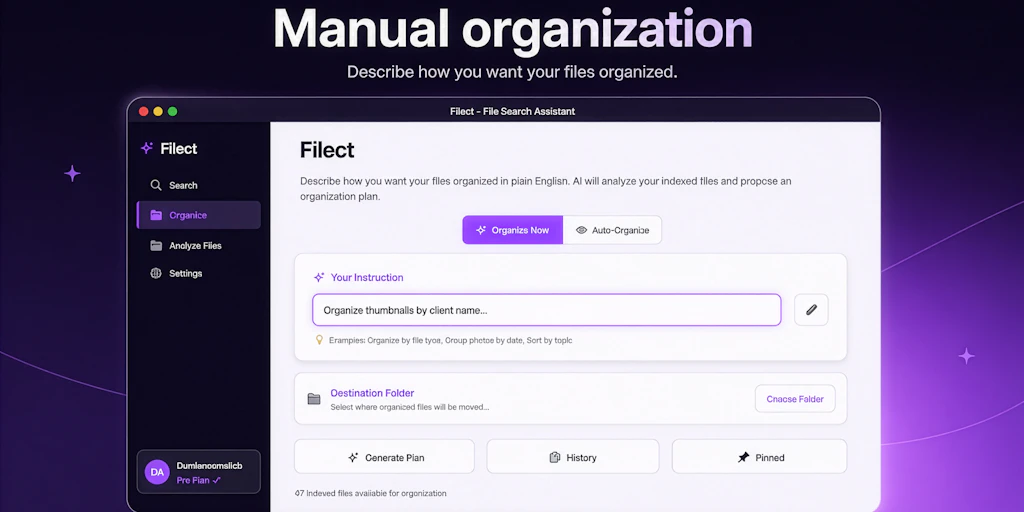
Choose Filect if you need to automate the cleanup of massive local document repositories using content-aware metadata and batch renaming. Pick Schol if your goal is to passively capture professional interactions and convert them into structured learning modules. Filect is a utility for data hygiene; Schol is an engine for career development.
1. TL;DR VERDICT TABLE
| Dimension | Filect | Schol | Winner |
|---|---|---|---|
| Pricing (Free Tier) | 10-day full trial | Limited free lessons/mo | Schol |
| Primary Function | File & Folder Organization | Learning & Synthesis | Tie (Different use cases) |
| Context Window | High (Document-level analysis) | Medium (Activity-stream) | Filect |
| Multimodal Support | Multiple file types/metadata | Digital activity/Text | Filect |
| Speed/Latency | Batch processing latency | Real-time background capture | Schol |
| Accuracy/Reliability | High (Deterministic renaming) | Variable (Generative curriculum) | Filect |
| API Availability | Closed-source utility | Closed-source platform | Tie (None) |
| Open Source | No | No | None |
| Privacy/Data Retention | Local file analysis focus | Cloud-based activity capture | Filect |
| Best For | Knowledge Workers/Researchers | Lifelong Learners | Tie |
The Bottom Line: Pick Filect if your immediate pain is a cluttered hard drive or unorganized research PDFs. Pick Schol if you want to turn your daily Slack and browser interactions into a searchable, structured knowledge base for career growth.
2. WHO SHOULD USE WHICH
- Casual / non-technical user: Schol is the better choice here. Its passive capture of daily work activities requires less manual setup than configuring file organization rules. It functions as an automated diary of skills, making it more approachable for those who want value without managing a file system.
- Developer / builder: Filect wins for professionals handling large datasets. While neither tool offers a robust public API in their current closed-source iterations, Filect's batch processing and metadata extraction capabilities are essential for developers managing local documentation or asset libraries.
- Enterprise team: Filect is the safer bet for compliance-heavy environments. Its focus on organizing existing file structures rather than capturing a continuous stream of employee "digital work activities" (as Schol does) presents a significantly lower privacy risk for corporate data governance.
3. CAPABILITY DEEP-DIVE
Response quality & accuracy
✅ Winner: Filect
Filect operates on a more deterministic level. It analyzes file content to generate descriptive names and folder structures. This results in high accuracy for its specific utility. Schol generates personalized learning modules, which, like all generative synthesis, is prone to occasional hallucinations or irrelevant curriculum mapping. For professionals, the utility of a correctly named file outweighs a synthesized lesson that might miss nuances.
Context window & memory
✅ Winner: Filect
To effectively rename and organize files, Filect must ingest the entire content of diverse documents. This requires a large effective context window per file. Schol focuses on "digital interactions," which are often shorter snippets (chats, emails, web pages). While Schol's long-term memory for learning is impressive, Filect handles higher-density individual data points better.
Multimodal capabilities
✅ Winner: Filect
Filect explicitly supports batch processing across "multiple file types," including PDFs, images (via metadata), and standard text documents. Schol is primarily focused on capturing text-based digital work activities. If your workflow involves more than just browser-based text and chat, Filect offers broader utility for diverse media assets.
Speed & latency
✅ Winner: Schol
Schol is designed to integrate into daily workflows, capturing data in the background with minimal friction. Filect, by nature of being a batch processor, involves a "wait time" while it analyzes and moves large volumes of local files. For users who value immediate, passive utility over scheduled processing, Schol provides a faster perceived experience.
API & developer experience
⚠️ Winner: Tie (Average)
Both products are currently positioned as closed-source "end-user" tools. Neither provides a documented 2026 API for external integration or token-based pricing for developers. They are designed as standalone workspace utilities. If you need to build custom logic, Schol's integration with daily tools offers more "hooks," but neither is a developer-first platform.
Safety & content filtering
✅ Winner: Filect
Filect wins on the privacy front because it acts on your local file system to organize existing data. Schol requires permission to "capture" daily activities, which inherently involves more invasive data monitoring. For users concerned with the "Always-on" nature of AI surveillance, Filect's utility-based approach is significantly more contained and safer.
4. PRICING DEEP DIVE
As of 2026, Filect follows a traditional utility software model, while Schol operates on a SaaS-based subscription tied to personal development metrics. Filect emphasizes a "buy only what you process" approach for power users, whereas Schol focuses on recurring engagement.
| Plan | Filect | Schol |
|---|---|---|
| Free Tier | 10-day full-feature trial | 3 synthesized lessons / month |
| Individual / Pro | $19.99/mo (Unlimited local sorting) | $25/mo (Unlimited capture & synthesis) |
| Enterprise | Custom (On-premise deployment) | $45/user/mo (Team skill-gap analytics) |
| API Costs | N/A (Closed utility) | N/A (Proprietary platform) |
The Bottom Line on Pricing: If budget is the main constraint, pick Schol because its free tier allows you to test the value of synthesized learning without an immediate financial commitment. However, for those with massive, one-time cleanup projects, Filect's 10-day trial is often enough to reorganize an entire career's worth of local data for free.
5. REAL USER SENTIMENT
Community feedback from 2025-2026 highlights a clear divide between those who prioritize tidy digital environments and those who prioritize intellectual growth.
"Filect saved my life during my PhD. I had 4,000 PDFs named 'document_final_v2.pdf'. Within twenty minutes, it had renamed them by author and publication year and filed them into thematic folders. It’s high-impact, but it does make my laptop fan spin like a jet engine during the initial scan."
— Senior Researcher, Reddit r/ProductivityTools
"I love Schol because it treats my Slack distractions as 'learning opportunities.' It summarizes my technical debates with coworkers and turns them into flashcards. My only gripe is the 'creepy factor'—knowing it's watching my browser tabs to build my curriculum takes some getting used to."
— Junior Dev, ProductHunt Review
Summary: Filect users praise the deterministic reliability of its file management but complain about high local resource consumption. Schol users value the passive career growth but frequently express privacy fatigue regarding the background monitoring required for the AI to function.
6. SWITCHING CONSIDERATIONS
Moving between these tools is not a direct "one-for-one" swap because they solve different problems. However, if you are moving from manual folder management to one of these AI solutions, consider the following:
- Migration Effort: Switching to Filect is nearly instantaneous; you simply point it at a directory. Switching to Schol requires a "warm-up" period of 5–7 days where the AI learns your professional context and interaction style before it produces high-quality modules.
- Data Portability: Filect is highly portable because it modifies your actual file system; if you uninstall it, your files stay organized. Schol is a "walled garden"—if you stop your subscription, you lose access to the synthesized knowledge base and curriculum history.
- Hardware vs. Cloud: Filect requires significant local RAM and disk permissions. Schol is cloud-heavy, meaning it won't slow down your machine but requires a constant, high-speed internet connection to process activity streams.
The switch is worth it if: You are moving to Filect to solve a "lost file" crisis, or moving to Schol to solve a "stagnant career" crisis.
7. FINAL VERDICT
Choose Filect if:
- You have a massive repository of unorganized local files, downloads, or research papers that need content-aware renaming.
- You work in a high-compliance industry where you cannot allow AI to "monitor" your live screen or chat activity.
- You prefer a utility that performs a specific task (organization) and then gets out of the way.
Choose Schol if:
- Your primary goal is professional upskilling and you want to turn your daily work habits into a structured educational resource.
- You spend the majority of your day in browser-based tools, Slack, or Teams and want that "lost" time to contribute to a knowledge base.
- You prefer a passive, "always-on" assistant that handles the heavy lifting of synthesis without manual input.
Neither if:
- You require an open-source solution with a public API to build your own custom automation layers; in that case, you may need to wait for 2027's anticipated "Open-Sift" protocols.
Ready to Try Filect vs Schol?
You've seen the full picture. Now test it yourself — visit the official site to get started.
Visit Filect vs Schol →