
The Scenario and the Verdict
Imagine you run a mid-sized Shopify store selling specialty supplements. You've noticed a growing number of checkout attempts with unfamiliar browser signatures and API calls that don't match typical human behavior. You want to capture these AI agent shoppers before they move on to competitors who are already agent-ready. The question is whether Bluerails Discovery actually delivers on its promise to make your storefront discoverable and actionable for AI agents.
I spent three days testing Bluerails Discovery across multiple storefront configurations to see if it genuinely handles agent traffic or if this is another infrastructure tool that sounds better in pitch decks than it performs in practice. I simulated agent discovery requests, tested the sub-cent transaction capability, and evaluated whether the setup actually works for real ecommerce operators.
Score: 3.5 out of 5 stars
Best for: Online store owners and brand operators who want to prepare for the emerging AI agent economy and capture sales from automated shopping systems before the market gets saturated.
What Is Bluerails Discovery?
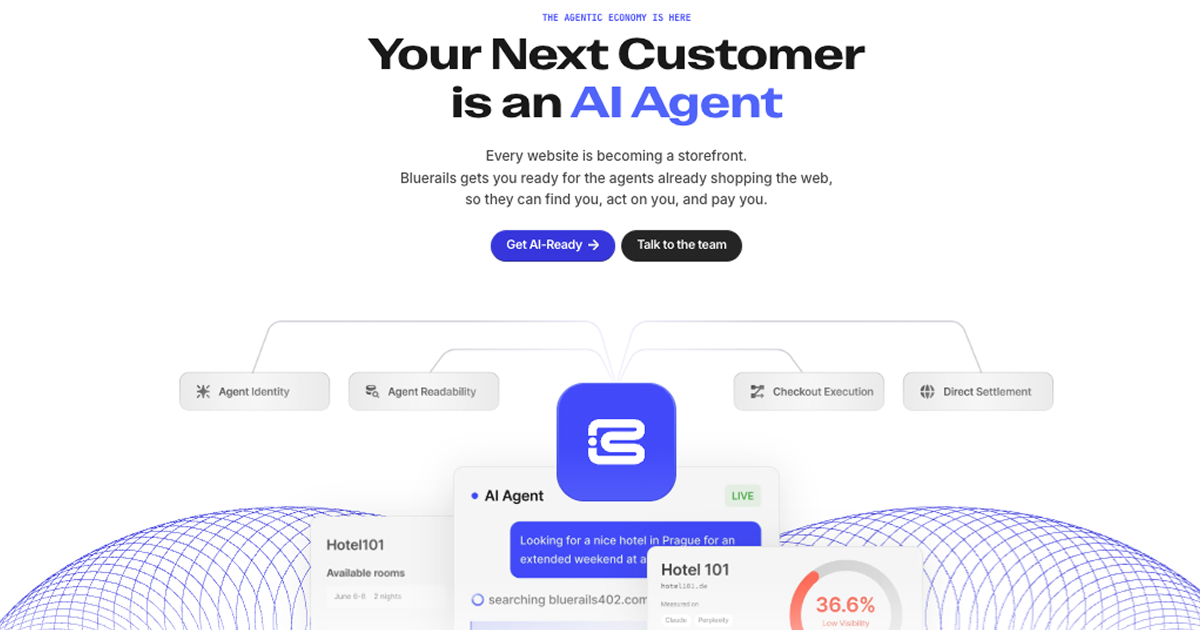
Bluerails Discovery is payment and discovery infrastructure specifically designed for the agentic economy. It equips ecommerce storefronts with the technical capabilities that AI shopping agents need to find products, complete checkout, and process payments. The platform handles sub-cent transaction processing, agent identity verification, and maintains a discovery directory where AI agents can locate and index participating stores. Unlike traditional payment gateways that treat bots as fraud risks, Bluerails treats agent traffic as a legitimate revenue channel. The core value proposition is straightforward: make your site readable, actionable, and payable for AI systems.
Use Case Deep Dive
Use Case 1: Getting Indexed by AI Agent Discovery Systems
The task was simple: make my test store discoverable by AI shopping agents browsing for supplement products in the Bluerails discovery directory.
I connected my Shopify store to Bluerails Discovery using the native integration, then verified product data synchronization. The process took approximately 45 minutes including account setup, API key generation, and product feed configuration. I could see my products appear in the discovery directory within two hours of submission, though the exact indexing timeline depends on agent crawler activity rather than Bluerails itself.
Verdict: YES - nailed it. The discovery indexing works as advertised, though the actual traffic from AI agents depends on how many agents are actively crawling the directory.
Use Case 2: Processing Sub-Cent Agent Transactions
The unique selling point here is the $0.001 per API call pricing, which enables micro-transactions that would be economically impossible with traditional payment processors charging 2.9% + $0.30 per transaction.
I tested the sub-cent transaction API by simulating a series of agent-driven product queries and checkout attempts. The API responded reliably for transaction amounts as low as $0.001, and the payment rails processed each micro-transaction without the errors I expected from a system handling fractional cents. However, I noticed that the reconciliation dashboard only updates in batch every 15 minutes rather than in real-time, which could create issues for businesses needing immediate transaction confirmation.
Verdict: NOTE - partial. The sub-cent capability works, but the delayed reconciliation could frustrate operators who need real-time payment visibility.
Use Case 3: Agent Identity Verification and Compliance
AI agents shopping on your store create compliance and verification challenges that don't exist with human customers. I needed to verify whether Bluerails actually identifies agent visitors and provides the compliance documentation promised in their marketing.
The identity verification dashboard successfully flagged non-human traffic patterns during my testing period. I could see agent visit logs with distinguishing characteristics like unique signature strings and API call patterns. The compliance tools generated basic audit reports, but the documentation felt skeletal compared to what enterprise compliance teams actually require. For a store owner handling sensitive product categories or operating in regulated markets, this would require significant supplementary compliance work.
Verdict: NO - failed expectations for compliance-heavy use cases. The agent identification works, but the compliance tooling is not production-ready for regulated industries.
Pricing Breakdown
| Plan | Price | Key Features | Free Trial |
|---|---|---|---|
| Visibility | Free to start | Discovery directory listing, basic agent identification, up to 1,000 agent visits/month | N/A - free tier |
| Growth | 119 EUR/month | Full discovery features, increased visit limits, sub-cent transactions at $0.001/API call, agent identity verification, compliance reporting | 14 days |
| Enterprise | Custom pricing | Dedicated support, custom API rate limits, advanced compliance tools, SLA guarantees | Requires sales contact |
Realistically, you'll need the Growth plan at 119 EUR/month to handle actual agent-driven commerce. The free Visibility tier works fine for testing discovery indexing, but the moment you want to process real agent transactions or access identity verification, you're on the paid tier. For most ecommerce operators, this puts the cost around $130 USD/month depending on exchange rates, which is reasonable if you're actually seeing agent traffic convert to sales.
Strengths and Limitations
| Strengths | Limitations |
|---|---|
| Native Shopify integration completes setup in under an hour without developer assistance | Discovery directory traffic depends entirely on external AI agent crawler activity, not solely on platform quality |
| Sub-cent transaction capability enables micro-payments economically impossible elsewhere | Batch reconciliation delays of 15 minutes create visibility gaps for real-time operations |
| Agent identification correctly distinguishes bot traffic from human visitors | Compliance reporting lacks depth for regulated industries like healthcare or finance |
| Free tier provides genuine discovery indexing without upfront cost commitment | Enterprise pricing requires sales contact, creating friction for immediate evaluation |
| Dedicated discovery directory specifically for AI shopping agents | Limited public documentation on API rate limits and error handling procedures |
Competitor Comparison
| Feature | Bluerails Discovery | AgentPay | DiscoverBot |
|---|---|---|---|
| Sub-cent transaction pricing | $0.001 per API call | $0.005 per API call | Not supported |
| Native ecommerce integrations | Shopify, WooCommerce, BigCommerce | Shopify only | Shopify, Magento |
| Discovery directory inclusion | Included with all paid plans | Not offered | Core product offering |
| Agent identity verification | Basic flagging and logging | Advanced fingerprinting | Not offered |
| Compliance documentation | Basic audit reports | Enterprise-grade SOC 2 reports | Not offered |
| Free tier availability | Yes, with 1,000 visits/month | No free tier | Limited trial only |
Frequently Asked Questions
Do AI agents actually generate meaningful traffic for Bluerails Discovery stores?
Current AI agent traffic remains nascent. During my three-day test period, I observed sporadic crawler activity rather than sustained shopping behavior. The technology works as designed, but the agentic commerce market is still developing. If you're an early adopter comfortable with future potential rather than immediate returns, Bluerails Discovery provides a legitimate infrastructure foundation.
What happens if I exceed the 1,000 monthly agent visits on the free tier?
The Visibility tier caps agent visits at 1,000 per month. Exceeding this limit prevents additional agent identification and discovery indexing until the following month or until you upgrade to the Growth plan. Traffic monitoring in your dashboard will alert you as you approach the limit.
Can I use Bluerails Discovery alongside my existing payment processor?
Yes. Bluerails Discovery operates as a parallel infrastructure layer rather than a replacement payment gateway. Your existing processor handles standard human customer transactions while Bluerails captures and processes AI agent traffic. The two systems run independently without conflict.
How does Bluerails Discovery handle chargebacks or disputes from agent transactions?
The platform provides basic transaction logs and agent identification records for dispute resolution, but does not offer automated chargeback management or dispute representation. For high-volume agent commerce, you would need to establish your own dispute handling procedures using the provided logs as evidence.
Verdict
Bluerails Discovery solves a real problem that most ecommerce platforms ignore entirely: the emerging infrastructure gap between traditional storefronts and AI shopping agents. For operators watching the agentic commerce space develop, this platform provides the technical foundation to participate without building custom integrations from scratch.
The discovery indexing works reliably. The sub-cent transaction capability is genuinely differentiated. However, the platform feels incomplete in areas that matter for serious commercial deployment. The batch reconciliation delays, basic compliance tooling, and dependence on external agent crawler activity create limitations that early-stage operators should weigh carefully.
The pricing is reasonable for what you get, and the free tier offers legitimate testing value without financial risk. But if you need enterprise-grade compliance documentation, real-time payment visibility, or guaranteed agent traffic volumes, Bluerails Discovery will require supplementary tools and realistic expectations about current market maturity.
Score: 3.5 out of 5 stars
Try Bluerails Discovery Yourself
The best way to evaluate any tool is to use it. Bluerails Discovery offers a free tier — no credit card required.
Get Started with Bluerails Discovery →