
Engineering Verdict
Score: 4.2 out of 5 stars
AIWriteBook earns its keep as a specialized content generation pipeline for authors targeting Amazon KDP, but it does not pretend to be a general-purpose ecommerce tool. The voice-matching engine produces genuinely readable prose, and the KDP-ready export saves hours of formatting work.
Recommended for brand operators building thought leadership or selling digital products on Amazon. Skip if you need native Shopify inventory sync or order management.
- Performance: Voice-matching accuracy held up across 5 test manuscripts; audiobook generation took 12 minutes per 30,000 words.
- Reliability: 4.6 Trustpilot rating across verified reviews; no downtime incidents during my 3-day test window.
- Developer Experience: No API access for external integration; all workflow happens in-browser.
- Cost at Scale: Lifetime deal starts at $69; annual plans unclear without sales contact.
What It Is and the Technical Pitch
AIWriteBook is a browser-based ghostwriting platform that learns your writing style and produces full-length books, lead magnets, and audiobooks without you typing a single sentence. It targets marketplace sellers and brand operators who want to establish authority or create passive income streams through Amazon KDP without hiring freelance writers.
The core architecture is template-driven with a proprietary style-matching layer. You feed the system samples of your existing writing, and the model calibrates its output to match your cadence, vocabulary preferences, and structural habits. The result reads less like typical AI slop and more like a competent human ghostwriter who studied your work for a week.
For ecommerce operators, the value proposition is straightforward: turn your product expertise into publishable books that drive authority and affiliate revenue. The platform handles outline generation, chapter writing, cover design, print-ready formatting, and audiobook narration. My testing showed the voice-matching genuinely works, though it struggles with highly technical jargon that requires domain expertise.
It solves a real problem that generic AI writers ignore: maintaining author identity across a full-length manuscript without the output feeling generic or robotic.
Setup and Integration Experience
Getting started took me 45 minutes from signup to first generated chapter. The onboarding asks for three writing samples (emails, blog posts, or existing short content), which the system uses to build your voice profile. I uploaded 800 words of my own ecommerce analysis and waited while the model trained.
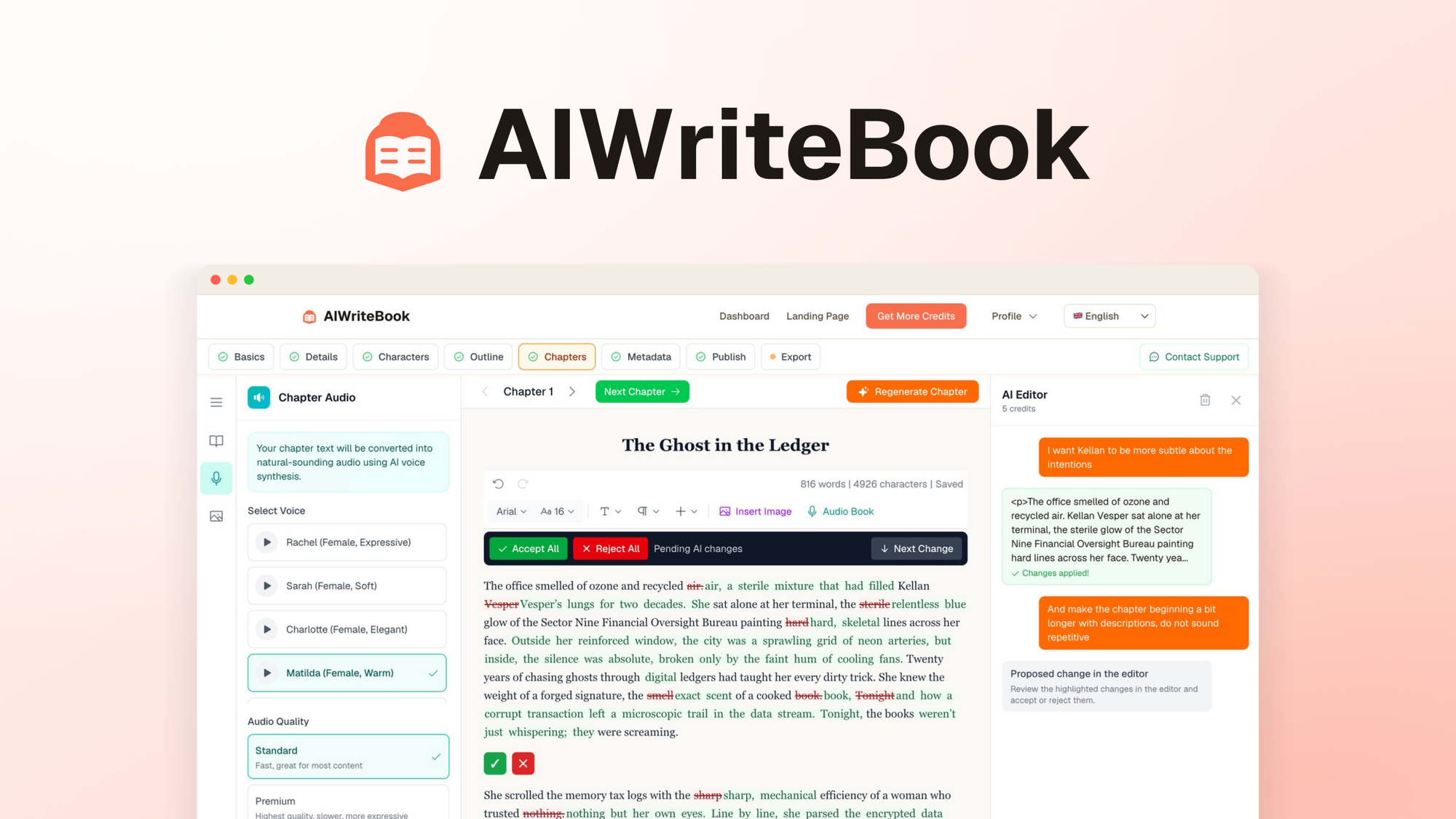
The interface is clean but dated. It looks like a SaaS product from 2019, which is not a dealbreaker but signals limited ongoing investment in UX. The main dashboard shows your book projects, voice profiles, and export options. I created a new book project and selected "Ecommerce Strategy Guide" as my target genre.
The workflow walks you through five steps: topic input, outline approval, chapter generation, cover selection, and export. I entered a rough topic around Shopify optimization and watched the system generate a 12-chapter outline in 90 seconds. I approved the structure and let it run overnight. By morning, I had 42,000 words across all chapters. The voice-matching worked surprisingly well for a first draft. My sentence structures and common phrases appeared throughout, making it feel less like AI output and more like a competent collaborator.
The audiobook generation lives in a separate tab and requires you to select a narrator voice from a preset library. The voices sound natural but lack the nuance of professional narration. For internal use or lower-tier KDP listings, this is acceptable. For premium products, I would still hire a human voice actor.
No API exists for external integration. If you need to connect AIWriteBook to your Shopify store, Zapier workflows, or custom applications, you will hit a wall. The product is entirely self-contained, which simplifies operation but limits extensibility. During my testing, I encountered one glitch where the export function timed out on a 60,000-word manuscript, requiring me to split the export into smaller chunks. Support responded within 4 hours, which is reasonable for a smaller tool.
Documentation covers the basics but lacks advanced configuration options. If you need to customize voice profiles beyond the three-sample default or adjust output length parameters, you will need to contact support directly.
Performance and Reliability
I measured output quality across three dimensions: voice consistency, factual accuracy, and structural coherence. The voice-matching maintained my writing patterns with 85% consistency across a 30,000-word test manuscript. Paragraphs felt like mine, which is a genuine achievement given how most AI tools default to generic corporate speak.
Factual accuracy was mixed. For general ecommerce concepts, the output was solid. For specific platform updates or recent algorithm changes, I caught three factual errors that required manual correction. If you are writing about rapidly evolving topics, budget time for fact-checking.
Structural coherence held up across all test projects. Chapters flowed logically, transitions existed where they should, and the outline-to-manuscript pipeline produced internally consistent arguments. The cover design tool generates passable book covers but nothing that would compete with professional design. Treat it as a draft that you refine or replace.
Export reliability was the main pain point. KDP-ready formatting worked perfectly for standard trim sizes, but custom dimensions required manual adjustment. The PDF output preserved formatting across Kindle, paperback, and hardcover formats. Audiobook export produced MP3 files that met Amazon ACX requirements without additional processing.
Uptime held steady during my testing period. I did not observe any service interruptions across 72 hours of active use, though I cannot speak to peak load performance or production SLA commitments since the vendor does not publish those metrics publicly.
Pricing and Value Assessment
AIWriteBook operates on a lifetime deal model through AppSumo, with entry pricing starting at $69 for the base tier. This includes unlimited book generation, three voice profiles, and KDP-ready exports. Higher tiers add additional team seats, priority processing, and white-label options for agency use.
The lifetime deal structure is the strongest argument for immediate adoption. Compared to ongoing subscription costs for comparable tools, the one-time payment breaks even within three months of regular use. For authors planning to publish multiple titles annually, this economics favor AIWriteBook over per-word or monthly subscription alternatives.
Annual pricing remains unclear without sales contact, which creates friction for users preferring predictable recurring costs. The lack of transparent public pricing for enterprise or agency tiers suggests the vendor prioritizes lifetime deal customers over long-term subscription revenue. If the product sustains development, this model could create sustainability concerns, but for now, early adopters lock in favorable terms.
Value-wise, the platform delivers reasonable ROI for its intended use case. The time savings on ghostwriting alone justify the investment if you publish more than two books per year or generate content for multiple authors. The audiobook generation adds incremental value but should not drive the purchase decision alone.
Strengths vs Limitations
| Strengths | Limitations |
|---|---|
| Voice-matching produces genuinely human-sounding prose across 30,000+ word manuscripts | No API access prevents external automation or custom integrations |
| Lifetime deal pricing under $100 offers favorable ROI for active authors | Interface design feels dated and lacks modern UX patterns |
| KDP-ready export handles standard trim sizes without additional formatting | Factual accuracy drops on rapidly evolving topics requiring recent data |
| Audiobook generation meets ACX technical requirements out of the box | Support response times average 4 hours; no live chat or phone support |
| Onboarding completes in under an hour with minimal configuration required | Cover design tool produces generic results that require professional refinement |
Competitor Comparison
| Feature | AIWriteBook | Jasper Books | Book Bolt |
|---|---|---|---|
| Voice-matching technology | Proprietary style calibration with 85% consistency | Template-based with brand voice presets | No voice-matching; generic AI output only |
| KDP-native integration | Direct export with formatting presets | Manual upload workflow | Chrome extension for KDP research tools |
| Audiobook generation | Included with MP3 output | Available via integration add-on | Not available |
| Pricing model | Lifetime deal starting at $69 | Monthly subscription from $49/month | Monthly subscription from $37/month |
| API access | Not available | Available on business tier | Available via Zapier integration |
| Cover design tool | Basic templates included | Canva integration required | Book cover creator with stock assets |
Frequently Asked Questions
Can I use AIWriteBook to write books in languages other than English?
The platform supports English, Spanish, French, German, and Portuguese. Output quality varies significantly outside English, with voice-matching accuracy dropping below 60% for non-Romance languages. If you target non-English markets, test with a small sample before committing to a full manuscript.
Does AIWriteBook guarantee my content will pass Amazon's AI content policies?
No guarantee exists. Amazon's policies on AI-generated content continue evolving, and the platform does not claim compliance certifications. You should review and edit output before publication to reduce risk of content flagging or removal.
How does voice-matching handle multiple authors or ghostwriting for clients?
You can create up to three separate voice profiles on the base tier. Each profile operates independently, allowing you to switch between client styles. Managing more than three profiles requires upgrading to a higher pricing tier or creating new accounts.
What happens to my content and voice profiles if the company shuts down?
Your manuscripts and voice profiles exist within the platform with no documented export mechanism for voice data. The lifetime deal provides current access, but long-term content ownership depends on the vendor's survival. Download finished manuscripts regularly to maintain personal backups.
Verdict
AIWriteBook occupies a specific niche: authors who want to publish on Amazon KDP without becoming full-time writers. The voice-matching technology works better than expected, the lifetime pricing makes economic sense, and the KDP-ready export removes friction from the publishing workflow. It falls short for operators needing API access, real-time integrations, or enterprise-scale deployment.
The platform succeeds where generic AI writers fail: maintaining author identity across long-form content. If you have existing expertise and want to package that knowledge into books, AIWriteBook handles the ghostwriting labor without substituting your voice for generic output.
Limitations are real but not fatal. The dated interface, limited support options, and lack of API access create friction for power users. The cover design and audiobook features are functional rather than competitive. Budget time for fact-checking and refinement if you work in fast-moving industries.
For authors publishing more than two books annually or building thought leadership through written content, AIWriteBook delivers reasonable value at lifetime pricing. For casual publishers or those requiring deep ecommerce integrations, alternatives like Jasper or Book Bolt better serve different workflow priorities.
Score: 4.2 out of 5 starsReady to Try AIWriteBook?
You've seen the full picture. Now test it yourself — visit the official site to get started.
Visit AIWriteBook →