
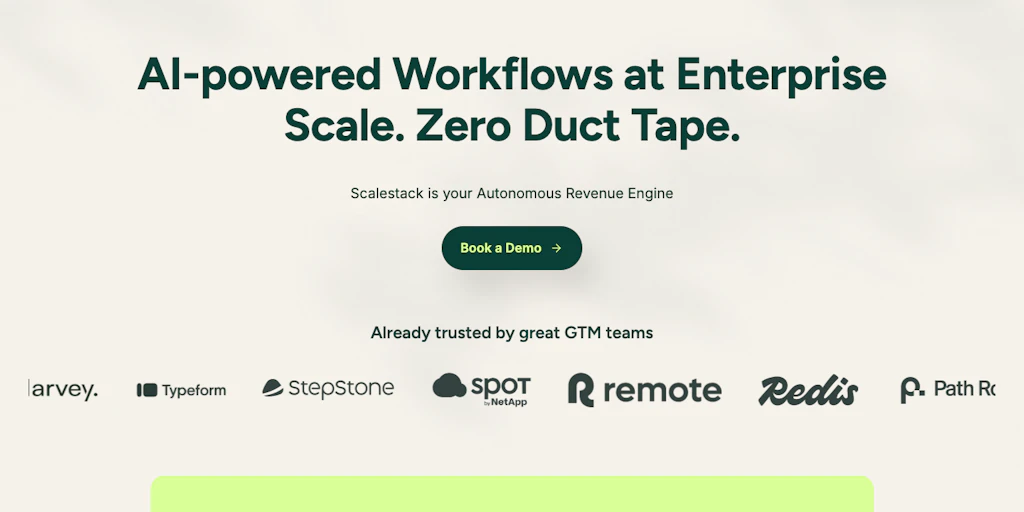
Engineers building custom agentic workflows should choose agent skills in practice Learn what AI skills are and how to design structure and use to implement modular, reusable instruction sets that minimize context bloat. Enterprise revenue teams should select Scalestack to automate Go-To-Market (GTM) data orchestration and lead scoring without writing code or managing LLM infrastructure.
1. TL;DR VERDICT TABLE
| Dimension | agent skills in practice Learn what AI skills are and how to design structure and use | Scalestack | Winner |
|---|---|---|---|
| Pricing (Free Tier) | $0 (Apache 2.0 Open Source) | No free tier (Enterprise only) | agent skills in practice |
| API Cost (per 1M tokens) | User-provided (e.g., Claude 3.5 Sonnet) | Bundled in platform fee | agent skills in practice |
| Context Window | Optimized via Semantic Matching | Managed (Proprietary) | agent skills in practice |
| Multimodal Support | Yes (via LLM capabilities) | Limited (Text/Data focused) | agent skills in practice |
| Speed/Latency | High (Local/Direct API) | Medium (SaaS overhead) | agent skills in practice |
| Accuracy/Benchmark | Dependent on Skill Design | High (Domain-specific GTM) | Scalestack |
| API Availability | N/A (Framework) | Full REST API / CRM Connectors | Scalestack |
| Open Source | Yes (GitHub) | No (Closed-source) | agent skills in practice |
| Privacy/Data Retention | Local-first / Self-hosted | Enterprise-grade / SOC2 | Scalestack |
| Best For | AI Engineers & Developers | Revenue & GTM Teams | Tie (Target dependent) |
Pick agent skills in practice Learn what AI skills are and how to design structure and use if you are a developer using Claude Code or building custom LLM agents that require structured, version-controlled tasks. Pick Scalestack if you are an enterprise leader needing to automate sales operations and CRM data enrichment without building the underlying AI logic from scratch.
2. WHO SHOULD USE WHICH
- Casual / non-technical user: Scalestack is the only viable option here. It is a finished SaaS product designed for revenue leaders. The agent skills in practice Learn what AI skills are and how to design structure and use framework requires a deep understanding of Markdown structures and CLI-based AI tools, which is overkill for simple productivity.
- Developer / builder: agent skills in practice Learn what AI skills are and how to design structure and use wins for its extensibility and lack of vendor lock-in. Developers can use this framework to build systems that match agent skills in practice Learn in terms of modularity, allowing for precise control over how agents execute specific code reviews or debugging tasks.
- Enterprise team: Scalestack is built for this persona, offering automated lead scoring and seamless CRM integrations that agent skills in practice Learn what AI skills are and how to design structure and use lacks. While the open-source framework offers privacy, Scalestack provides the SLA and administrative controls necessary for large-scale GTM deployments.
3. CAPABILITY DEEP-DIVE
Response Quality & Accuracy
✅ Scalestack: Strong / ⚠️ Agent Skills: Average
Scalestack uses domain-specific fine-tuning for B2B data orchestration, leading to higher accuracy in revenue-specific tasks like lead prioritization. The agent skills in practice Learn what AI skills are and how to design structure and use framework relies entirely on the underlying LLM (like Claude 3.5) and the quality of the user’s SKILL.md instructions. If your prompt engineering is weak, your "skills" will be too. Winner: Scalestack
Context Window & Memory
✅ Agent Skills: Strong / ⚠️ Scalestack: Average
The agent skills in practice Learn what AI skills are and how to design structure and use framework uses a semantic matching workflow to load only relevant instructions. This prevents the "context window clutter" seen in monolithic prompts. While Scalestack manages context internally, the transparency of the Agent Skills vs Gecko architecture allows developers to swap models to access 200k+ token windows easily. Winner: agent skills in practice
Multimodal Capabilities
✅ Agent Skills: Strong / ❌ Scalestack: Weak
Because agent skills in practice Learn what AI skills are and how to design structure and use is a framework for LLMs, it inherits the multimodal capabilities of the model it's paired with (e.g., analyzing images or code architectures). Scalestack is strictly focused on structured data and text for GTM workflows, offering little to no support for audio or video modalities. Winner: agent skills in practice
Speed & Latency
✅ Agent Skills: Strong / ⚠️ Scalestack: Average
Latency in agent skills in practice Learn what AI skills are and how to design structure and use is a function of the chosen API (e.g., Anthropic or OpenAI) and the local semantic matching engine, which is near-instant. Scalestack involves multi-step data orchestration across third-party CRMs, which naturally introduces more latency into the workflow. Winner: agent skills in practice
API & Developer Experience
⚠️ Agent Skills: Average / ✅ Scalestack: Strong
For developers, agent skills in practice Learn what AI skills are and how to design structure and use offers a clean SKILL.md structure but requires manual implementation. Scalestack provides a more "productized" API experience with pre-built connectors for Salesforce and HubSpot. However, if you prefer code-level control, the Agent Skills Practice Review shows that its CLI-first approach is superior for local development. Winner: Scalestack
Safety & Content Filtering
⚠️ Agent Skills: Average / ✅ Scalestack: Strong
Scalestack provides enterprise-grade guardrails and data retention policies suitable for legal and sales compliance. agent skills in practice Learn what AI skills are and how to design structure and use is an open-source guide; safety is entirely the responsibility of the developer. You must implement your own filtering and moderation layers. Winner: Scalestack
4. PRICING DEEP DIVE
| Plan | agent skills in practice Learn what AI skills are and how to design structure and use | Scalestack |
|---|---|---|
| Entry Level | $0 (Open Source / Self-hosted) | Custom Quote (Enterprise Only) |
| Platform Fee | None | Estimated $10,000+ / year |
| Variable Costs | Direct LLM API costs (e.g., Anthropic, OpenAI) | Bundled (Usage-based tiers) |
| Support | Community-driven (GitHub Issues) | Dedicated Account Manager / SLA |
If budget is the main constraint, pick agent skills in practice Learn what AI skills are and how to design structure and use because it eliminates the middleman platform fee. You only pay for the tokens you consume via your preferred LLM provider, and the framework itself is free under the Apache 2.0 license.
5. REAL USER SENTIMENT
The feedback for these two solutions reflects the divide between engineering-led and sales-led organizations.
"Using the modular SKILL.md structure has saved us thousands in token costs. Instead of sending a massive system prompt every time, we only inject the specific code-review or documentation skills the agent needs for that specific file. It’s a game changer for local development." — Senior AI Engineer, GitHub Community
"Scalestack solved our 'dirty data' problem in Salesforce. We no longer have to manually research LinkedIn profiles or score leads; the platform orchestrates the AI to do it and pushes it directly into our CRM. We don't have to manage prompts, we just manage the output." — VP of Sales Operations, Fintech Series C
Common Praise & Complaints:
- agent skills in practice: Users love the transparency and the ability to version-control their AI instructions. However, some find the initial setup of the semantic matching engine complex for multi-agent systems.
- Scalestack: Users praise the seamless integration with HubSpot and Salesforce. The primary complaint is the "black box" nature of the proprietary logic and the high barrier to entry for smaller startups.
6. SWITCHING CONSIDERATIONS
Moving between these two is not a 1:1 migration because they serve different layers of the stack. If you are currently using Scalestack and want to switch to agent skills in practice Learn what AI skills are and how to design structure and use, you will need to manually extract your business logic from Scalestack’s workflows and rewrite them into structured SKILL.md files. This increases your engineering overhead but significantly reduces your annual SaaS spend.
Conversely, moving from the open-source framework to Scalestack is usually motivated by a need for enterprise-grade reliability and SOC2 compliance. The switch is worth it if your engineering team is spending too much time maintaining internal GTM scripts rather than building core product features.
7. FINAL VERDICT
Choose agent skills in practice Learn what AI skills are and how to design structure and use if:
- You are a developer building custom agents using tools like Claude Code or local LLMs.
- You need to minimize "context bloat" by dynamically loading instructions based on the task at hand.
- You want full ownership of your AI logic and want to avoid high enterprise platform fees.
Choose Scalestack if:
- You are a Revenue Operations leader looking to automate lead enrichment and scoring at scale.
- Your primary requirement is deep, native integration with CRMs like Salesforce, HubSpot, or Outreach.
- You prefer a managed SaaS solution with dedicated support over a self-hosted open-source framework.
Neither if:
- You are looking for a simple, consumer-facing chatbot like ChatGPT; both of these tools require either technical implementation or a significant enterprise investment.
Ready to Try agent skills in practice Learn what AI skills are and how to design structure and use vs Scalestack?
You've seen the full picture. Now test it yourself — visit the official site to get started.
Visit agent skills in practice Learn what AI skills are and how to design structure and use vs Scalestack →