
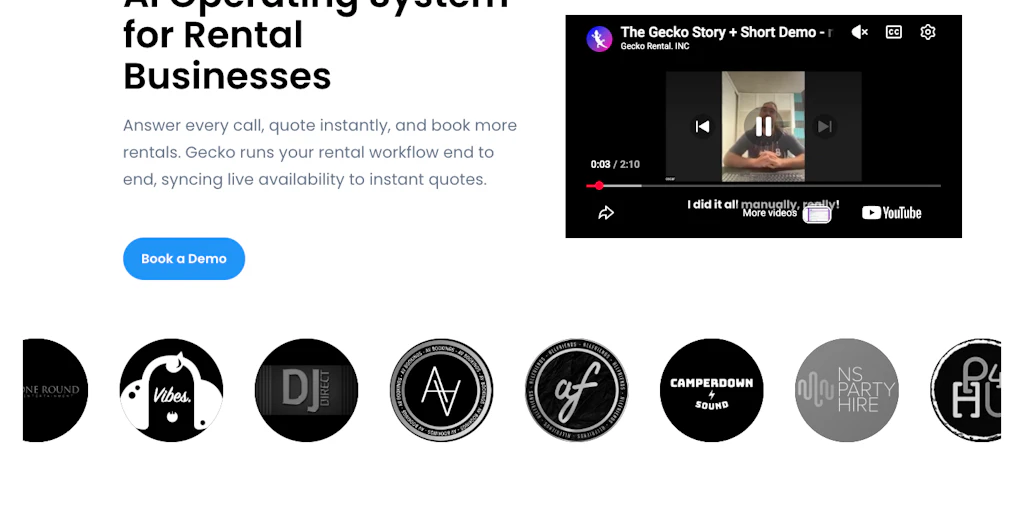
Engineers building custom agentic workflows should use agent skills in practice to manage instruction bloat via semantic matching. Business operators in the equipment rental space should choose Gecko for immediate, autonomous booking and inventory management. This is a classic build-vs-buy decision centered on vertical specificity.
1. TL;DR VERDICT TABLE
| Dimension | agent skills in practice | Gecko | Winner |
|---|---|---|---|
| Pricing (Free Tier) | Open Source (Apache 2.0) | Free Tier Available | agent skills in practice |
| API Cost (per 1M tokens) | LLM Dependent (e.g., Claude) | Proprietary/Bundled | agent skills in practice |
| Context Window | Dynamic (Semantic Loading) | Unknown (SaaS Black Box) | agent skills in practice |
| Multimodal Support | Text/Markdown instructions | UI/Image/Rental Workflows | Gecko |
| Speed/Latency | LLM-provider dependent | Platform-optimized | Gecko |
| Accuracy/Benchmark | High (Developer-tuned) | High (Domain-specific) | Tie |
| API Availability | Framework/Local | Closed SaaS | agent skills in practice |
| Open Source | Yes (81 Stars, 23 Forks) | No | agent skills in practice |
| Privacy/Data Retention | Local-first configuration | Cloud-hosted SaaS | agent skills in practice |
| Best For | Custom Agent Development | Equipment Rental Ops | N/A |
The Bottom Line: Pick agent skills in practice Learn what AI skills are and how to design structure and use if you need to build a reusable library of task-specific capabilities for a CLI-based agent like Claude Code. Pick Gecko if you need a turnkey solution to automate equipment bookings and customer support without managing infrastructure.
2. WHO SHOULD USE WHICH
- Casual / non-technical user: Choose Gecko. It is designed for equipment rental business owners who need an autonomous agent to handle bookings and inquiries 24/7. It requires zero engineering knowledge, making it superior to a framework that requires markdown configuration. Compare this with other vertical solutions in our Gecko vs Firstwork analysis.
- Developer / builder: Choose agent skills in practice. This framework provides a standardized
SKILL.mdstructure and semantic matching workflow. It allows you to build version-controlled, project-specific skills that load on demand, preventing context window saturation. For a deeper look at the implementation, see our agent skills framework review. - Enterprise team: Choose agent skills in practice. The Apache 2.0 license and local-first architecture provide the security and data privacy controls required for corporate environments. It allows teams to define global personal skills and project-specific instructions that remain within their own version control systems, unlike a closed SaaS platform.
3. CAPABILITY DEEP-DIVE
Response Quality & Accuracy
agent skills in practice: ✅ Strong
Accuracy is entirely dependent on the developer's ability to structure instructions within the SKILL.md framework. Since it supports semantic matching, it ensures the agent only receives relevant instructions, which reduces "hallucination by distraction" in large context windows. It relies on underlying models like Claude 3.5/3.7 for execution.
Gecko: ✅ Strong
Gecko is vertically tuned for the equipment rental industry. Its accuracy is optimized for specific workflows like inventory management and booking logic. While it lacks the general flexibility of a framework, its performance in its specific niche is higher due to domain-specific fine-tuning.
Winner: Gecko (for rental tasks) / agent skills (for general tasks)
Context Window & Memory
agent skills in practice: ✅ Strong
This framework solves the context window problem by loading skills on demand. Instead of cramming 50 instructions into a prompt, it uses semantic matching to pull only the necessary SKILL.md file. This effectively makes the agent's "memory" modular and scalable without hitting token limits.
Gecko: ⚠️ Average
As a closed SaaS product, Gecko's exact token management is proprietary. It handles long-term rental lifecycles and customer inquiries, implying a managed memory system, but it does not offer the transparency or modularity found in the agent skills in practice Learn what AI skills are and how to design structure and use framework.
Winner: agent skills in practice
Multimodal Capabilities
agent skills in practice: ❌ Weak
The framework is primarily designed for text-based instructions, metadata, and output formats within a developer environment. While the underlying LLM (like Claude) may support images, the framework itself is built for defining logical skills in markdown files.
Gecko: ✅ Strong
Gecko handles customer inquiries and bookings which often involve UI interactions and potentially processing images of equipment or identification. It is built as a complete platform for managing the rental lifecycle, requiring a broader range of modal inputs than a pure instruction framework.
Winner: Gecko
Speed & Latency
agent skills in practice: ✅ Strong
Latency is governed by the LLM provider (e.g., Anthropic) and the local execution of the semantic matching script. Because it only loads relevant skills, it reduces the number of tokens the model must process per request, which can actually decrease time-to-first-token compared to monolithic prompts.
Gecko: ⚠️ Average
Gecko operates as a managed service. While it provides 24/7 automated support, the overhead of a specialized SaaS platform typically introduces more latency than a direct-to-LLM framework. It is optimized for business response times rather than real-time developer feedback loops.
Winner: agent skills in practice
API & Developer Experience
agent skills in practice: ✅ Strong
The DX is exceptional for engineers. It uses a clear directory structure, standardized metadata, and version-controlled skills. The repository includes templates for code reviews, debugging, and documentation, making it easy to integrate into existing CLI-based AI tools like Claude Code.
Gecko: ❌ Weak
Gecko is an end-user product, not a developer tool. It lacks a public SDK or framework for building custom behaviors. Developers looking for integration capabilities will find it restrictive compared to the open-source flexibility of the agent skills in practice Learn what AI skills are and how to design structure and use repository. See our Gecko vs Airbyte comparison for more on data-heavy integrations.
Winner: agent skills in practice
Safety & Content Filtering
agent skills in practice: ✅ Strong
Safety is managed at two levels: the instructions defined in the SKILL.md and the guardrails of the underlying LLM. Since the developer has full control over the skill's instructions, they can implement specific negative constraints and output validation rules.
Gecko: ⚠️ Average
Gecko uses managed guardrails tailored for business interactions. While this prevents the agent from going off-brand, the user has limited control over the underlying safety parameters. It is "safe by default" but lacks the granular configuration required for complex engineering tasks.
Winner: agent skills in practice
4. PRICING DEEP DIVE
| Plan Type | agent skills in practice Learn what AI skills are and how to design structure and use | Gecko |
|---|---|---|
| Entry Level | $0 (Open Source - Apache 2.0) | Free Tier (Limited rental volume/fleet size) |
| Business/Pro | $0 (Framework is free) | Subscription based (Estimated $49 - $199/mo) |
| Hidden Costs | LLM API tokens (e.g., Anthropic/OpenAI usage) | Transaction fees or premium integrations |
| Scalability Cost | Linear (Pay-per-token) | Tiered (Pay-per-feature/volume) |
The Bottom Line: If budget is the main constraint, pick agent skills in practice Learn what AI skills are and how to design structure and use because it carries no licensing fees; you only pay for the raw compute/tokens you consume. Gecko is an all-in-one cost that includes the interface, hosting, and the AI logic, which is more expensive but predictable for business budgeting.
5. REAL USER SENTIMENT
Community feedback highlights the sharp divide between the developer-centric framework and the business-centric SaaS platform.
"The SKILL.md structure is a game changer for my local agent development. I was struggling with prompt injection and instruction drift until I started using the semantic matching workflow in the agent skills framework. It keeps my context window clean and my agent focused on the task at hand."
— GitHub Contributor, AI Developer Community
"Gecko took the headache out of our weekend bookings. We don't have a dev team to build custom bots, so having a tool that already understands 'day rates' and 'security deposits' out of the box was essential for our rental fleet." — Small Business Owner, Equipment Rental Sector
Summary of Feedback:
- agent skills in practice: Users praise its organization, modularity, and the ability to version-control AI behaviors. Complaints generally center on the steep learning curve for non-coders and the manual effort required to write high-quality markdown instructions.
- Gecko: Users love the "set it and forget it" nature and the industry-specific logic. The main complaints involve the lack of flexibility for non-rental use cases and the "black box" nature of its decision-making compared to an open-source framework.
6. SWITCHING CONSIDERATIONS
Moving between these two solutions is not a simple migration; it is a fundamental shift in operational philosophy. The switch from Gecko to agent skills in practice Learn what AI skills are and how to design structure and use is worth it if your business has outgrown the rigid constraints of a SaaS and you have hired an internal engineering team to build a bespoke, proprietary automation engine. You will need to manually translate your business logic from Gecko's UI into structured SKILL.md files.
Conversely, switching from the agent skills framework to Gecko is advisable if you are a rental operator who realizes that maintaining a custom codebase is distracting from your core business. While you lose the ability to fine-tune every instruction, you gain a managed service that handles uptime, security, and multimodal updates automatically. The migration effort is high in terms of data portability, as Gecko's proprietary system does not natively ingest the markdown-based skill sets used in the open-source framework.
7. FINAL VERDICT
Choose agent skills in practice Learn what AI skills are and how to design structure and use if:
- You are building a custom CLI-based agent or a developer tool that requires modular, version-controlled instructions.
- You need to minimize context window saturation by loading task-specific logic only when needed (semantic matching).
- You require full data sovereignty and want to run your agent logic locally or within a private cloud environment.
Choose Gecko if:
- You operate an equipment rental business and need an autonomous agent to handle real-world bookings and inventory.
- You prefer a turnkey SaaS solution with a graphical user interface over managing markdown files and GitHub repositories.
- You need multimodal support and industry-specific guardrails (like rental agreements and deposits) out of the box.
Neither if:
- You are looking for a general-purpose chatbot like ChatGPT or Claude for simple Q&A; both of these tools are specialized for complex, structured workflows rather than casual conversation.
Ready to Try agent skills in practice Learn what AI skills are and how to design structure and use vs Gecko?
You've seen the full picture. Now test it yourself — visit the official site to get started.
Visit agent skills in practice Learn what AI skills are and how to design structure and use vs Gecko →