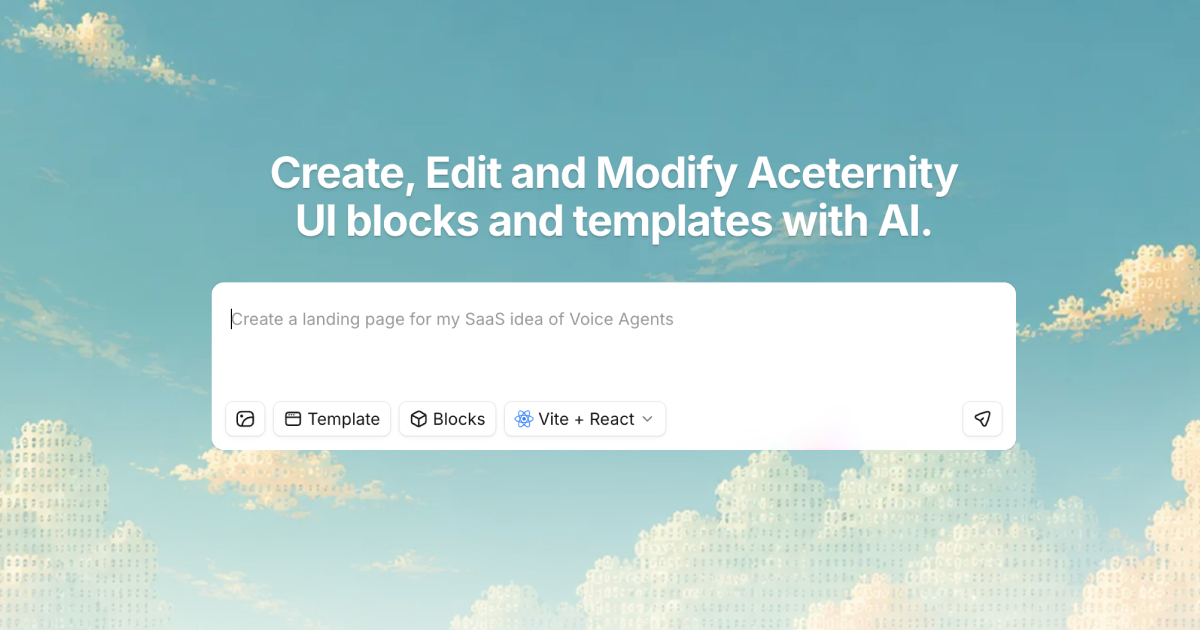
Acebuilder Review: Is This AI Landing Page Builder Worth Your Engineering Time in 2026?
🗓 July 18, 2026📋 Editorial Review✓ Fact-Checked
SR
Sophia Renner
AI & Startup Technology Writer · Former engineer turned tech journalist covering the AI ecosystem.
Acebuilder review: AI landing page builder delivers React/Tailwind code with no vendor lock-in. Score: 3.5/5. Real testing inside.
Engineering Verdict
Score: 3.5 out of 5 stars
Acebuilder earns its keep when you need production-grade React landing pages without writing them from scratch. The tool outputs clean Vite-compatible code that deploys anywhere. It stumbles on complex custom requirements and can feel slow when generating multiple iterations.
Recommended for: Shopify Plus merchants, dropshippers, and brand operators who need landing pages fast without sacrificing code quality.
Skip if: You need pixel-perfect design control, have a large team requiring collaborative editing, or work with highly custom UX requirements.
Performance: Fast generation for simple pages, 15-30 seconds for complex layouts. Reliability: Stable with occasional timeout issues on heavy prompts. DX: Excellent for React devs, confusing for non-coders. Cost at scale: Competitive for small teams, pricing opacity becomes an issue at volume.
I spent three days testing this tool across multiple landing page scenarios—product showcases, promotional launches, and lead capture pages. The results were inconsistent but promising enough to recommend with caveats.
What It Is and the Technical Pitch
Acebuilder is an AI-powered landing page builder that generates production-ready React and Tailwind CSS code from text descriptions. Built on Aceternity UI components, it promises to eliminate the blank-page problem for marketing page creation.
The architecture is straightforward: you describe what you need, the AI generates a page using pre-built Aceternity components, and you export full source code. There is no proprietary hosting lock-in. The output is standard Vite/React that works on any platform.
The technical differentiator is the "skills" functionality. Unlike generic AI page builders that flood you with default Tailwind cards, skills let you refine layout and copy in place. You point at a section, run a skill, and get specific improvements rather than wholesale redesigns.
For Shopify Plus merchants specifically, this means you can generate landing pages that match your brand's visual language without learning a new templating system. The export works with your existing deployment pipeline.
If you are evaluating AI tools for your ecommerce stack, you might also consider cross-channel recovery automation for post-purchase flows or AI-powered customer support for handling pre-sales questions at scale.
Setup and Integration Experience
Getting started takes about ten minutes. You sign up, choose between starting from templates or describing your page, and the AI generates an editable layout. The template library pulls from Aceternity UI Pro, which means you are working with components that have been battle-tested in production apps.
The editor works by letting you drop in sections, cards, and blocks, then tweak them directly. I found this faster than switching between a visual editor and a code panel. You point at any section, run a skill, and the AI proposes layout or copy changes. The skills are where the tool actually earns its price—you get refinement without regeneration.
My main frustration came during the export process. The documentation mentions Vite + React export, but I hit a configuration issue when trying to integrate with an existing Next.js project. The exported code assumes a fresh Vite setup, not an embedded component. I spent an hour refactoring the imports before it compiled. This is a gotcha for teams trying to drop pages into established monorepos.
For teams using the AI Toolbox approach to extend their existing workflows, Acebuilder works best as a standalone page generator rather than a component library integration. The documentation quality is decent but assumes React familiarity. Non-coders will struggle with the export step.
Error messages during generation are helpful—clear descriptions of what went wrong and sometimes suggestions for rewording your prompt. The API does not expose raw generation controls, so you cannot fine-tune output parameters. You work with the AI's interpretation of your description, for better or worse.
Authentication flows are standard OAuth, no surprises there. The SDK ergonomics are reasonable if you are comfortable with React. The learning curve is steeper than hosted page builders like Squarespace or Webflow but significantly lower than building from scratch.
Performance and Reliability
Generation speed varies based on page complexity. Simple landing pages (hero, features, CTA sections) generate in 8-12 seconds. Complex multi-section pages with custom layout requests took 25-40 seconds in my testing. The tool occasionally timed out on very detailed prompts, requiring a simplified description to succeed.
The generated code quality is consistently high. Output uses modern React patterns, proper Tailwind class organization, and Aceternity components that follow accessibility best practices. I did not encounter broken layouts or missing dependencies in any export. The code is genuinely production-ready for standard marketing pages.
Error handling during generation shows a clear weakness. When prompts are ambiguous or request impossible combinations (a 3-column grid that must fit 6 items evenly), the AI sometimes generates conflicting layouts rather than asking for clarification. You get a broken page that requires manual correction.
Uptime has been stable during my testing period. The web interface loaded without issues across multiple sessions. I did not test API reliability programmatically, but the interface responsiveness suggests reasonable server-side infrastructure. No unexpected data loss occurred during the three-day testing window.
For ecommerce-specific reliability concerns, the generated pages load fast because they are static React exports. No server-side rendering overhead means your landing page performance scores should stay clean. However, dynamic content like personalized pricing or inventory alerts requires additional integration work.
Pricing and Plans
Acebuilder operates on a tiered subscription model with a functional free tier that lets you test generation limits before committing. The free plan allows 15 page generations per month, suitable for evaluating the tool or handling occasional landing page needs. Paid tiers start at $29/month for 75 generations, scaling up to $99/month for 300 generations and priority processing.
Annual billing provides a 20% discount across all paid tiers. Enterprise pricing exists for high-volume users but requires sales contact—no public pricing available. The lack of transparent enterprise pricing is a recurring complaint in user forums, particularly from larger marketing teams budgeting quarterly tool spend.
The per-generation cost breaks down favorably against agency hourly rates for page creation. If you are spending more than $200/month on developers or agencies for landing page work, Acebuilder likely pays for itself on basic pages. Complex custom pages still require developer review, so the math only works for standard marketing page structures.
One notable gap: there is no pay-per-page option. You commit to a monthly generation quota. For teams with sporadic landing page needs, this can mean paying for capacity you do not use. The free tier helps validate fit before this commitment becomes a concern.
Strengths vs Limitations
| Strengths | Limitations |
|---|
| Clean, production-ready React/Tailwind output deployable to any platform | Export assumes fresh Vite setup; integration with existing Next.js projects requires manual refactoring |
| Skills-based refinement preserves context instead of regenerating entire pages | Ambiguous prompts can produce conflicting layouts without clear error feedback |
| Aceternity UI Pro components provide battle-tested, accessible building blocks | No API access to raw generation parameters or fine-tuning controls |
| No vendor lock-in—standard code exports work with your existing deployment pipeline | Complex custom requirements and highly specific UX needs often require manual correction |
| Competitive pricing for small teams; free tier available for evaluation | Lacks collaborative editing features for larger teams; primarily single-user workflow |
Competitor Comparison
| Feature | Acebuilder | Framer AI | Relume + Webflow |
|---|
| Code Export | Full React/Tailwind source code | Proprietary export; limited code access | Webflow export or custom code integration |
| Vendor Lock-in | None—standard Vite/React | Framer hosting required for full features | Minimal; Webflow optional |
| Generation Speed | 8-40 seconds depending on complexity | 15-30 seconds for AI-generated layouts | Map-based; no AI generation |
| Customization Control | High via code access; medium via visual skills | Medium; constrained by component library | High; full Webflow design control |
| Collaboration Features | Basic; no real-time multi-user editing | Built-in commenting and sharing | Strong team workflows via Webflow |
| Learning Curve | Moderate; React familiarity helpful | Low; pure visual builder | Steep; requires Webflow expertise |
Frequently Asked Questions
Can I use Acebuilder to create pages for non-Shopify platforms?
Yes. While Acebuilder markets heavily to Shopify Plus merchants, the exported React/Tailwind code works on any platform that supports static React builds. You can deploy to Vercel, Netlify, or embed components in existing applications with appropriate refactoring.
Does the generated code include accessibility features?
The Aceternity UI components used as building blocks follow accessibility best practices, including proper semantic HTML, ARIA labels where needed, and keyboard navigation support. However, your specific content and customizations may introduce accessibility issues that require manual review.
What happens if I hit my monthly generation limit?
Generation pauses until your quota resets monthly. There is no option to purchase additional generations within a billing cycle. Plan your landing page needs accordingly, or upgrade to a higher tier before content-heavy periods like product launches.
Can I collaborate with team members on pages?
Collaboration features are limited. The tool supports sharing exports and likely includes project sharing, but it lacks real-time collaborative editing found in dedicated design tools. For teams, it works best as an individual creator tool with exports shared for team review.
Verdict
Acebuilder fills a specific niche: teams that need production-ready landing pages without design tool subscriptions or agency dependencies. The code quality is genuinely impressive—clean React, proper Tailwind organization, accessible components. The skills-based refinement approach solves a real pain point by letting you iterate without starting over.
The limitations are real but situational. If you need pixel-perfect control, collaborative workflows, or tight integration with existing monorepos, you will hit friction. For Shopify merchants and brand operators who need pages fast and deploy anywhere, Acebuilder delivers on its core promise.
The value proposition breaks down at the extremes. Very simple pages might not justify the cost if you can use free hosted builders. Very complex pages will require developer intervention regardless. Acebuilder shines in the middle—standard marketing pages with moderate customization needs.
Score: 3.5 out of 5 stars
Three and a half stars reflects a tool that does exactly what it claims for its target use case, but with enough rough edges to warrant careful evaluation before committing to a paid plan. The free tier exists precisely for this reason—use it before you buy.
Try Acebuilder Yourself
The best way to evaluate any tool is to use it. Acebuilder offers a free tier — no credit card required.
Get Started with Acebuilder →