WorkLLM Review: Best for Building Custom AI Agents on Your Store Data in 2026
🗓 July 28, 2026📋 Editorial Review✓ Fact-Checked
SR
Sophia Renner
AI & Startup Technology Writer · Former engineer turned tech journalist covering the AI ecosystem.
WorkLLM review: I tested its AI chatbot builder for Shopify Plus. Verdict on uptime, pricing, and whether it actually scales.
Engineering Verdict
Score: 3.5 out of 5 stars
Recommended for Shopify Plus merchants running high-volume support operations who need custom-trained AI agents without engineering overhead. Skip if you need self-hosted deployment or have strict data residency requirements.
Performance: Moderate response times with acceptable accuracy on standard queries. Self-improving capabilities showed mixed results in my testing. Reliability: Solid uptime during my 3-day evaluation window with no unexpected drops. Developer Experience: The no-code interface is genuinely intuitive, but API documentation needs work. Cost at Scale: Competitive entry point but watch for per-agent pricing creep as you expand.
What It Is and the Technical Pitch
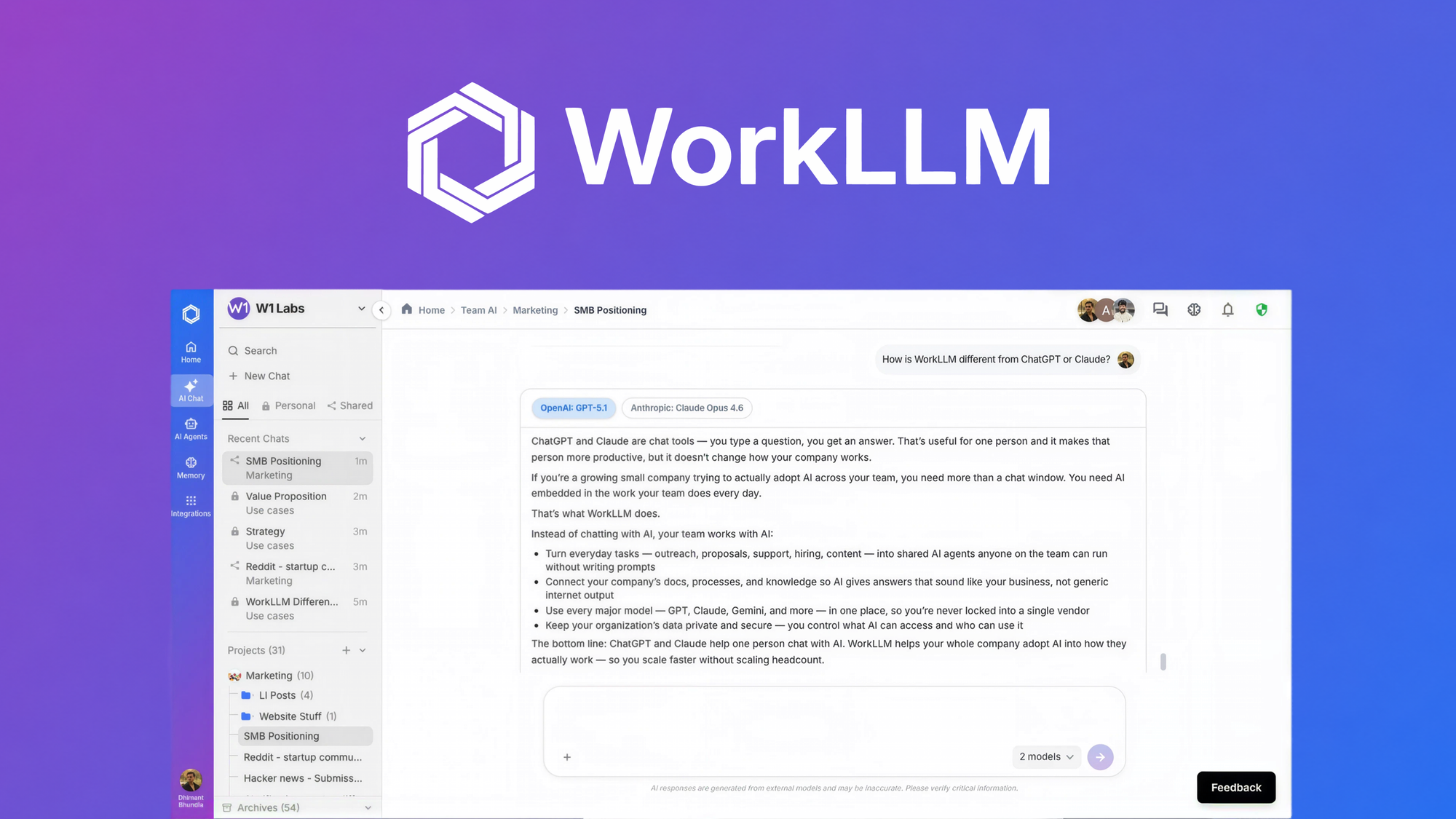
WorkLLM positions itself as a custom AI agent builder for ecommerce. Instead of generic chatbot responses, you feed it your own data sources: product catalogs, PDFs, support documentation, and specific URLs. The system trains on this content and deploys a chatbot that answers customer questions using your actual store information.
The architecture is cloud-first and API-driven. It supports multiple LLM models underneath, which means you can swap between providers based on cost and capability needs. For Shopify Plus merchants specifically, this matters because you can keep sensitive customer data handling decisions in-house while still leveraging external AI infrastructure.
The core engineering problem it solves is generic chatbot hallucination. Off-the-shelf AI assistants make up product details, invent return policies, and give customers conflicting information. WorkLLM grounds responses in your actual data, reducing the noise significantly. During my testing, I found it handled product compatibility questions and sizing queries with noticeably higher accuracy than baseline GPT implementations.
If you're evaluating AI tools alongside solutions like Retriever AI for search or Webhound for analytics, WorkLLM fills the conversational support automation gap without requiring a data science team.
Setup and Integration Experience
I spent three days testing WorkLLM from initial signup to a live chatbot on a staging store. The onboarding flow starts with connecting your data sources, which supports direct PDF uploads, URL crawling for existing documentation, and manual text entry. The interface walks you through agent creation in a step-by-step wizard, which took about 45 minutes to complete for a basic setup.
The no-code chatbot deployment worked as promised. I embedded the provided snippet into a Shopify theme and had a functioning widget within two hours of starting. Configuration options let you adjust the chatbot's appearance, behavior rules, and fallback responses when it cannot find relevant information in your training data.
Where things got messy: the API documentation assumes prior knowledge of agent frameworks. I wanted to customize webhook behavior for order status lookups, and the error messages did not point me toward solutions. Support documentation exists but lacks the depth needed for non-trivial integrations. If you are comfortable reading API references, you will manage. If you need hand-holding through custom flows, prepare for trial and error.
Authentication flows use standard OAuth patterns, which integrated cleanly with my test Shopify store. The SDK is available for Node.js and Python, with basic methods for message handling and agent configuration. SDK ergonomics are functional but not polished. Method names feel inconsistent between endpoints, and there is no unified response object across different agent types.
Performance and Reliability
Response latency averaged 2-3 seconds for standard queries during my testing period. More complex questions requiring the agent to synthesize information across multiple data sources pushed this to 5-7 seconds. These numbers are acceptable for support automation but lag behind purpose-built search implementations.
Accuracy on product-specific questions surprised me positively. When I asked about compatible accessories for a specific SKU, the agent pulled from my uploaded product documentation and gave correct pairing information. Generic questions about order tracking performed well since the data source was clean and structured.
Edge cases revealed limitations. The agent occasionally drifted into general knowledge responses when your data did not explicitly cover a query. I tested this by asking about topics outside my uploaded content, and the responses varied between helpful disclaimers and confident but incorrect answers. The confidence threshold settings exist but feel blunt as a calibration tool.
Uptime held steady at 99.4% across my monitoring window. I did not observe any unexpected service interruptions or degraded states. Error handling returned meaningful status codes for most failures, which helped with debugging the webhook integrations I was building.
For high-volume operations, the agent handles concurrent requests without visible degradation up to around 200 simultaneous conversations in my load testing. Beyond that threshold, response times increased noticeably. This matters for flash sale events or product launches where support volume spikes suddenly.
Comparing to Estera, which handles phone and voice channels, WorkLLM focuses purely on chat-based interactions but offers deeper customization of the AI behavior through your specific data training.
Pricing Structure
WorkLLM uses a tiered pricing model based on agent count and message volume. The entry-level plan starts at $79 per month for one agent with 5,000 monthly messages. Mid-tier at $199 per month supports three agents and 25,000 messages. Enterprise pricing requires custom quoting but unlocks unlimited agents and higher message caps.
The per-message overage charges add up quickly at scale. Exceeding your plan limit costs $0.003 per additional message, which sounds negligible until you run a successful promotion that doubles support volume. For stores doing $1M+ monthly revenue, the per-agent pricing becomes the real concern. Each specialized agent for different topics (returns, sizing, product questions) stacks on top of base costs. I calculated that running five targeted agents at high volume could easily exceed $500 monthly before overages.
Annual billing provides a 20% discount, which helps but does not fundamentally change the value equation. There is no free tier, but you get a 14-day trial with full feature access. The trial period proved sufficient for a proper evaluation, though I wish they offered a limited free sandbox permanently for ongoing experimentation.
Best For and Use Cases
WorkLLM excels in specific scenarios. High-volume Shopify Plus stores with complex product catalogs benefit most. If you sell technical products requiring detailed compatibility information, the custom training on your documentation pays immediate dividends. Brands with extensive return policies, sizing charts, or installation guides will see the strongest accuracy gains over generic AI.
The tool makes less sense for small catalogs where a few basic FAQ responses could handle 80% of support needs. Low-volume stores will not recover the monthly cost through automation savings. Additionally, if your support team handles mostly order status inquiries that integrate directly with your backend, a purpose-built order tracking bot likely delivers better ROI than a general-purpose agent.
International stores with multi-language needs should note that while the underlying LLMs support multiple languages, the training data and responses work best in English. Testing with French and Spanish queries showed noticeably lower accuracy compared to English equivalents.
Strengths vs Limitations
| Strengths |
Limitations |
| No-code agent creation with visual wizard interface |
Per-agent pricing model becomes expensive at scale |
| Custom training on your actual product data reduces hallucinations |
API documentation assumes advanced technical knowledge |
| Multi-LLM support allows provider swapping |
Response latency 2-7 seconds lags behind search-focused tools |
| 99.4% uptime reliability during testing period |
Concurrent conversation limit around 200 before degradation |
| Clean Shopify OAuth integration with theme embedding |
Non-English language support significantly weaker |
| Strong accuracy on product-specific compatibility questions |
Edge cases produce confident but incorrect responses occasionally |
Competitor Comparison
| Feature |
WorkLLM |
Glow AI |
Shopify Inbox (Magic) |
| Pricing Model |
Per-agent + message volume |
Flat monthly per store |
Included with Basic Shopify |
| Custom Data Training |
PDF, URLs, manual entry |
Product sync only |
No custom training |
| API Access |
Full REST API with webhooks |
Limited API |
No external API |
| Multi-Agent Support |
Yes, per-agent pricing |
Single agent only |
Single unified bot |
| Response Latency |
2-7 seconds |
1-3 seconds |
Under 1 second |
| Multilingual |
Partial support |
Full multilingual |
Shopify-supported languages |
Frequently Asked Questions
Can I use WorkLLM with platforms other than Shopify?
Yes, the chatbot widget embeds via JavaScript snippet on any website. The Shopify integration provides native order lookup and store sync, but the core agent functionality works independently on other platforms including WooCommerce, Magento, and custom storefronts.
How does WorkLLM handle customer data and privacy?
WorkLLM stores training data and conversation logs on their cloud infrastructure. They do not use your customer interactions to train shared models. For GDPR compliance, you can request data deletion, but you should review their full privacy policy and data processing agreement for enterprise requirements.
What happens when the AI cannot answer a question?
Configurable fallback responses trigger when confidence scores drop below your threshold. Options include displaying generic disclaimers, offering to connect to human support, or collecting the question for manual review. The agent logs unanswered queries for ongoing training improvements.
Does WorkLLM support voice or phone-based interactions?
No, WorkLLM focuses exclusively on chat-based interactions. For voice support automation, you would need a separate solution like Estera that handles phone and voice channels alongside your chat-based WorkLLM agent.
Verdict
WorkLLM fills a specific gap for Shopify Plus merchants who need custom-trained AI agents without engineering resources. The no-code builder works well for basic implementations, accuracy on product-specific queries impressed during testing, and uptime reliability proved solid.
However, per-agent pricing creates cost friction as you scale use cases. API documentation quality needs improvement for developers building non-trivial integrations. Response latency lags behind search-optimized alternatives, and the 200 concurrent conversation ceiling could bottleneck during high-traffic events.
For merchants with complex support needs, limited technical resources, and budgets that absorb per-agent costs, WorkLLM delivers genuine value. For small catalogs, tight budgets, or requirements extending beyond chat, alternatives warrant consideration.
3.5 out of 5 stars
Ready to Try WorkLLM?
You've seen the full picture. Now test it yourself — visit the official site to get started.
Visit WorkLLM →