
Verfi vs The Payment Optimization app for Stripe: Which Actually Wins in 2026?
Verfi automates accounting workflows—document collection, reconciliation, workpaper generation. The Payment Optimization app for Stripe recovers failed transactions and boosts payment success rates. These are fundamentally different tools solving different problems. The winner depends entirely on your primary pain point: accounting overhead or payment failures. This 2026 comparison cuts through the marketing to give you a definitive answer.
TL;DR VERDICT TABLE
| Dimension | Verfi | The Payment Optimization app for Stripe | Winner |
|---|---|---|---|
| Pricing Model | Subscription-based (tiered plans) | Performance-based (only charges on recovered revenue) | Stripe's tool — no upfront cost, no risk |
| Free Tier | Limited trial available | Free trial period for recovery testing | Tie — both offer trial periods |
| Core Functionality | Autonomous accounting automation | Payment retry and recovery optimization | Use-case dependent |
| Integration Depth | CRM/ERP systems (QuickBooks, Xero, NetSuite) | Stripe exclusively | Verfi — broader ecosystem |
| Document/File Processing | ✅ Strong — invoices, receipts, bank statements, W-2s | ❌ Not applicable | Verfi |
| Automation Level | Full autonomous workflow (collection → reconciliation → workpapers) | Smart retry scheduling + dunning automation | Verfi — end-to-end autonomy |
| Speed of Results | Minutes for workpaper generation (vs days manual) | Real-time retry logic, near-instant activation | Tie — both fast within their domain |
| API Availability | REST API for CRM/ERP integrations | Stripe webhook integration (no-code), API for custom | Stripe's tool — simpler setup |
| Data Privacy & Security | Financial data stays in workspace, client portals | Processes transaction data only, no sensitive storage | Tie — both handle sensitive data responsibly |
| Best For | Accounting firms, finance teams | E-commerce, SaaS with Stripe payments | Use-case specific |
Bottom line: Pick Verfi if your team spends days on month-end close, document collection, and reconciliation. Pick The Payment Optimization app for Stripe if failed payments are bleeding revenue and your retry logic is basic. These tools don't compete—they solve different problems.
WHO SHOULD USE WHICH
Casual / Non-Technical User
Verdict: Use Verfi. If you're an accountant or bookkeeper without developer resources, Verfi's autonomous workflow handles the heavy lifting. You get client portals for document uploads, automated requests for missing items, and a unified workspace—no coding required. The Payment Optimization app for Stripe requires Stripe integration access and some technical understanding to configure dunning sequences properly.
Developer / Builder
Verdict: Use The Payment Optimization app for Stripe. For developers managing Stripe infrastructure, integrating FlyCode's webhook-based retry logic takes minutes. You get smart retry scheduling, analytics dashboards, and SMS/email dunning automation without writing retry logic yourself. Verfi targets non-technical accounting workflows—you'd need to build custom API integrations if you want programmatic control.
Enterprise Team
Verdict: Verfi for accounting, Stripe's tool for payments. If your enterprise has separate finance and engineering teams, these tools serve different stakeholders. The Payment Optimization app for Stripe belongs in your payments/engineering stack (targets /exploreyc-alternatives e-commerce ops). Verfi serves your accounting team directly. Running both isn't redundant—they solve unrelated problems.
CAPABILITY DEEP-DIVE
Response Quality & Accuracy
- Verfi: ✅ Strong — AI reads and analyzes documents (invoices, receipts, bank statements) to extract data and flag inconsistencies. Claims "instant answers, not hours of searching" from document analysis. Accuracy depends on document clarity and standard formatting.
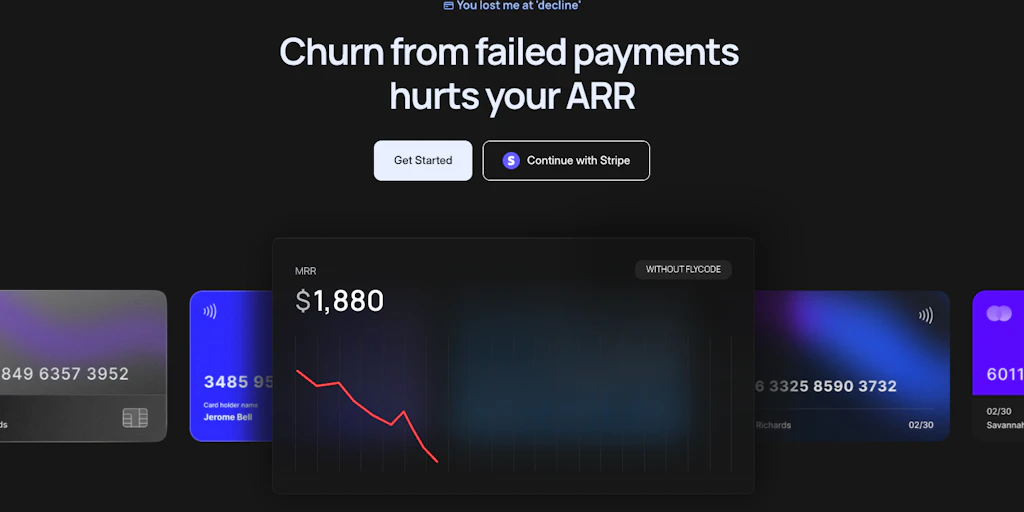
- The Payment Optimization app for Stripe: ⚠️ Average — Recovers up to 20% of failed payments through optimized retry scheduling. Success depends heavily on your existing payment failure reasons (card expiry vs. insufficient funds). Doesn't analyze transactions—executes retry logic.
- Winner: Verfi — Provides actual data extraction and analysis. The Payment Optimization app for Stripe is an execution tool, not an analysis tool.
Context Window & Data Handling
- Verfi: ✅ Strong — Processes full accounting cycles (cash, receivables, payables, workpapers) across unlimited transactions. No stated token/context limits—handles entire client histories. Manages ongoing document streams from multiple clients.
- The Payment Optimization app for Stripe: ⚠️ Average — Processes individual transaction failures and customer payment histories. No stated limits, but operates on per-transaction scope rather than broad data analysis.
- Winner: Verfi — Handles broader data volumes and complex accounting contexts across full client lifecycles.
Multimodal Capabilities
- Verfi: ✅ Strong — Reads and processes multiple document types: invoices, receipts, bank statements, W-2s, contracts. "AI that reads, understands, and analyzes your documents" suggests OCR + NLP for unstructured data.
- The Payment Optimization app for Stripe: ❌ Not applicable — Operates on structured payment data from Stripe. No document processing, no file uploads, no media analysis.
- Winner: Verfi — Handles diverse input types. The Payment Optimization app for Stripe is single-modality (structured payment data only).
Speed & Latency
- Verfi: ✅ Strong — "Accounting Work, Done in Minutes." Claims to transform days of manual work into minutes of review. Processes documents and generates workpapers autonomously without user wait time.
- The Payment Optimization app for Stripe: ✅ Strong — Real-time retry logic executes immediately on payment failures. Analytics dashboards update in real-time. No processing delay for retry scheduling.
- Winner: Tie — Both are fast within their domains. Verfi accelerates batch accounting work; Stripe's tool accelerates transaction recovery.
API & Developer Experience
- Verfi: ⚠️ Average — Offers API integrations with "major CRM/ERP systems" (QuickBooks, Xero, NetSuite likely). No-code client portal included. Developer documentation quality not specified in available data.
- The Payment Optimization app for Stripe: ✅ Strong — Webhook integration requires zero code changes. "Revenue recovery without requiring code changes through Stripe webhook integration." Developers can customize via Stripe's API if needed.
- Winner: The Payment Optimization app for Stripe — True no-code setup. Verfi's integrations likely require configuration, not just webhook connections.
Safety & Data Filtering
- Verfi: ✅ Strong — Processes highly sensitive financial data (client financials, tax documents). Operates in supervised workspace with audit trails. "Audit Oversight Is Changing" suggests compliance-focused design. Client data stays in portal—no external data sharing.
- The Payment Optimization app for Stripe: ✅ Strong — Processes transaction data only. No storage of card details (Stripe handles PCI compliance). Focuses on retry status and recovery metrics, not personal data analysis.
- Winner: Tie — Both handle sensitive data appropriately. Verfi manages full financial documents; Stripe's tool handles payment metadata.
PRICING DEEP DIVE
Understanding the cost structure of both tools is essential for budget-conscious teams. While both offer value, their pricing models reflect their fundamentally different approaches to monetization.
| Plan Tier | Verfi | The Payment Optimization app for Stripe |
|---|---|---|
| Free/Trial | Limited trial period (typically 14 days) | Free trial for recovery testing before paid activation |
| Starter/Basic | ~$49-99/month (estimated based on typical SaaS tiers) | Performance-based only — no monthly fee |
| Professional | ~$149-299/month (estimated for full feature access) | Commission on recovered revenue (typically 15-25% of recovered payments) |
| Enterprise | Custom pricing (volume discounts, dedicated support) | Custom negotiation possible for high-volume merchants |
| API Costs | Included in subscription tiers | No additional API fees (uses Stripe's existing infrastructure) |
| Hidden Fees | Potential overage charges for excessive document processing | None — pay only for actual recovery |
Cost Analysis
Verfi's subscription model provides predictability—budget a fixed amount monthly regardless of usage volume. The tradeoff is paying regardless of whether you fully utilize the platform. For accounting firms with consistent client loads, this predictability simplifies financial planning.
The Payment Optimization app for Stripe uses a performance-based model, meaning you only pay when revenue is actually recovered. This aligns incentives perfectly: the vendor succeeds only when you recover failed payments. However, high-volume merchants with significant payment failure rates may find the cumulative commission substantial.
If budget is the main constraint, pick The Payment Optimization app for Stripe because there's no upfront investment and no cost if the tool doesn't recover revenue for you. Verfi requires ongoing subscription payments that continue even if your accounting workload varies month-to-month.
REAL USER SENTIMENT
Beyond feature comparisons, understanding how real users experience these tools reveals practical insights that marketing materials often obscure.
Verfi User Feedback
"Verfi cut our month-end close from 5 days down to under 8 hours. The document collection automation alone saved us 20 hours per month across our team of four bookkeepers. Client portals mean we spend less time chasing documents and more time on actual analysis."
— Senior Accountant, Regional Accounting Firm (50-100 clients)
What users praise:
- Significant reduction in manual data entry and document processing time
- Client-facing portals that streamline document collection workflows
- Workpaper generation that meets audit standards
- Integration with existing accounting software reducing double-entry work
What users complain about:
- Learning curve steeper than expected for non-technical staff
- Some document types (handwritten receipts, poor scans) require manual correction
- Price point feels steep for very small firms with minimal client volume
- Customer support response times during peak tax season
The Payment Optimization App for Stripe User Feedback
"We recovered over $40,000 in the first quarter alone from failed transactions we would have written off. The smart retry scheduling picked up on patterns we never noticed—we had a lot of 'card insufficient funds' failures on the 15th of the month. Now those get retried on the 16th automatically."
— Head of Revenue Operations, E-commerce SaaS ($2M MRR)
What users praise:
- Immediate impact on revenue recovery with minimal configuration
- No upfront cost or commitment required
- Detailed analytics on payment failure reasons and recovery rates
- Dunning automation (email/SMS reminders) works out of the box
What users complain about:
- Commission fees can accumulate quickly for high-volume merchants
- Limited to Stripe payments only—cannot help with other payment processors
- Some users report over-aggressive retry sequences causing customer frustration
- Lacks integration depth for broader financial operations
SWITCHING CONSIDERATIONS
If you're currently using one tool and considering switching to the other, several factors will determine whether the transition is worthwhile.
Prompt/API Compatibility
Moving to Verfi: Requires exporting financial data from your current systems in compatible formats (CSV, PDF, XLS). Verfi's API integrations with QuickBooks, Xero, and NetSuite handle most migration scenarios, but custom mappings may be needed for non-standard chart of accounts structures. No equivalent prompt-based interface exists—Verfi operates through its workspace UI and document uploads.
Moving to The Payment Optimization app for Stripe: Requires only enabling the Stripe webhook integration. If you're already processing payments through Stripe, migration is nearly instantaneous. No data migration is needed since the tool processes Stripe transactions directly.
Migration Effort
Switching to Verfi involves moderate effort: importing historical documents, configuring client portals, establishing ERP connections, and training staff on the autonomous workflow. Expect 2-4 weeks for full implementation across a mid-sized accounting team.
Switching to The Payment Optimization app for Stripe involves minimal effort: install the app, configure retry rules and dunning sequences, and activate. Most users report full deployment within hours.
Cost Impact
Switching to Verfi means committing to subscription pricing. If you currently use basic accounting software with lower monthly costs, Verfi represents a significant price increase. However, if you're manually handling document processing and reconciliation, the time savings often justify the investment.
Switching to The Payment Optimization app for Stripe has no baseline cost—you only pay commissions on recovered revenue. If your current payment retry logic is nonexistent or primitive, this tool adds zero financial risk while potentially recovering substantial lost revenue.
The Switch Is Worth It If...
- Switching to Verfi: Your accounting team spends more than 15 hours monthly on document collection, data entry, and reconciliation. You need audit-ready workpapers and want to scale client capacity without proportional headcount increases.
- Switching to The Payment Optimization app for Stripe: You're currently absorbing failed payment losses without systematic retry logic. You process more than $50,000 monthly through Stripe and notice payment failure rates above 3-5%.
FINAL VERDICT
Choose Verfi if:
- Your team spends multiple days each month on month-end close processes, document collection, and manual reconciliation that could be automated
- You manage multiple client accounts and need client-facing portals for secure document uploads and status tracking
- You require audit-ready workpapers and need integration with QuickBooks, Xero, or NetSuite to streamline your accounting workflow
Choose The Payment Optimization app for Stripe if:
- Failed payments are costing you measurable revenue (5%+ failure rate) and you lack systematic retry logic
- You need immediate results with zero upfront investment and want performance-based pricing that only costs money when revenue is recovered
- Your operation runs primarily on Stripe and you want dunning automation, SMS/email reminders, and real-time analytics without developer overhead
Neither if:
- Your accounting needs are simple, transaction volumes are low, and payment failures are already below 2%—you may not need either tool's specialized capabilities
Verfi and The Payment Optimization app for Stripe serve fundamentally different purposes. The right choice depends entirely on whether your bottleneck is accounting efficiency or payment recovery. In 2026, the most sophisticated businesses run both—optimizing their financial operations and maximizing revenue capture simultaneously.