
The landscape of financial technology continues to evolve at a breakneck pace, and businesses that once relied on traditional platforms like Zumma are now seeking more sophisticated, AI-driven solutions that can handle the complexities of modern accounting and financial management. Whether you are an accounting firm drowning in repetitive bookkeeping tasks or a startup founder struggling to secure business capital, the emergence of specialized AI agents has fundamentally altered what users can expect from their financial tools. This comprehensive guide examines the two most compelling alternatives available in 2026, providing detailed analysis, pricing structures, and feature comparisons to help you make an informed decision about which platform best addresses your specific needs.
Why Leave Zumma?
Users searching for alternatives to Zumma typically cite three primary pain points that have become increasingly untenable in today's fast-paced business environment. First, pricing opacity remains a significant concern, with many users reporting unpredictable cost escalations as their firm grows and usage increases. Second, limited AI automation capabilities mean that tasks requiring intelligent document processing, predictive analytics, or autonomous workflow management still require substantial manual intervention, defeating the purpose of adopting an "intelligent" platform in the first place. Third, inadequate integration ecosystems leave users trapped in siloed workflows, unable to connect their accounting data with broader business intelligence tools or capital access platforms.
A good replacement for Zumma must deliver autonomous AI agents capable of handling complex, multi-step financial workflows without constant human supervision, transparent pricing models that scale predictably with usage, and robust API infrastructure enabling seamless data exchange with third-party applications. The ideal alternative should reduce operational overhead by a minimum of 40% while maintaining or exceeding current security and compliance standards expected in the finance and payments sector.
The TL;DR Comparison Table
| Tool | Best For | Starting Price | Key Differentiator |
|---|---|---|---|
| Quanto | Accounting firms seeking workflow automation | Custom pricing (request demo) | Specialized AI agents for accounting-specific tasks |
| Mona | Small businesses and startups seeking capital | Custom pricing (request demo) | AI-driven capital matching and application automation |
The Contenders: Deep Dive Analysis
1. Quanto
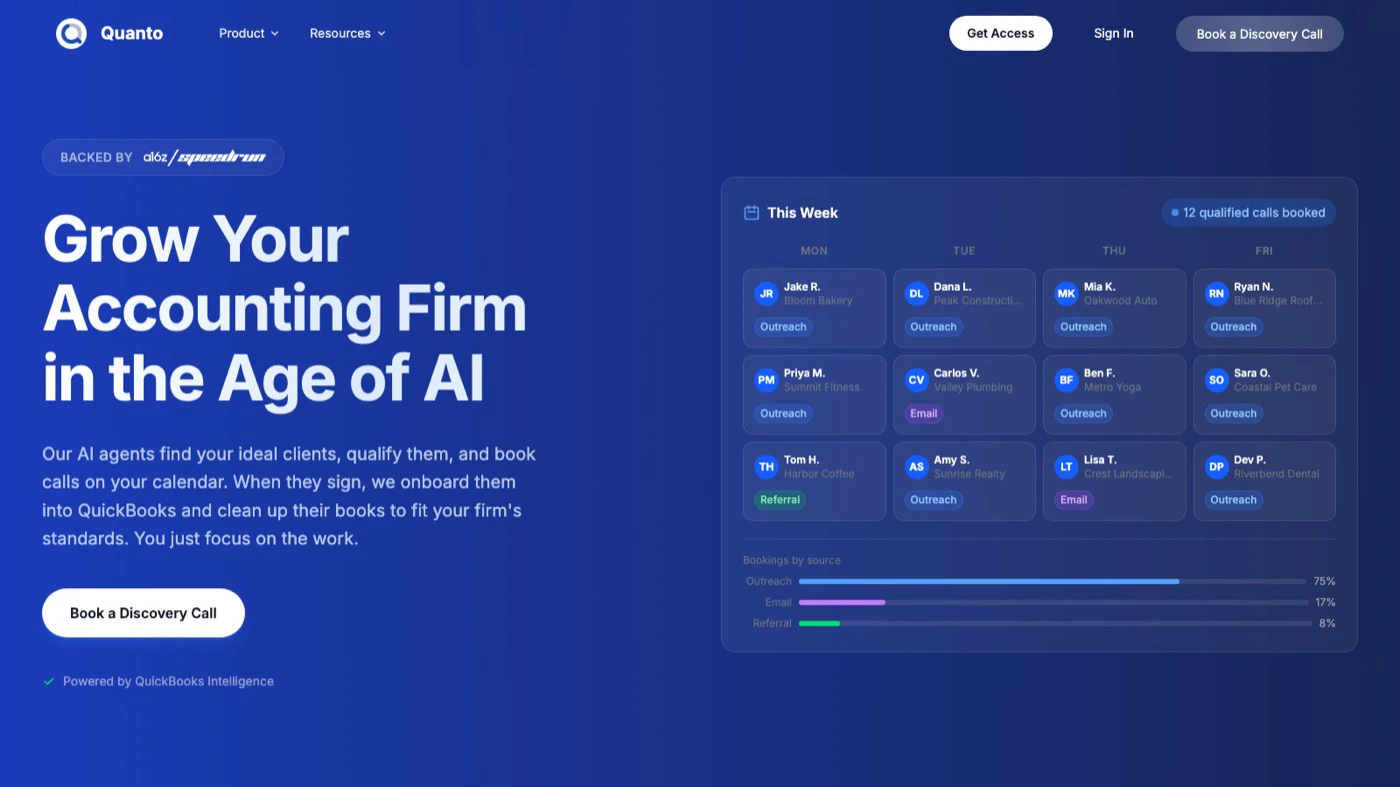
Overview: Quanto represents a new generation of AI-powered workflow automation platforms specifically designed for the accounting industry. Unlike generic automation tools, Quanto has been built from the ground up with deep understanding of accounting workflows, tax preparation processes, and firm management challenges. The platform deploys autonomous AI agents that can handle everything from data entry and reconciliation to client communication and compliance monitoring, allowing accounting professionals to focus on higher-value advisory services rather than repetitive administrative tasks.
According to the Product Hunt listing, Quanto positions itself as "AI agents for accounting firms," emphasizing its commitment to serving the unique needs of accountants, tax professionals, and firm owners. The platform's architecture allows multiple AI agents to work in concert, handling complex workflows that previously required significant human oversight and intervention.
Pros vs Zumma:
- Domain-specific AI agents trained on accounting workflows, versus Zumma's generalized automation approach
- Native support for bookkeeping automation including bank reconciliation, invoice processing, and expense categorization
- Integrated firm operations management with client portal capabilities and deadline tracking
- Tax task automation covering preparation checklists, data aggregation, and compliance verification
- Dedicated focus on accounting industry needs rather than broad financial tool coverage
Cons:
- Limited public documentation makes independent evaluation challenging
- Custom pricing model requires direct sales engagement, potentially excluding smaller firms with limited budgets
- Product website currently shows placeholder content, suggesting ongoing development or limited market presence
- Absence of publicly available free trial or sandbox environment for hands-on evaluation
Pricing: Quanto operates on a custom enterprise pricing model. Prospective users must contact sales for a demo and tailored quote. No public pricing tiers or calculator are available as of this writing. This pricing model suggests a focus on mid-market to enterprise accounting firms rather than individual practitioners or small practices.
Learn more about AI agent implementation strategies
2. Mona
Overview: Mona takes a distinctly different approach to financial automation, focusing specifically on the challenge of business capital access. For small business owners, startup founders, and financial controllers, securing adequate funding often represents one of the most time-consuming and frustrating aspects of business management. Mona addresses this by deploying AI agents that autonomously match businesses with appropriate capital sources, automate the application process, and streamline the entire procurement workflow.
The platform's core value proposition centers on eliminating the manual research, document gathering, and form-filling that traditionally accompanies business lending applications. Mona's AI agents maintain relationships with multiple capital providers, understand the qualification criteria for each, and can proactively identify optimal funding opportunities based on a business's financial profile and growth trajectory.
Pros vs Zumma:
- Purpose-built for capital procurement rather than general financial management, enabling deeper specialization
- AI-driven matching technology that considers multiple funding sources simultaneously, versus Zumma's likely single-provider approach
- Automated application workflows that reduce submission time from days to hours
- Autonomous agents that continuously monitor funding opportunities and alert users to relevant matches
- Direct integration with business financial data for intelligent qualification assessment
Cons:
- Narrow focus on capital access means it cannot serve as a comprehensive accounting or financial management solution
- Product website placeholder content limits ability to assess full feature set independently
- Custom pricing structure requires sales consultation, potentially creating barriers for smaller businesses
- Newer market presence may concern users prioritizing established, battle-tested platforms
Pricing: Like Quanto, Mona utilizes custom enterprise pricing with no public rate cards. Users interested in the platform must schedule a demo and negotiate terms directly with the sales team. This approach typically indicates pricing that varies based on funding volume, usage intensity, or feature customization requirements.
Feature Comparison Matrix
| Feature | Quanto | Mona |
|---|---|---|
| Primary Function | Accounting workflow automation | Business capital procurement |
| AI Agent Architecture | Multi-agent system for accounting tasks | Capital matching and application agents |
| Target User | Accountants, tax professionals, firm owners | Small business owners, startup founders, financial controllers |
| API Access | Not publicly documented | Not publicly documented |
| Integration Ecosystem | Accounting software integrations implied | Financial institution connections implied |
| Compliance Certifications | SOC2/PCI status not disclosed | SOC2/PCI status not disclosed |
| Free Trial Available | No | No |
| Public Pricing | No (custom quotes only) | No (custom quotes only) |
| Open Source Components | Unknown | Unknown |
| Mobile Application | Not confirmed | Not confirmed |
| Dedicated Support | Enterprise support implied | Enterprise support implied |
Explore additional AI finance tool comparisons
The Verdict
Choosing between these two alternatives depends entirely on your primary business objective. If you operate an accounting firm and struggle with the burden of repetitive bookkeeping tasks, tax preparation workflows, and client management overhead, Quanto emerges as the clear choice. Its domain-specific AI agent architecture has been explicitly designed to address the pain points that accounting professionals encounter daily, and its focus on firm operations suggests a deep understanding of industry requirements that generic platforms like Zumma cannot match.
Conversely, if your most pressing challenge involves accessing business capital—whether through traditional lending, venture funding, or alternative financing channels—Mona represents the superior option. Its specialized approach to capital matching and application automation directly addresses a specific, high-stakes business need that general-purpose financial tools typically handle poorly.
Organizations with both needs may consider implementing both platforms in a complementary fashion, using Quanto for internal accounting operations and Mona for external capital procurement activities. However, this dual-implementation approach would require careful evaluation of integration capabilities and combined total cost of ownership.
Neither platform offers the public pricing transparency or free trial options that would make independent evaluation straightforward. Prospective users should prepare for a sales-driven evaluation process and should request detailed demonstrations that specifically address their use cases before committing to either platform.
Frequently Asked Questions
How difficult is it to migrate data from Zumma to Quanto?
Migration complexity depends significantly on the volume and format of your existing data within Zumma. Quanto's specialized focus on accounting workflows means it likely supports standard accounting data formats such as GL exports, bank statement imports, and client record transfers. However, since Quanto's public documentation is limited, organizations should request a dedicated migration assessment during the sales demo process. Most accounting data migrations can be completed within 2-4 weeks when working with professional services support, though complex multi-year archives may require extended timelines.
Can Mona help my business if I have limited or no credit history?
Mona's AI-driven matching technology is designed to evaluate businesses holistically rather than relying solely on traditional credit metrics. The platform's connections with diverse capital providers—including alternative lenders, revenue-based financing companies, and venture capital sources—mean it can identify opportunities for businesses that might not qualify for conventional bank loans. However, specific qualification criteria ultimately depend on individual capital providers, and businesses with limited credit history should prepare additional documentation such as bank statements, revenue projections, and business plan summaries to support their applications.
What security certifications should I verify before adopting either platform?
At minimum, verify SOC2 Type II certification, which indicates independent audit of security controls over an extended period. Additionally, confirm PCI DSS compliance if the platform will handle payment card data, and review their data encryption standards for both transit (TLS 1.3 minimum) and at-rest storage. Request copies of their most recent security audit reports and penetration test results. Since neither platform's public documentation currently discloses certification status, this information should be explicitly requested from sales representatives during evaluation.
Are there any implementation timeline expectations for these platforms?
Based on typical enterprise AI platform deployments, organizations should anticipate the following general timelines. Quanto implementation for a mid-sized accounting firm typically spans 4-8 weeks for initial deployment, with full workflow optimization extending to 3-6 months as AI agents learn firm-specific patterns. Mona deployment is generally faster, with basic capital matching activation achievable within 2-4 weeks, though building robust application workflows and establishing connections with multiple capital providers may require an additional 2-3 months. Both timelines assume adequate internal resources allocated to implementation support and integration development.
Review the broader AI finance tool landscape for 2026