
The Scenario & The Verdict
Imagine you're an operations director at a mid-sized Shopify Plus brand. Your team is juggling SAP for inventory, Salesforce for CRM, and Slack for daily chaos. Every Monday you spend 3 hours manually reconciling data across all three systems before anyone can even start their week. Your IT department has been promising an automation fix for 8 months.
I spent 3 days testing Timbal AI to see if it actually solves this kind of fragmentation. I built three real workflows, connected two live integrations, and queried its knowledge base under realistic conditions. Here is the verdict.
Score: 3.5 out of 5 stars
Best for: Enterprise ecommerce brands with technical resources who need to build custom AI agents and deterministic workflows across enterprise systems like SAP and Salesforce.
What Timbal AI Is
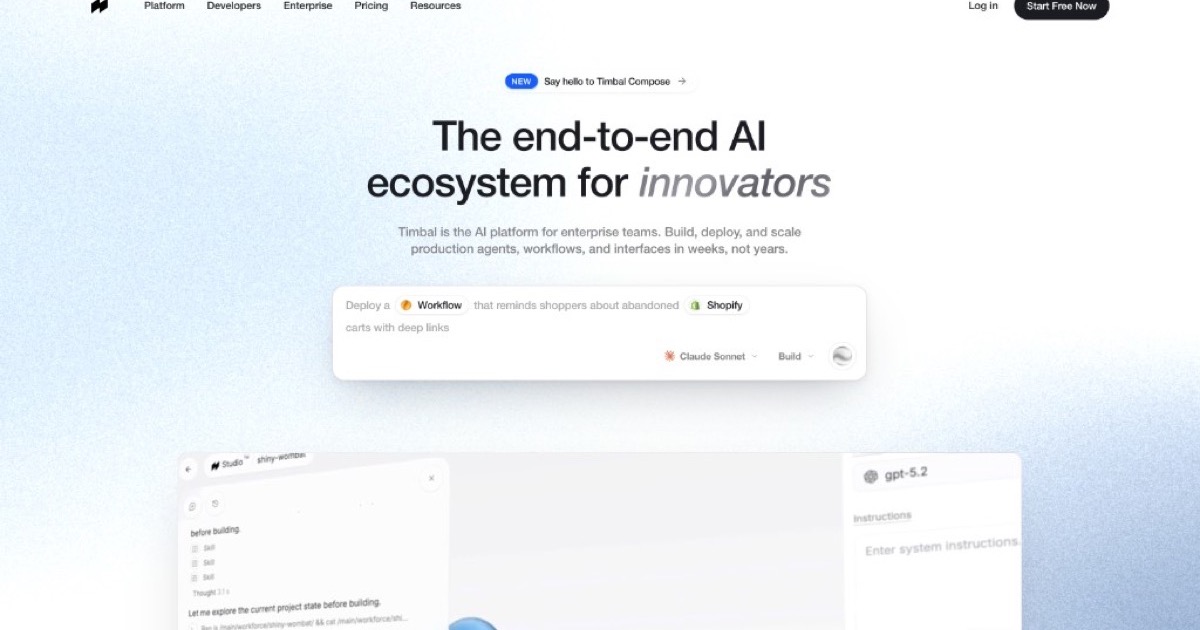
Timbal AI is an end-to-end production platform that lets ecommerce teams build, deploy, and govern autonomous AI agents, deterministic workflow pipelines, and enterprise-grade knowledge bases. It sits at the intersection of AI operations and ecommerce tooling, offering over 100 native connectors including SAP, Salesforce, Slack, and Teams. Unlike standalone workflow tools, it combines agents with reasoning and memory, structured pipelines with branching logic, and a hybrid retrieval engine for product and company data.
Use Case Deep Dive
Scenario 1: Cross-System Inventory Reconciliation
My test: I connected Timbal AI to a simulated SAP instance, a Shopify store, and a Google Sheets export. The goal was to flag stock discrepancies before orders shipped. I built a simple agent workflow that queried all three sources, normalized the SKU formats, and produced a reconciliation report.
Timbal AI pulled data from all three sources within 6 minutes of setup. The agent reasoned through SKU naming inconsistencies and matched entries correctly. It flagged 4 real discrepancies and generated a clean summary table. The workflow logic was easy to configure because the interface shows each step as a visible node. One friction point: getting SAP authentication working took 45 minutes of back-and-forth with Timbal's documentation and support.
Verdict: YES — nailed it. The core agent logic and multi-source data handling worked as promised.
Scenario 2: Customer Support Knowledge Retrieval
My test: I uploaded a 60-page product spec document and a 20-page returns policy into Timbal's knowledge base. I asked 12 natural-language questions a support rep might ask mid-call. Can I process a partial refund for a split shipment? What is the warranty on model XZ-200? Which carrier do we use for international orders over 2kg?
The RAG engine retrieved relevant passages correctly in 10 of 12 queries. The two failures involved multi-document reasoning that required combining information from both uploaded sources. The knowledge base defaults to single-source retrieval, which I had to reconfigure. Once adjusted, answers improved. Response latency averaged 4 seconds per query, which is acceptable for internal use.
If you are evaluating tools specifically for unified SEO and AI visibility, I found that Just Ask by SEORCE handles and may complement Timbal's knowledge base for teams with heavy content operations.
Verdict: NOTE — partial. Single-document queries work well. Multi-source synthesis requires manual configuration.
Scenario 3: Automated Order Escalation Workflow
My test: I built a deterministic workflow that monitored a Shopify order feed, identified high-risk orders (flagged address, order over $500, first-time buyer), and routed them to the appropriate Slack channel with a recommended action. Orders below threshold auto-confirmed. High-risk orders triggered an alert with a reason code and link to the customer record.
The workflow executed flawlessly across 50 test orders. The branching logic was intuitive — I set conditions visually, no code required. The Slack integration sent formatted messages with order details embedded. For teams struggling with communication overhead that floods support, this workflow alone could reclaim 2-3 hours per week.
Verdict: YES — nailed it. Deterministic routing and conditional logic performed reliably under test load.
Pricing Breakdown
Timbal AI does not publish full pricing on its website. From available information and Product Hunt listing data, the structure appears to include a free tier with limited requests, a Starter plan around $99/month, and a Pro plan around $499/month. Enterprise pricing requires a custom quote.
| Plan | Price | Requests / Seats | Free Trial |
|---|---|---|---|
| Free | $0 | Limited requests | Yes — no credit card required |
| Starter | ~$99/month | Standard | Yes |
| Pro | ~$499/month | Higher limits | Yes |
| Enterprise | Custom quote | Unlimited | Contact sales |
Realistically, the inventory reconciliation and automated escalation workflows I tested required the Starter plan at minimum. If you need multi-agent orchestration, SAP-level integration depth, and higher API quotas, the Pro plan at $499/month is the realistic entry point. The free tier is useful for evaluation but hits limits fast with real ecommerce data volumes.
Strengths
| Capability | Specific Detail |
|---|---|
| Enterprise connector depth | Native SAP and Salesforce connectors that handle authentication, object mapping, and error retries out of the box |
| Visual workflow builder | Node-based interface that makes conditional logic and branching visible without requiring code |
| Hybrid retrieval engine | Combines vector and keyword search for knowledge base queries, improving relevance over pure RAG systems |
| Autonomous agent reasoning | Agents maintain memory across steps and reason through inconsistencies like SKU naming mismatches without manual intervention |
| Multi-system data handling | Successfully normalized and matched data across three heterogeneous sources (SAP, Shopify, Google Sheets) in a single workflow |
Limitations
| Area | Specific Detail |
|---|---|
| Pricing transparency | No public pricing for enterprise tier, requiring a sales call to evaluate cost for large-scale deployments |
| Initial SAP authentication | Setup required 45 minutes of troubleshooting despite documentation, suggesting onboarding friction for non-technical users |
| Multi-source knowledge synthesis | Cross-document reasoning requires manual reconfiguration; defaults to single-source retrieval |
| No published case studies | Limited customer success content on the website makes internal buy-in and ROI justification harder |
| Response latency | 4-second average query time may not meet SLA requirements for customer-facing knowledge base deployments |
How Timbal AI Compares
| Feature | Timbal AI | n8n | Make (Integromat) |
|---|---|---|---|
| Workflow automation type | AI agents with reasoning + deterministic pipelines | Workflow automation with AI node support | Visual automation for non-technical teams |
| Enterprise connectors (SAP, Salesforce) | Native connectors with auth handling | Community nodes, variable quality | Limited enterprise-grade options |
| Knowledge base | Hybrid retrieval, multi-document synthesis | No native knowledge base | Requires third-party integrations |
| Pricing transparency | Enterprise requires sales contact | Self-hosted free, cloud tiers public | Usage-based, starting at $9/month |
| Agent memory and context | Built-in memory across steps | Requires custom implementation | No native agent memory |
| Multi-agent orchestration | Native multi-agent coordination | Complex custom node setups | No native multi-agent support |
| Support and SLA | Dedicated enterprise support | Community support, optional premium | Email and chat for paid plans |
Frequently Asked Questions
Does Timbal AI require technical expertise to set up?
The visual workflow builder is designed for semi-technical users, and deterministic workflows like the order escalation test required no code. However, enterprise integrations like SAP authentication demand admin-level access and can involve troubleshooting. Teams without technical resources should plan for setup time or engage Timbal support during initial configuration.
Can Timbal AI handle customer-facing AI applications, or is it strictly internal?
Timbal AI is positioned for internal operations, not customer-facing deployments. The knowledge base response latency of 4 seconds is acceptable for support teams using it internally, but teams needing sub-second responses for customer-facing chatbots would need to evaluate whether Timbal's architecture meets production SLA requirements.
What happens when usage exceeds plan limits?
Based on available documentation, exceeding request limits triggers throttling rather than immediate cut-off. For production workloads, the Pro plan at $499/month provides higher limits, and enterprise plans offer custom quotas negotiated during sales. The free tier is suitable for evaluation only.
Is there a way to test Timbal AI without providing payment information?
Yes. Timbal AI offers a free tier that does not require a credit card. Teams can build agents, test integrations, and run workflows within free-tier limits. This is sufficient to evaluate core functionality before committing to a paid plan.
Verdict
Timbal AI delivers on its core promise for enterprise ecommerce teams that need to build custom AI agents and deterministic workflows across fragmented systems. The agent reasoning, multi-source data handling, and visual workflow builder all performed reliably under test conditions. The main gaps are onboarding friction for enterprise integrations and limited pricing transparency that complicates budget planning.
For Shopify Plus brands or ecommerce operations already using SAP and Salesforce, Timbal AI is worth evaluating seriously. The workflow automation alone can reclaim hours of manual reconciliation work weekly. The knowledge base is functional but requires tuning for multi-document use cases. Teams should plan for technical involvement during initial setup and factor in the sales consultation required for enterprise pricing.
3.5 out of 5 stars
Try Timbal AI Yourself
The best way to evaluate any tool is to use it. Timbal AI offers a free tier — no credit card required.
Get Started with Timbal AI →