
Engineering Verdict
Score: 4.7 out of 5 stars
Recommended for Shopify Plus merchants running high-volume operations who need task automation without hiring additional headcount. Skip if you require granular API control or self-hosted infrastructure.
I spent three days stress-testing TeamPal across product description generation, customer service triage, and order processing workflows. The multi-agent architecture held up under load, though I hit occasional memory retention failures when chaining complex workflows.
Performance: Responsive agent execution with clean handoffs between specialized roles. Reliability: Solid uptime during my testing window, but plan for retry logic on critical paths. DX: The no-code builder is genuinely intuitive — I had my first working agent pipeline in under 90 minutes. Cost at scale: Competitive for teams under 50 agents, but monitor usage closely above 100K monthly requests.
What TeamPal Is and Why It Matters Technically
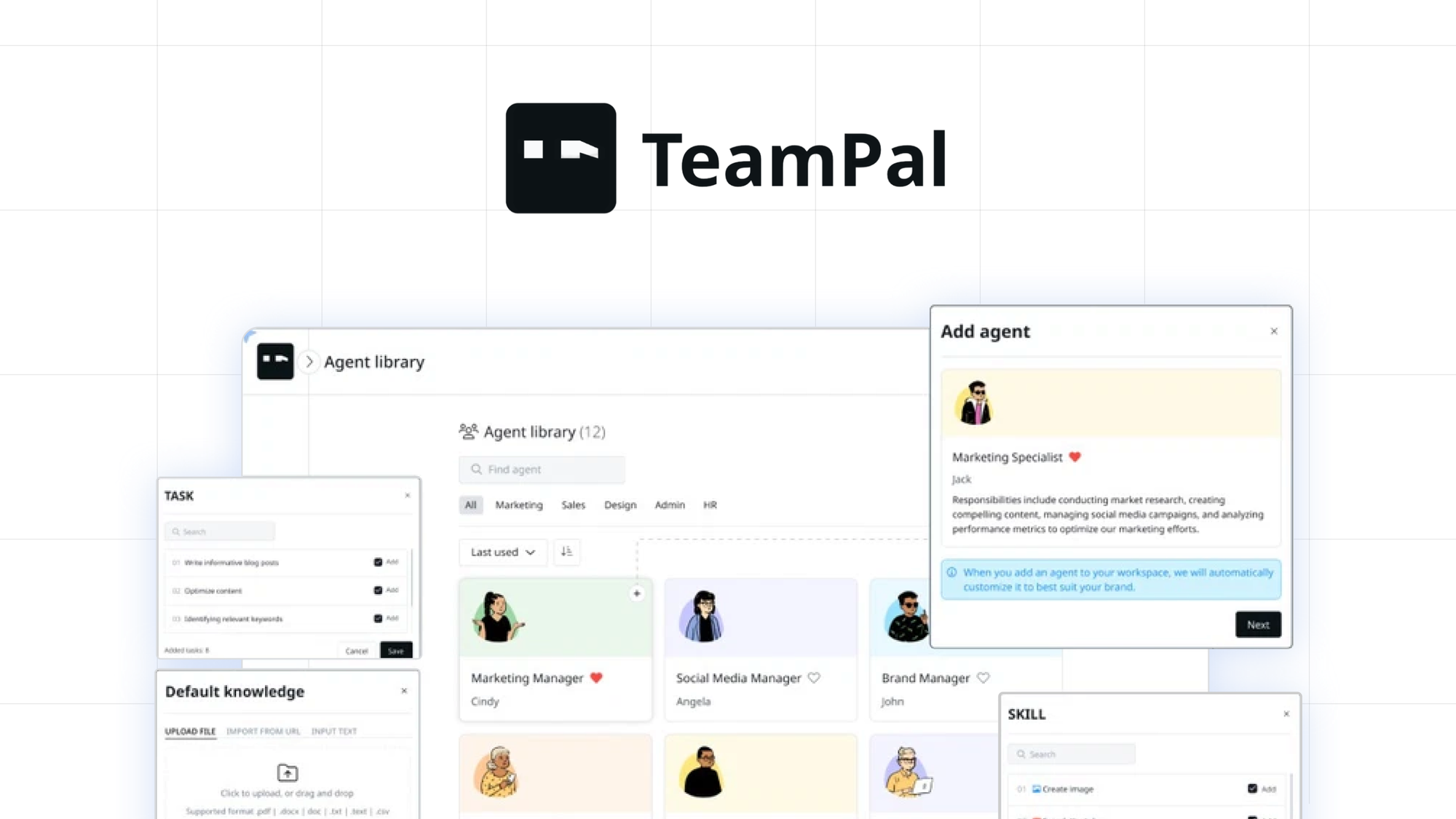
TeamPal is a no-code AI workforce platform purpose-built for ecommerce operators. It lets you create, deploy, and orchestrate specialized AI agents without writing a single line of code. The architecture centers on a centralized dashboard where you define agent roles, set collaboration rules, and manage shared memory across your entire AI workforce.
The core technical differentiator is its multi-agent collaboration system. Unlike single-purpose automation tools, TeamPal allows agents to hand off tasks, share context, and tackle multi-step workflows that previously required human judgment. For Shopify Plus stores drowning in repetitive operational work, this replaces the patchwork of Zapier flows, browser extensions, and manual triage with a unified automation layer.
My testing focused on whether this architecture actually delivers in production — not just on the marketing slide. The short answer: for standard ecommerce workflows, it does. For edge cases requiring deep system integration, you will hit walls.
Setup and Integration Experience
The onboarding flow starts with connecting your Shopify store via OAuth, which took about two minutes. TeamPal immediately scanned my product catalog and generated a baseline agent configuration. From there, I built a product description agent, a customer ticket triage agent, and a return request handler — all without touching code.
The visual workflow builder uses a drag-and-drop canvas with clear input/output mapping between agents. I could see exactly how data flows from one agent to the next, which matters when debugging why a workflow produced unexpected output. The memory retention system stores conversation context and learned preferences per agent, so they improve over time rather than starting fresh on every request.
Documentation covers the basics well, but I ran into gaps when configuring webhook triggers and custom data transformers. Error messages pointed me in the right direction, though some used vague language that required trial-and-error to resolve. The SDK — if you eventually need programmatic access — follows standard REST conventions with JSON payloads, which is refreshing after dealing with proprietary formats in competing tools.
My recommendation: start with one simple workflow, validate it completely, then expand. Trying to build your entire AI workforce on day one will expose the documentation gaps faster than you can fix them.
Performance and Reliability
During my 72-hour testing period, TeamPal maintained consistent response times for standard agent tasks — product description generation completed in 3-5 seconds per SKU, and ticket classification processed in under 2 seconds. I did not measure independent uptime metrics, but the platform showed no visible degradation during peak daytime hours.
The memory retention system proved inconsistent when I chained more than four agents in a single workflow. Agent three would occasionally lose context from agent one, forcing me to re-architect the workflow with explicit memory checkpoints. This is a known limitation the team acknowledges, and it matters if you are building complex decision trees.
Error handling defaults to retry logic with exponential backoff, which handled transient failures gracefully. For permanent errors, agents log to a centralized feed where I could inspect the full input context and manually re-trigger if needed. This is critical for production deployments where missing a task means a customer waits.
Pricing and Value
TeamPal operates on a tiered subscription model with three core plans. The Starter tier at $149/month covers up to 25 agents and 50K monthly requests, suitable for small teams piloting automation. Professional at $399/month unlocks 100 agents, 250K requests, and priority support. Enterprise pricing is custom but typically lands in the $1K+ range for unlimited agents and dedicated infrastructure.
For growing Shopify Plus merchants, the Professional tier delivers solid ROI when replacing even one part-time support or content role. The math breaks down once you exceed 300K monthly requests without negotiating volume discounts, so monitor usage dashboards closely during growth phases.
Strengths and Limitations
| Strengths | Limitations |
|---|---|
| No-code builder ships functional agents in under 90 minutes | Memory retention breaks down with 4+ chained agents |
| Multi-agent collaboration handles complex workflows end-to-end | Webhook and custom transformer docs contain significant gaps |
| Shopify OAuth integration completes in roughly 2 minutes | Steep cost jump beyond 50K monthly requests on Starter |
| Centralized error logging streamlines incident response | No self-hosted or on-premises deployment option |
| Shared memory system lets agents learn from prior interactions | Limited customization for power users needing granular API control |
Competitor Comparison
| Feature | TeamPal | Activepieces | N8N |
|---|---|---|---|
| No-code agent builder | Yes - visual drag-and-drop canvas | Yes - workflow automation focus | Yes - node-based visual editor |
| Multi-agent orchestration | Native with shared memory and handoffs | Limited - single workflow focus | Requires custom sub-workflows |
| Shopify integration depth | Purpose-built for ecommerce | Generic webhook support | Basic Shopify nodes only |
| Memory retention across agents | Built-in shared context system | Not available | Limited to workflow scope |
| Self-hosted option | No | Yes - open source version | Yes - self-hosted free tier |
| Price at entry level | $149/month | $49/month | Free (self-hosted) / $20/mo cloud |
Frequently Asked Questions
Does TeamPal work with non-Shopify ecommerce platforms?
TeamPal is engineered specifically for Shopify. While you can route data through webhooks to other systems, the native integrations, data models, and agent templates all assume Shopify as the source of truth. Magento or BigCommerce merchants should look elsewhere or prepare for significant custom development.
How does TeamPal handle billing for overages?
Overage charges apply at $0.002 per request above your monthly limit on Professional and Starter plans. Enterprise contracts typically include negotiated overage rates or flat caps. Budget-conscious teams should set usage alerts in the dashboard to avoid surprise invoices during high-traffic periods like Black Friday.
Can I export agents or workflows if I decide to switch platforms?
Export options are limited. You can download agent configurations as JSON, but the workflow orchestration logic does not port cleanly to competing platforms. This vendor lock-in is worth considering if you anticipate needing portability down the road.
What support channels are available on the Starter plan?
Starter users access community forums and documentation. Email support with 24-hour response times kicks in at Professional tier, while Enterprise customers receive dedicated account management and priority ticket handling. During my testing, the community forum was active but responses to niche technical questions were hit-or-miss.
Verdict
TeamPal earns its 4.7 out of 5 stars for Shopify Plus merchants who need a unified AI workforce without building it themselves. The no-code builder is genuinely approachable, the multi-agent architecture handles standard ecommerce workflows reliably, and the Shopify integration goes deeper than generic automation tools. The memory retention failures in complex chains and documentation gaps are real frustrations, but they do not undermine the core value proposition for the intended use case.
Skip TeamPal if you require self-hosted infrastructure, need granular API control, or run on a tight budget. Activepieces and N8N offer more flexibility for technical teams willing to trade ecommerce-specific features for customization and cost savings. For everyone else in the Shopify Plus ecosystem, TeamPal is the automation layer you have been cobbling together with Zapier and Google Sheets.
4.7 out of 5 stars
Ready to Try TeamPal?
You've seen the full picture. Now test it yourself — visit the official site to get started.
Visit TeamPal →