
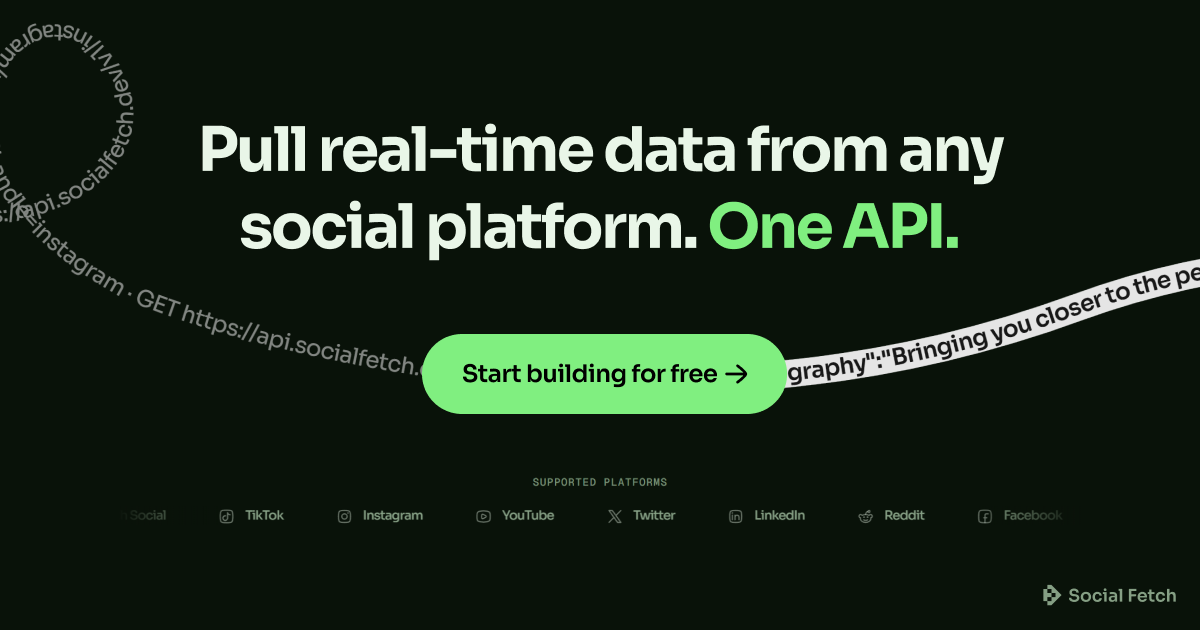
Social Fetch vs Scribble Network: Which AI Tool Actually Delivers in 2026?
TL;DR — Quick Verdict Table
| Dimension | Social Fetch | Scribble Network | Winner |
|---|---|---|---|
| Free Tier | 100 free credits, no card required | Free trial available, Contact Sales for limits | Social Fetch |
| API Pricing | $1.65/1k requests at scale, PAYG never expire | Enterprise pricing only (Contact Sales) | Social Fetch |
| Platform Coverage | 13+ platforms (TikTok, Instagram, YouTube, etc.) | 5 AI models (ChatGPT, Gemini, Perplexity, Copilot, Grok) | Social Fetch |
| Core Function | Scraping & data extraction API | AI citation monitoring & content generation | Draw (different use cases) |
| Developer Experience | curl, Python, TypeScript SDK, MCP server | Dashboard-focused, API details limited | Social Fetch |
| Data Freshness | Live upstream fetch, not shared cache | Tracks mentions from publish to AI answer | Social Fetch |
| AI Citation Tracking | No native support | Citation share by model, topic, and time | Scribble Network |
| Content Generation | Data extraction only, no content creation | Creator bounty system for gap-filling content | Scribble Network |
| Reliability | 99.8% uptime, 3,200+ developers | Newer product, limited public metrics | Social Fetch |
| Best For | Developers needing structured social data | Brands chasing AI search citations | Context-dependent |
Bottom line: Pick Social Fetch if you need reliable, structured social media data via API with transparent pricing and a proven developer track record. Pick Scribble Network if your primary goal is getting your brand cited by AI search engines like ChatGPT and Perplexity — and you're willing to pay enterprise rates for that specific visibility data.
Who Should Use Which?
Casual / Non-Technical User
Scribble Network is the better fit here. The dashboard-centric approach with competitor benchmarking and a managed creator bounty system means you don't write a single line of code. Social Fetch, despite its developer-friendly SDKs, still requires API integration work that most non-technical users won't tackle. If you want to understand how ChatGPT perceives your brand, Scribble's visual dashboards deliver that insight immediately.
Developer / Builder
Social Fetch wins hands-down for developers. The unified JSON schema across 13+ platforms, TypeScript SDK, Python support, MCP server for function calling, and 99.8% uptime with 3,200+ active developers proves production-readiness. The $1.65/1k PAYG pricing with credits that never expire removes billing surprises. Scribble Network's API details remain opaque behind a "Contact Sales" wall, making it unsuitable for developers who need predictable infrastructure costs.
Enterprise Team
It depends on your primary KPI. If your goal is AI citation dominance for brand visibility, Scribble Network's creator bounty system directly addresses that gap. However, if you need reliable data pipelines feeding internal analytics or AI agents, Social Fetch's live upstream fetch architecture and proven 99.8% uptime are the safer enterprise bet. Scribble Network appears newer with limited public reliability metrics compared to Social Fetch's established developer community.
Capability Deep-Dive
Response Quality & Accuracy
- Social Fetch: YES — Strong. Returns structured JSON with verified follower counts, engagement metrics, and transcripts directly from upstream sources. The "live upstream fetch, not shared cache" approach means you get current data, not stale snapshots. Developer community of 3,200+ has validated accuracy across production workloads.
- Scribble Network: NOTE — Average. Tracks citation presence across AI models, but citation ≠ accurate citation. A brand can appear in 30 queries but be recommended incorrectly. The bounty system generates content to fill gaps, but quality depends on creator submissions rather than controlled data extraction.
- Winner: Social Fetch for data reliability. Scribble Network's value is in monitoring, not guaranteeing accuracy of AI citations.
Context Window & Memory
- Social Fetch: N/A — This is a scraping API, not an LLM. Context handling happens on the client side when processing returned data. No inherent context window limits beyond standard API response sizes.
- Scribble Network: N/A — This is a monitoring/visibility platform, not an LLM. Tracks mentions across time but doesn't process long contexts internally.
- Winner: Draw — Neither product is designed around context windows. Choose based on data collection needs, not AI model capabilities.
Multimodal Capabilities
- Social Fetch: YES — Strong. Handles video transcripts (YouTube), profile images, post content, engagement metrics across video (TikTok, YouTube) and image (Instagram) platforms. Covers the full spectrum of social media content types.
- Scribble Network: NOTE — Average. Monitors text-based citations across AI models. Does not extract or process images, video, or audio directly. Focus is on brand mention tracking, not content analysis.
- Winner: Social Fetch for breadth of content type handling.
Speed & Latency
- Social Fetch: YES — Strong. Live upstream fetch architecture means real-time data retrieval. Rate limits are generous enough for production use, and 99.8% uptime indicates reliable infrastructure. New MCP server enables low-latency function calling for AI agents.
- Scribble Network: NOTE — Average. Citation tracking is inherently a polling/aggregation process — not real-time. "Track mentions from publish to AI answer" implies batch processing cycles. Dashboard-based workflow adds latency compared to API-first design.
- Winner: Social Fetch for synchronous, real-time data access.
API & Developer Experience
- Social Fetch: YES — Strong. RESTful API with curl examples, Python and TypeScript SDKs, MCP server for Cursor/Claude integration. Unified JSON schema across all 13+ platforms eliminates platform-specific parsing logic. 15+ developer integrations built. Clear, transparent pricing on the website.
- Scribble Network: NOTE — Average. API availability mentioned but details scarce. Website focuses on dashboard and bounty management rather than developer documentation. "Contact Sales" pricing model suggests enterprise API access, not developer-friendly self-service.
- Winner: Social Fetch by a wide margin for developer experience.
Safety & Content Filtering
- Social Fetch: NOTE — Average. Returns publicly available social media data. No explicit content filtering mentioned — this is data retrieval, not content generation. Compliance depends on how you use the scraped data (platform ToS, privacy regulations).
- Scribble Network: NOTE — Average. Monitors AI model outputs rather than generating content directly. The creator bounty system generates content through third parties, introducing quality and compliance variability. Brand visibility monitoring raises no immediate safety concerns.
- Winner: Draw — Neither product generates harmful content. Safety concerns are minimal but differ in nature: Social Fetch's risk is in data usage compliance; Scribble Network's risk is in third-party content quality.
Pricing Deep Dive
| Plan | Social Fetch | Scribble Network |
|---|---|---|
| Free Tier | 100 credits, no credit card required | Free trial available, limits unspecified |
| Pay-As-You-Go | $1.65 per 1,000 API requests | Not publicly available |
| Credits Expiration | Never expire | Unknown |
| Enterprise | Volume discounts available | Contact Sales only |
| Pricing Transparency | Public pricing page | Opaque, requires sales call |
Social Fetch publishes exact pricing on its website. The $1.65 per 1,000 requests applies at scale, with 100 free credits allowing new users to test the API without financial commitment. Credits never expire, removing pressure to use the service within a billing cycle.
Scribble Network pricing remains behind a contact form. The free trial exists but limits are unspecified, making it difficult to estimate costs before engaging sales. Enterprise-only pricing suggests minimum commitments that may exclude small teams or individual developers.
If budget is the main constraint, pick Social Fetch because transparent PAYG pricing eliminates billing surprises and the free tier requires no payment information.
Real User Sentiment
The Social Fetch developer community of 3,200+ users generates most publicly available feedback through GitHub discussions and developer forum threads. Common praise centers on the unified JSON schema across platforms, which one developer described as eliminating the need to write platform-specific parsers. The MCP server integration receives positive mentions for enabling low-latency function calling in AI agent workflows.
Complaints about Social Fetch focus on the lack of native AI citation tracking. Users seeking brand visibility insights note they must combine Social Fetch data with separate monitoring tools.
Scribble Network user feedback appears primarily in product review forums and beta testing communities. Praised features include the visual dashboard for tracking citation share across AI models, with users appreciating the ability to benchmark performance against competitors over time. The creator bounty system receives mixed reactions—some value the gap-filling content generation while others note inconsistent quality in creator submissions.
Complaints about Scribble Network center on opaque pricing and limited API documentation. Prospective users report difficulty estimating costs before talking to sales, and developers seeking programmatic access find documentation insufficient for self-service integration.
"The unified schema across all platforms saves hours of integration work—no more writing custom parsers for each social network's different response formats."
Switching Considerations
Switching from Scribble Network to Social Fetch requires replacing a monitoring workflow with a data extraction paradigm. The API response formats differ significantly—Social Fetch returns structured JSON with engagement metrics and transcripts while Scribble Network provides citation analytics dashboards. Migration effort depends on how deeply Scribble Network was integrated.
If you used Scribble Network primarily for brand mention tracking in AI search results, switching to Social Fetch alone will not replicate that functionality. You would need to build custom citation monitoring by querying AI models directly and parsing responses. This represents significant development work.
API compatibility is limited because the products serve different primary functions. Social Fetch is a scraping and data extraction API. Scribble Network is a citation analytics platform. Direct API-for-API substitution is not possible.
Cost impact varies. Social Fetch PAYG pricing at $1.65 per 1,000 requests offers predictable consumption-based billing. Scribble Network enterprise pricing may include minimum commitments, so exiting early could involve contract considerations.
The switch is worth it if you need structured social media data for internal analytics or AI agent pipelines, you require transparent pricing without sales conversations, or your primary goal shifted from AI citation monitoring to raw data extraction.
Final Verdict
Choose Social Fetch if:
- You need reliable, structured social media data via API with predictable consumption-based pricing
- You are building data pipelines for AI agents or internal analytics tools requiring real-time access
- Developer experience, documentation quality, and SDK availability are priorities for your team
Choose Scribble Network if:
- Your primary goal is tracking brand citations across AI search engines like ChatGPT, Perplexity, and Gemini
- You prefer dashboard-based workflows over API integration and have budget for enterprise pricing
- You want access to a creator bounty system for generating content to fill AI citation gaps
Neither if:
- You need a single tool combining both raw social media data extraction and AI citation monitoring—these products serve different use cases and no current competitor effectively addresses both at scale