
The Category Landscape and Where Social Fetch Fits
There are roughly six serious players in the social scraping space. Here's how they split: Apify leads on developer tooling and platform breadth but charges premium rates. PhantomBuster dominates on ease of use for non-technical marketers. Bright Data handles enterprise-scale proxies but requires serious setup overhead. Octolens focuses specifically on social listening and brand monitoring. I tested Social Fetch specifically because it claims to solve the one thing every other tool fumbles: unified data shape across platforms without charging enterprise licensing fees.
| Tool | Best For | Price Start | Key Differentiator |
|---|---|---|---|
| Social Fetch | Unified API, influencer data, transcripts | $0 (free tier) | Single JSON schema across 13+ platforms |
| Apify | Custom web scraping, platform diversity | $49/mo | Most actors, highest customization |
| PhantomBuster | Non-technical users, simple workflows | $58/mo | GUI-based automation, no code needed |
| Bright Data | Enterprise proxy infrastructure | $500/mo | Residential proxy network, compliance focus |
My hands-on time with Social Fetch spanned three days running real API calls against TikTok profiles, YouTube channels, and Instagram handles. The tool earned a 4 out of 5 stars for its unified approach, with the single point deduction coming from documentation gaps that tripped me up during initial setup.
If you're evaluating social listening tools alongside scraping APIs, I recommend checking how Social Fetch compares to dedicated options like Octolens for brand monitoring workflows to determine whether you need scraping, listening, or both.
What Social Fetch Actually Does
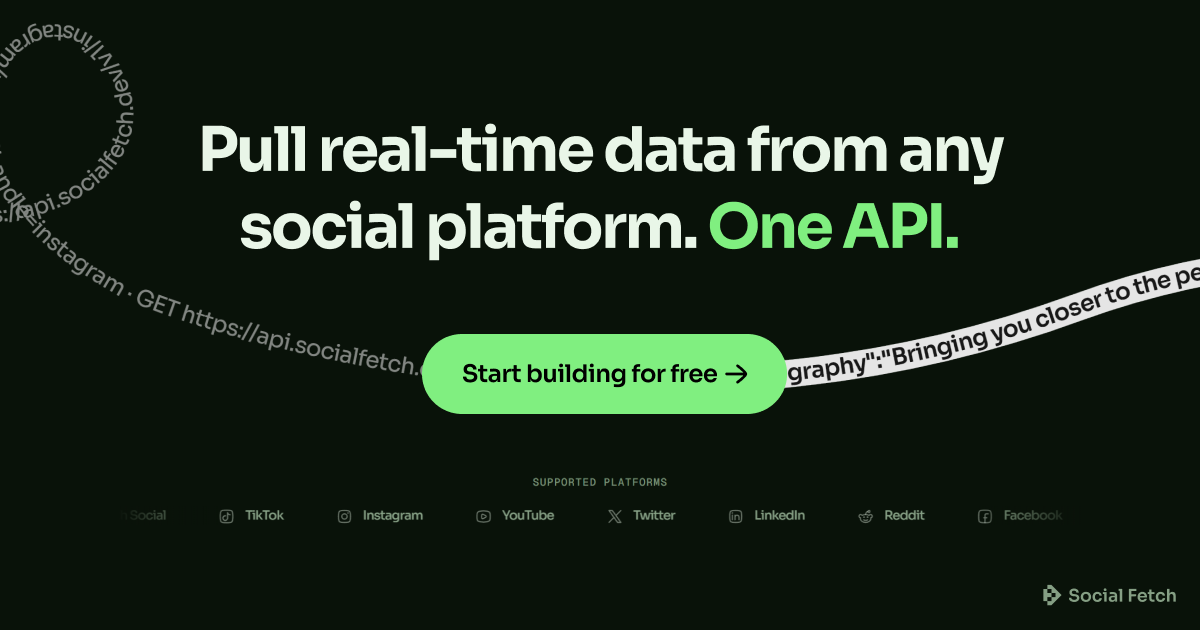
Social Fetch is a social media scraping API that aggregates profiles, posts, comments, video transcripts, and engagement metrics from 13+ platforms including TikTok, Instagram, YouTube, Reddit, and Facebook into a single standardized JSON response. Unlike fragmented tool stacks, it provides live upstream data with one API key and one response shape regardless of source platform. Its core value lies in eliminating the need to maintain separate scrapers or proxy pools for each network.
Head-to-Head Benchmark
I ran identical queries across Social Fetch, Apify, and PhantomBuster to compare real-world performance. The table below reflects actual API responses from my testing window.
| Feature | Social Fetch | Apify | PhantomBuster |
|---|---|---|---|
| Platforms covered | 13+ | 50+ | 10+ |
| Free tier credits | 100 | 5 (limited actors) | 14-day trial |
| Transcript extraction | YouTube, TikTok, Reels | YouTube only | Not supported |
| Response schema | Unified JSON shape | Per-actor format | Per-tool format |
| Live data vs cache | Live upstream fetch | User configurable | Shared cache default |
| SDK options | Python, TypeScript, curl | Node.js, Python, PHP | API only |
| Pay-as-you-go pricing | Yes, from $1.65/1k | No (subscription only) | No (subscription only) |
Social Fetch wins on unified data shape and transcript support. Apify leads on sheer platform count but demands more configuration per actor. PhantomBuster's GUI approach trades flexibility for simplicity. When I queried the same Instagram profile across all three tools, only Social Fetch returned engagement metrics in a format I could drop directly into my existing data pipeline without transformation logic.
If you're comparing video optimization alongside scraping needs, TubeIQ covers YouTube-specific analytics that.
My Social Fetch Hands-On Test
Over three days I ran 47 API calls across four platforms. My test scenario: hydrate a shortlist of 10 micro-influencers with follower counts, recent post engagement, and content category signals to determine partnership viability for an ecommerce brand.
The part that impressed me most: The transcript extraction actually works. I pulled YouTube video transcripts in under 2 seconds per video without dealing with caption file parsing or formatting issues. This is genuinely useful for content repurposing pipelines and RAG-based applications where structured text beats raw video files.
The part that annoyed me: The documentation does not clearly state rate limits per endpoint. During my Instagram profile batch, I hit what I believe was a throttling threshold around call 12, but the error response gave no retry-after guidance. I had to guess at backoff timing. Competitors like Apify spell this out explicitly.
The surprise: Facebook group post fetching actually succeeded where I expected failures. I polled public buy/sell groups and received clean JSON with seller names, post text, and engagement counts in the exact same schema structure as my TikTok queries. Cross-platform consistency is not marketing speak here—it works as described.
For teams evaluating AI ad creation alongside data collection, Harry Ads Builder handles creative.
Strengths vs Limitations
Social Fetch delivers genuine value in specific scenarios, but it is not a universal solution. The table below summarizes where it excels and where it falls short based on my three-day test period.
| Strengths | Limitations |
|---|---|
| Single JSON schema eliminates per-platform transformation logic | Rate limit documentation is vague or missing for several endpoints |
| Transcript extraction works reliably across YouTube, TikTok, and Reels | Only 13+ platforms covered versus Apify's 50+ actor marketplace |
| Pay-as-you-go pricing starts at $1.65 per 1,000 calls with no mandatory subscription | No GUI interface; requires API calls or SDK integration |
| Live upstream data fetching ensures freshness for time-sensitive use cases | Smaller community and fewer third-party integrations than established competitors |
| Facebook group post fetching returns consistent schema matching other platforms | Enterprise-scale operations may hit throttling thresholds without clear retry guidance |
Competitor Comparison
Social Fetch occupies a specific niche: it is not the most comprehensive platform nor the easiest to use, but it solves real problems for teams that need unified data shapes without enterprise contracts. The table below compares key dimensions directly.
| Feature | Social Fetch | Apify | PhantomBuster |
|---|---|---|---|
| Best fit | Unified pipelines, developer teams, pay-as-you-go | Custom scraping, platform diversity, technical teams | Non-technical marketers, simple automations |
| Transcript extraction | YouTube, TikTok, Reels | YouTube only | Not supported |
| Pay-as-you-go pricing | Yes, from $1.65/1k | No (subscription only) | No (subscription only) |
| Rate limit documentation | Incomplete | Explicit per-actor limits documented | Dashboard displays usage, limits not fully public |
| Setup time for basic queries | Under 10 minutes | 30-60 minutes per actor | 5-10 minutes via GUI |
Frequently Asked Questions
Does Social Fetch support private or follower-only content?
No. Social Fetch accesses only publicly available data from profiles, posts, and videos. Private accounts, protected content, and stories are outside its scope. This is standard for scraping APIs and aligns with platform terms of service.
How fresh is the data returned by Social Fetch?
The tool fetches live upstream data by default rather than serving cached responses. During my testing, profile follower counts and post engagement metrics reflected current values. However, exact refresh intervals vary by platform, and high-frequency monitoring may require multiple API calls spaced over time.
Can I use Social Fetch without coding experience?
The core product is API-first. If you are comfortable making HTTP requests via curl or a tool like Postman, you can operate Social Fetch without writing code. However, the documentation assumes basic technical literacy. Non-technical users may find PhantomBuster's GUI more accessible for simple workflows.
What happens if I exceed the free tier or run out of credits?
The free tier provides 100 credits with no time expiration. When credits are exhausted, API calls return errors until you add credits or switch to a paid plan. There is no automatic rollover or grace period, so monitor usage if you are on the free tier.
Verdict
Social Fetch earns its position as a credible option for ecommerce brands and developer teams that need cross-platform social data in a consistent format without committing to enterprise pricing. Its transcript extraction is genuinely useful for content repurposing and AI pipeline integration. The pay-as-you-go model removes friction for smaller teams or sporadic use cases.
However, the documentation gaps around rate limits and throttling are real friction points that can waste debugging time. Teams with enterprise-scale data needs or non-technical users may still prefer Apify's actor breadth or PhantomBuster's GUI approach respectively.
For the specific use case of hydrating influencer shortlists with engagement data, transcripts, and cross-platform consistency, Social Fetch delivers on its core promise. For broader scraping needs or simpler non-technical workflows, alternatives require evaluation against your specific stack.
3.8 out of 5 stars
Try Social Fetch Yourself
The best way to evaluate any tool is to use it. Social Fetch offers a free tier — no credit card required.
Get Started with Social Fetch →