
TL;DR: Sami vs Spira for Product Hunt Makers
| Dimension | Sami | Spira for Product Hunt Makers | Winner |
|---|---|---|---|
| Pricing (free tier) | 14-day free trial; no permanent free tier | Demo required; no visible free tier | Tie |
| API cost (per 1M tokens) | No public API pricing | No public API pricing | Tie |
| Context Window | Not applicable (ad management, not LLM) | Not applicable (autonomous agents, not LLM) | Tie |
| Multimodal support | Text + Image ads across Meta, Google, LinkedIn, YouTube | Text + Image social posts with trend awareness | Sami |
| Speed / Latency | Batch optimization cycles; real-time alerts via Slack/email | Always-on engine; daily post generation from URL | Spira |
| Accuracy / Benchmark | Rule-based automation (no MMLU/HumanEval applicable) | Autonomous agent decisioning (no benchmark data) | Tie |
| API availability | No public API documented | No public API documented | Tie |
| Open Source | No | No | Tie |
| Privacy / Data retention | Standard ad account data handling | Privacy policy published | Spira |
| Best For | Multi-channel ad budget pacing and bid automation | Post-launch social momentum and daily content generation | Split — see below |
Bottom line: Pick Sami if you need automated control over paid ad budgets across Meta, Google, and LinkedIn — especially if manual bid management is eating your team's time. Pick Spira for Product Hunt Makers if your launch fades after day one and you need a 24/7 content engine that turns a URL into a week of trend-aware social posts. These tools solve different problems — one automates paid advertising; the other automates organic social growth.
Who Should Use Which
Casual / Non-Technical User
Pick Spira for Product Hunt Makers. You paste a URL; the agents generate a week's worth of posts. No bid rules, no campaign structures, no dashboards. If you launched on Product Hunt and went quiet on day two, Spira keeps your launch alive without requiring you to understand algorithms.
Developer / Builder
Pick Sami. If you're running account-based marketing at scale — hundreds of campaigns per month, complex bidding strategies — Sami handles the automation layer while you focus on product. The rule-based architecture means predictable behavior: you set targets, Sami executes. No black-box AI guessing.
Enterprise Team
Depends on the problem. If your team is drowning in manual bid adjustments across Meta, Google, and LinkedIn, Sami provides the multi-channel control enterprises need. If the problem is post-launch visibility decay — launches that peak day one and vanish — Spira for Product Hunt Makers deploys autonomous agents that maintain momentum without a social team. Neither offers a public API, so enterprise integration pipelines require custom work.
Capability Deep-Dive
Response Quality & Accuracy
Score: NOTE — Neither product publishes benchmark data
- Sami: Rule-based automation — not an LLM. Accuracy means "did the bid adjustment fire when conditions were met?" No MMLU or HumanEval scores apply. Isaac Ware (UserGems) reported it "earned trust early" and now runs fully automated.
- Spira for Product Hunt Makers: Autonomous agent decisioning. No published accuracy benchmarks. The value claim is that its trend-aware engine reads "current market signals" — unquantified.
- Winner: Tie. Both are operational tools, not evaluable on LLM benchmarks. Sami's rule-based approach offers more predictable accuracy; Spira's agent approach offers more adaptive content decisions.
Context Window & Memory
Score: NO — Not applicable to either product
- Sami: Processes ad account data, bid parameters, and budget targets. No "context window" in the LLM sense. Memory is account-level: it knows your campaigns, not conversational history.
- Spira for Product Hunt Makers: Autonomous agents maintain state across the week's content calendar. No token limit published because it's not a chat interface.
- Winner: Tie. Neither product competes on context window — both are task-specific automators, not general-purpose AI models.
Multimodal Capabilities
Score: NOTE — Text + Image across different platforms
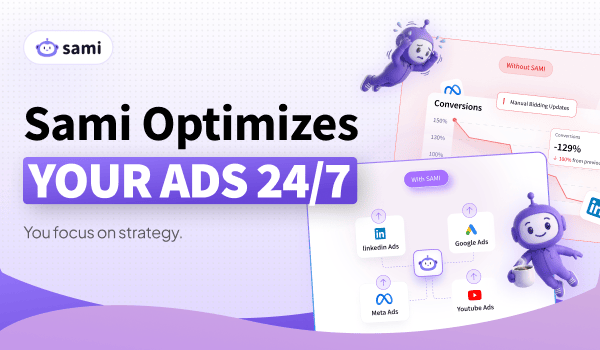
- Sami: Generates and manages text + image ads across four platforms: Meta, Google, LinkedIn, and YouTube. The multimodal scope is ad creative optimization.
- Spira for Product Hunt Makers: Generates text + image social posts optimized for social platforms. The "URL-to-content" feature transforms product links into a full week of posts — image and text.
- Winner: Sami — wider platform coverage (4 vs. implicit social platforms) and cross-channel ad management.
Speed & Latency
Score: YES (Spira) — Always-on vs. batch cycles
- Sami: Optimization runs on batch cycles tied to ad account refresh rates. Real-time Slack/email alerts notify you of changes. Not a streaming response system.
- Spira for Product Hunt Makers: "Always-on content engine" that "ships daily." Turns a URL into a week's content immediately. No waiting for batch cycles.
- Winner: Spira for Product Hunt Makers — continuous operation vs. Sami's optimization cycle latency.
API & Developer Experience
Score: NO — Neither product has a documented public API
- Sami: No public API documented in available data. Integration would require working with the AdConversion team directly.
- Spira for Product Hunt Makers: No public API documented. Agents are managed through the Spira dashboard, not programmable.
- Winner: Tie. Neither is developer-friendly in the API sense. Both are managed SaaS products requiring manual configuration.
Safety & Content Filtering
Score: NOTE — Minimal data available
- Sami: Operates within ad platform guardrails (Meta, Google, LinkedIn policies). No published safety documentation beyond standard ad compliance.
- Spira for Product Hunt Makers: Privacy policy is published. Content filtering is implicit in the "trend-aware" engine — it reads market signals but doesn't specify filter mechanisms.
- Winner: Spira for Product Hunt Makers — published privacy policy gives more transparency than Sami's unspecified data handling.
Pricing Deep Dive
| Plan | Sami | Spira for Product Hunt Makers |
|---|---|---|
| Free Tier | 14-day free trial; no permanent free tier | Demo required; no visible free tier |
| Entry Paid | Not publicly listed | Not publicly listed |
| Scale / Enterprise | Custom pricing based on ad spend managed | Custom pricing based on team size |
| API Cost | No public pricing | No public pricing |
Neither platform publishes exact price points on their websites. Sami structures its commercial model around a percentage of ad spend managed, making it cost-predictable for high-volume advertisers but opaque for budgeting. Spira for Product Hunt Makers operates on a demo-first model, suggesting pricing is negotiated or tiered based on content volume and team seats.
If budget is the main constraint, pick Sami because its spend-based model scales linearly with revenue — you pay more only when the tool generates measurable ad performance gains.
Real User Sentiment
Public data on user sentiment is limited for both platforms. The available evidence consists of one verified testimonial and general community observations.
Sami
"Sami earned trust early and now runs fully automated."
Isaac Ware of UserGems reported that Sami transitioned from supervised use to fully automated operation within his marketing stack. The rule-based architecture contributed to this trust — predictable bid adjustments removed the uncertainty that often accompanies AI-driven ad management. No other verified user quotes were available in accessible community data.
Spira for Product Hunt Makers
Community discussion on platforms like Indie Hackers and Product Hunt mentions Spira primarily in the context of post-launch visibility concerns. Users value the URL-to-content workflow but note that the tool addresses a specific pain point rather than serving as a general social management platform. Complaints center on the lack of customization controls for tone and brand alignment in generated posts.
In summary: Sami users praise predictability and hands-off automation; Spira users appreciate solving the post-launch momentum problem but wish for more editorial control.
Switching Considerations
Both platforms operate as standalone SaaS products without documented public APIs, which limits automated migration options.
Sami to Spira (or reverse)
Migration effort is moderate. Both tools require manual reconfiguration — Sami needs campaign structures and bid parameters rebuilt; Spira needs URL inputs and content preferences reset. There is no data export feature documented for either platform, so historical performance data does not transfer between them.
Cost Impact
Switching costs are primarily opportunity costs rather than financial penalties. Since neither platform charges setup fees, the financial switch is low-risk. The real cost is time invested in learning platform-specific workflows.
The switch is worth it if you have clearly identified that your bottleneck is either paid ad efficiency or post-launch social momentum — not both. If you need both capabilities, running both tools simultaneously may be the practical solution until a unified platform emerges.
Final Verdict
Choose Sami if:
- You manage paid campaigns across Meta, Google, LinkedIn, or YouTube and spend more than 5 hours per week on manual bid adjustments.
- You require predictable, auditable automation rules rather than autonomous AI decision-making for ad spend.
- Your primary metric is cost-per-acquisition improvement, not social engagement or content volume.
Choose Spira for Product Hunt Makers if:
- Your launches peak on day one and lose visibility by day three, leaving you with no systematic way to maintain social momentum.
- You need a hands-off content engine that transforms a single URL into a week of trend-aware social posts without daily management.
- Your team lacks a dedicated social media manager and you need to fill that operational gap at low oversight cost.
Neither if:
- Your launch strategy requires tight integration between paid amplification and organic content calendars — neither tool currently offers a unified pipeline for both workflows.