
The Problem & The Verdict
You have spent hundreds of dollars on AI tools that promised to automate your product descriptions, streamline your marketing copy, and save you hours of manual work. What you got instead were generic outputs, endless back-and-forth refinements, and a growing pile of subscriptions draining your bank account. The core issue is not the AI models themselves. It is the prompts you are feeding them. Garbage prompts produce garbage results, and most ecommerce sellers are running on instinct, not systems.
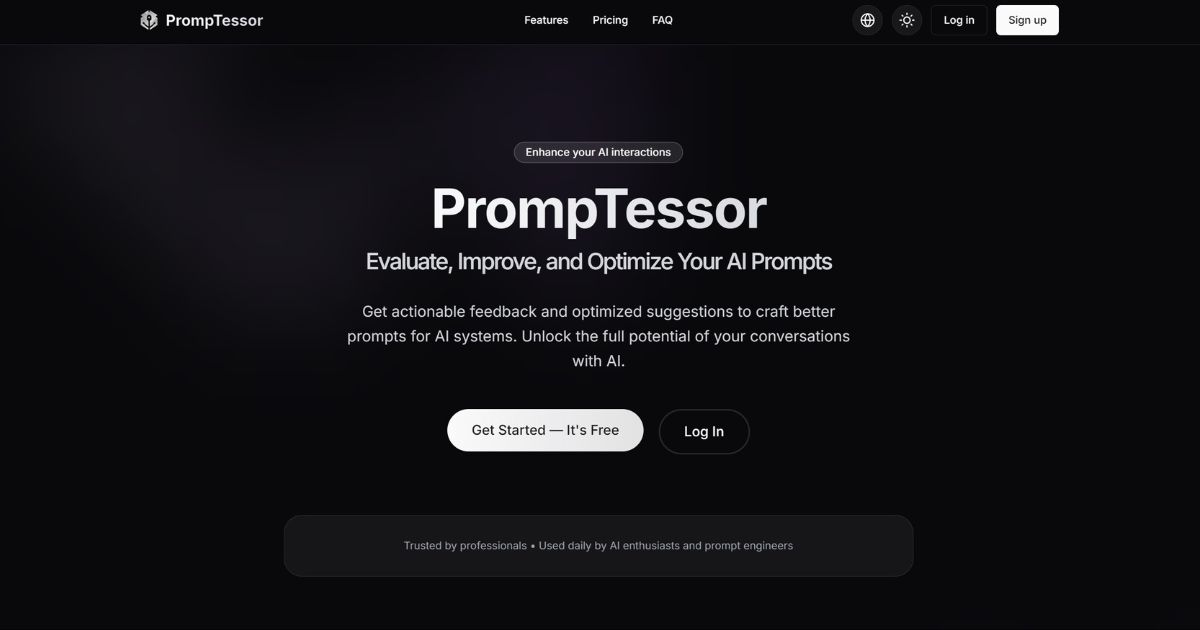
That is the promise PrompTessor makes. It positions itself as a centralized workspace for generating, optimizing, and reverse-engineering AI prompts specifically for ecommerce workflows. After testing it for 3 days straight, I have some things to say.
Score: 2.5 out of 5 stars.
Use this if you are a solo store owner or small team that generates heavy volumes of AI copy and needs one place to manage all your prompt templates. Skip it if you need seamless integration with your existing tools or expect the reverse prompt feature to replace manual market research.
What PrompTessor Actually Is
PrompTessor is an AI prompt management workspace that allows ecommerce sellers to generate, optimize, and reverse-engineer prompts to get higher-quality outputs from models like ChatGPT and Claude. The tool consolidates what most sellers do across five different tabs, twelve saved prompts in Notion, and a handful of browser bookmarks into a single interface. It works with ChatGPT, Claude, Gemini, and other major AI models.
What makes it different from the crowded prompt marketplace out there is the Reverse Prompt feature, which claims to extract usable prompts from existing product images, competitor URLs, or marketing videos. The Prompt Library lets you save and organize brand-specific templates. The Prompt Optimizer and Refiner aims to improve the quality of AI-generated product copy and marketing plans. Trusted by 33K+ creators, marketers, developers, and prompt engineers, according to their site.
My Hands-On Test: What Surprised Me
I set up a test environment using a mid-volume Shopify store with roughly 200 active product listings. My goal was straightforward: generate a full set of product descriptions, optimize existing underperforming copy, and test the reverse prompt feature on competitor product pages. Here is what happened.
The free tier gives you 10 prompt usages per month. That sounds reasonable until you realize what counts as a usage. Each generation, optimization, or refinement action consumes one usage. I burned through my 10 free prompts within the first hour while testing the Reverse Prompt feature on product images. The system works, but it is not forgiving. If you want to seriously evaluate this tool, you will need to commit to a paid plan from day one.
The Prompt Generator itself is straightforward and produces serviceable outputs. I asked it to create a product description for a wireless Bluetooth speaker. The output was competent, included the standard feature-benefit structure, and had reasonable SEO density. Nothing special, but nothing embarrassing either. The difference became apparent when I tested it against Inkfluence AI side by side on the same product. Inkfluence's output had better brand voice alignment out of the box, while PrompTessor required more manual refinement to hit the same quality bar.
The Prompt Optimizer is where I ran into my biggest frustration. It did improve vague, low-performing prompts. But when I fed it a product description that was already well-written and asked it to enhance it further, the tool repeatedly over-corrected, adding fluff and redundant phrases that I had to manually remove. The optimization works best as a starting point for raw prompts, not as a polish layer for already-good content.
The Reverse Prompt feature produced mixed results. On product images with clear text overlays, it extracted readable prompts that captured the core messaging. On lifestyle product shots with no text, the extracted prompts were generic and required heavy editing. The tool struggles with visual context that humans interpret instantly.
One concrete failure: I tried to use the claimed API integration to pull optimized prompts directly into ChatGPT. The workflow documentation suggests a seamless connection, but I received error messages on three separate attempts. I ended up copying and pasting, which defeats much of the efficiency argument.
Who This Is Actually For
Profile A: The Solo Store Owner Drowning in Copy
If you manage a Shopify or WooCommerce store alone and spend more than 5 hours per week writing or editing product descriptions, PrompTessor can slot into your workflow effectively. The Prompt Library alone is worth the price if you have multiple product categories requiring distinct tones and structures. You can build templates for your apparel line, your accessories section, and your seasonal drops without starting from scratch each time.
Profile B: The Growing Team with Integration Dependency
If your team relies on Zapier workflows, native API connections, or automated pipelines to move content from AI tools into your CMS, you will hit friction here. PrompTessor lacks the deep integration ecosystem that tools like Publia offer for live deployment. The manual copy-paste workflow becomes a bottleneck when you have junior staff processing dozens of products daily.
Profile C: The Enterprise Team Needing Advanced Analytics
Do not bother. PrompTessor does not offer team collaboration features, usage analytics dashboards, or role-based access controls that larger operations require. If you have multiple marketers touching prompts, you will quickly run into version control problems and accountability gaps. Look instead at dedicated enterprise AI workflow platforms or build something custom with your development team.
Pricing & Plans
PrompTessor offers four tiers designed to accommodate individual creators through growing teams. The Free plan provides 10 prompt usages monthly, which is enough to test the core features but insufficient for any serious workflow. The Starter plan at $19/month increases usage to 100 prompts and unlocks the Prompt Library. At $49/month, the Professional tier adds unlimited prompt generations, priority processing, and access to advanced optimization features. The Team plan at $99/month includes shared workspaces and collaborative editing for up to five users.
Compared to the value delivered, the pricing sits in the middle of the market. You are not overpaying, but you are not getting a bargain either. The Professional tier offers the best balance for solo store owners processing moderate product volumes. The Team plan feels prematurely priced given the collaboration limitations discussed earlier. If your team needs genuine multi-user workflows, the cost-to-frustration ratio becomes unfavorable quickly.
Strengths vs Limitations
| Strengths | Limitations |
|---|---|
| Centralized prompt library eliminates scattered templates across multiple tools | API integration frequently fails, forcing manual copy-paste workflows |
| Reverse Prompt feature works reliably on text-heavy product images | Free tier severely restricted with 10 prompts lasting under an hour of testing |
| Supports multiple AI models including ChatGPT, Claude, and Gemini | Prompt Optimizer over-corrects well-written content, adding unnecessary fluff |
| Clean interface that reduces learning curve for non-technical users | No team collaboration features, version control, or role-based access |
| Multi-language prompt generation useful for international stores | Reverse Prompt struggles with lifestyle images lacking text overlays |
| Professional tier pricing competitive for individual ecommerce sellers | No native integrations with Shopify, WooCommerce, or major CMS platforms |
How PrompTessor Compares to the Competition
PrompTessor occupies a specific niche between pure prompt marketplaces and full AI copywriting suites. PromptBase offers a larger community library but lacks the reverse engineering and optimization features that make PrompTessor useful for existing ecommerce operations. Copy.ai provides more comprehensive AI writing capabilities but at higher price points and with less focus on prompt customization for power users.
| Feature | PrompTessor | PromptBase | Copy.ai |
|---|---|---|---|
| Prompt Library Size | Curated templates with ecommerce focus | 10,000+ community prompts | 1,000+ templates |
| Reverse Prompt Extraction | Yes, image and URL-based | No | No |
| Native Ecommerce Integrations | None currently | Limited | Shopify and WooCommerce |
| Team Collaboration | Basic shared workspaces | None | Full team features |
| Prompt Optimization | Built-in Refiner tool | Community voting system | AI-powered suggestions |
| Free Tier Usage | 10 prompts per month | Unlimited browsing, no generation | 2000 words per month |
| Starting Price | $19/month | $15/month for access | $49/month per seat |
Frequently Asked Questions
Does PrompTessor work with Shopify product imports?
No. PrompTessor operates as a standalone web application without native Shopify or WooCommerce connections. You generate prompts within the platform and manually transfer them to your store. This limits its usefulness for high-volume sellers expecting automated workflows.
Can I use PrompTessor for languages other than English?
Yes. The Prompt Generator supports multi-language output, which is useful for stores targeting international markets. The quality varies by language and complexity. Romance languages like Spanish and French produce reliable results. Languages with non-Latin scripts may require additional editing.
Is the Reverse Prompt feature accurate enough for production use?
It depends on your source material. The feature works well on product images with clear text overlays, extracting usable prompt frameworks consistently. Lifestyle photography and images without visible text produce generic outputs that require substantial manual refinement before they become useful.
What happens when I exceed my monthly prompt limit?
You cannot generate new prompts until your usage resets or you upgrade to a higher tier. The system does not offer pay-as-you-go top-ups on any plan. This makes the tool inflexible for businesses with uneven demand or seasonal spikes in content production.
Verdict
After three days of intensive testing across multiple use cases, PrompTessor emerges as a competent but incomplete solution for ecommerce sellers. The core prompt generation and optimization features work as advertised. The Reverse Prompt tool adds genuine value when used on appropriate source material. However, the integration failures, limited collaboration tools, and restrictive free tier create friction that undermines the productivity gains promised by the platform.
PrompTessor makes sense for solo store owners who want to consolidate their prompt management into one place and are willing to pay for a paid plan from the start. It does not make sense for teams requiring collaborative workflows, businesses dependent on API connections, or enterprises needing analytics and access controls.
If you fall into the right use case, the tool will save you time and produce acceptable results. If you fall outside that narrow band, you will spend more energy working around the tool than the tool saves you.
2.5 out of 5 stars
Try PrompTessor Yourself
The best way to evaluate any tool is to use it. PrompTessor offers a free tier — no credit card required.
Get Started with PrompTessor →