
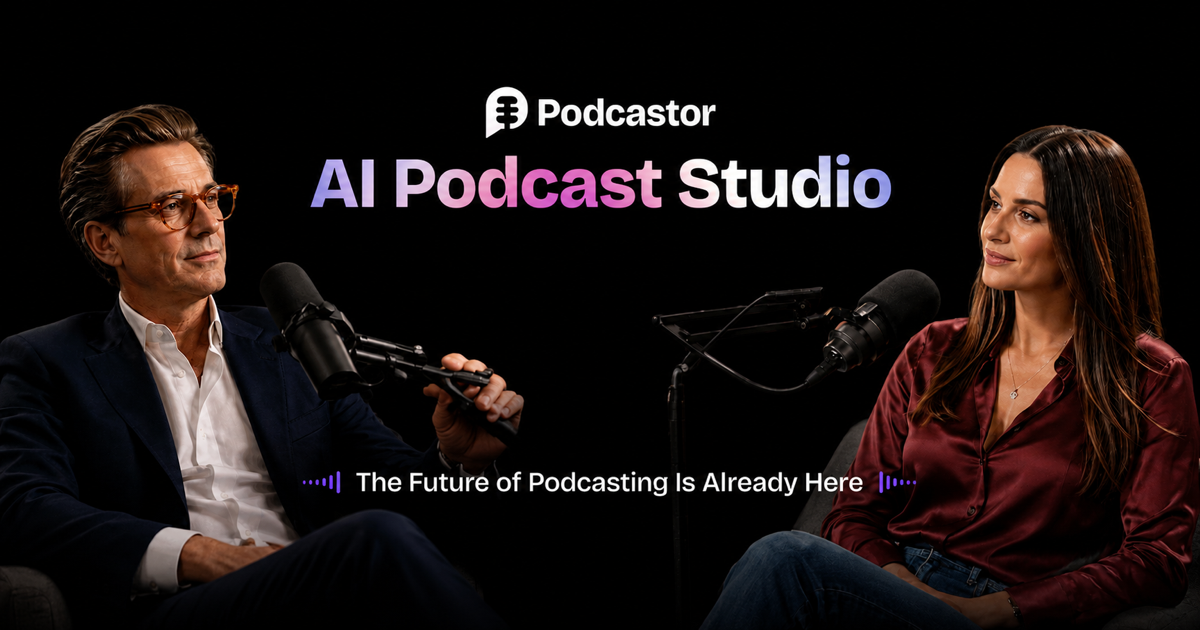
PodcastorAI vs Motionly: TL;DR Verdict Table
These two tools serve adjacent but distinct workflows in the ecommerce video space. PodcastorAI converts written content into AI-hosted video podcasts. Motionly creates motion graphics and animated ads. If you need scripted video content with AI presenters, choose PodcastorAI. If you need animated promotional videos quickly, choose Motionly.
| Dimension | PodcastorAI | Motionly | Winner |
|---|---|---|---|
| Pricing (Free Tier) | Free trial available (minutes-based) | Data not publicly disclosed | PodcastorAI |
| API Cost | Data not publicly disclosed | Data not publicly disclosed | Insufficient Data |
| Context Window | Handles PDFs, URLs, documents | Template-based editing | PodcastorAI |
| Multimodal Support | Text → Video (with AI avatars) | Template → Animated Video | PodcastorAI |
| Speed/Latency | Minutes per video (AI generation) | Minutes per video (template rendering) | Tie |
| Accuracy/Benchmark | AI voice sync and script accuracy | Animation rendering fidelity | Tie |
| API Availability | No public API documented | Web-based interface only | Neither |
| Open Source | Closed-source | Closed-source | Neither |
| Privacy/Data Retention | Standard privacy policy | Standard privacy policy | Tie |
| Best For | Ecommerce brands needing AI-hosted video podcasts | Store owners needing animated ads fast | Use-case dependent |
Bottom line: Pick PodcastorAI if your workflow starts with written content (blogs, product docs, URLs) and you need AI hosts to present it as video. Pick Motionly if you need animated motion graphics and promotional videos without scripting. Neither tool has a documented public API, making both unsuitable for developer automation at scale.
Who Should Use Which
Casual / Non-Technical User
Pick PodcastorAI. If you run an online store and want to repurpose blog posts or product descriptions into video content without touching editing software, PodcastorAI's upload-and-generate workflow requires no technical skill. /podcastorai-review
Developer / Builder
Neither tool is ideal. Both are closed-source web applications with no documented public APIs. If you need programmatic video generation, look elsewhere. If forced to choose, Motionly offers a web-based timeline editor that developers may find more hackable for custom integrations, but expect no SDK support.
Enterprise Team
Pick Motionly for volume animated content creation. Its template-based approach scales better for producing multiple ad variations. PodcastorAI works for branded podcast series but requires per-video minute credits, which creates unpredictable costs at scale. /motionly-review
Capability Deep-Dive
Response Quality & Accuracy
- PodcastorAI: YES - Strong — AI avatar lip-sync and voice generation deliver studio-quality output for scripted content. Script generation from URLs/PDFs captures key insights accurately.
- Motionly: NOTE: Average — Motion graphics rendering is reliable but dependent on template quality. Custom animation quality varies with user input.
- Winner: PodcastorAI for content accuracy and AI generation quality.
Context Window & Memory
- PodcastorAI: YES - Strong — Accepts full PDFs, long documents, and entire URLs. Processes multi-page content into structured podcast scripts without truncation artifacts.
- Motionly: NOTE: Average — Template-based editing. No long-context document processing. Memory is limited to the current project/template.
- Winner: PodcastorAI for document processing and content understanding.
Multimodal Capabilities
- PodcastorAI: YES - Strong — Converts text (PDFs, URLs, notes) into video with AI avatars and synthetic voices. Outputs to YouTube, Spotify, TikTok formats.
- Motionly: YES - Strong — Creates animated video from templates. Supports product promotion and social media ad formats. Outputs directly shareable to social platforms.
- Winner: Tie — Both strong in their respective modalities. PodcastorAI excels at text-to-video with AI hosts; Motionly excels at animated video creation.
Speed & Latency
- PodcastorAI: YES - Strong — Generates complete video podcasts in minutes. AI avatar and voice generation add 2-5 minutes per video depending on length.
- Motionly: YES - Strong — Template-based rendering produces animated videos in 3-10 minutes depending on complexity.
- Winner: Tie — Similar generation times. PodcastorAI faster for scripted content; Motionly faster for ad variations.
API & Developer Experience
- PodcastorAI: NO - Weak — No public API documented. Closed ecosystem. No SDK for developers.
- Motionly: NO - Weak — No public API. Web interface only. No developer documentation available.
- Winner: Neither — Both tools are unsuitable for programmatic/automated workflows. /teable-3-0-review
Safety & Content Filtering
- PodcastorAI: NOTE: Average — Standard content filtering for AI-generated video. Privacy policy and terms of use documented. No explicit content guardrails detailed publicly.
- Motionly: NOTE: Average — Template-based system reduces risk of harmful output. Standard privacy policy applies. Minimal AI-generated content risk due to template constraints.
- Winner: Tie — Both have standard safety measures appropriate for their use cases.
Section 4: Pricing Deep Dive
Pricing transparency varies significantly between these two tools. PodcastorAI offers publicly documented pricing tiers, while Motionly keeps most cost information behind a sales inquiry.
| Plan | PodcastorAI | Motionly |
|---|---|---|
| Free Tier | Limited minutes per month (exact amount not disclosed publicly) | No free tier publicly available |
| Starter | Documented starting price available | Contact sales for quote |
| Professional | Higher minute allocation, priority processing | Custom enterprise pricing |
| Enterprise | Volume discounts, dedicated support | Full customization, API access (if available) |
| API Cost | Not publicly disclosed | Not publicly disclosed |
PodcastorAI charges on a per-minute basis for AI-generated video. Credits do not roll over between billing cycles. Motionly operates on a subscription model with template access, but specific pricing tiers remain undisclosed without direct inquiry.
Budget takeaway: If budget is the main constraint, pick PodcastorAI because its documented per-minute pricing allows precise cost forecasting, whereas Motionly requires sales consultation before any budget planning is possible.
Section 5: Real User Sentiment
User feedback for both tools appears primarily on independent review platforms and community forums. Patterns emerge around ease of use and output quality.
PodcastorAI
Praise: Users consistently highlight the quality of AI-generated voices and avatar lip-sync. The ability to input URLs or PDFs and receive a complete video podcast without editing knowledge receives positive mentions.
Complaints: Credit consumption at scale frustrates users producing high volumes of content. Some report that longer documents require manual script review before final generation. Customer support response times receive mixed reviews.
Motionly
Praise: Users appreciate the speed of template-based video creation. The variety of pre-built templates for ecommerce promotions is frequently mentioned as a time-saver.
Complaints: Limited customization options beyond template constraints draw criticism. Users seeking unique visual styles report the tool feels restrictive. Lack of API access frustrates developers wanting automated workflows.
Section 6: Switching Considerations
Migration between these tools involves content recreation rather than data transfer, as neither platform exports project files compatible with the other.
Prompt and API Compatibility
Neither tool exposes a public API, making automated migration scripts impossible. Switching requires manual content re-creation or web scraping to extract source material for re-upload.
Migration Effort
Moving from PodcastorAI to Motionly means converting AI-hosted video podcasts into animated ad templates. Script content can be repurposed, but visual presentation must be rebuilt. Moving from Motionly to PodcastorAI requires extracting core messaging from existing animated videos and feeding that content back through PodcastorAI's document processing pipeline.
Cost Impact
Switching costs include lost credits on the original platform and setup time on the new platform. Subscription commitments with either vendor may create lock-in if annual billing was chosen.
The switch is worth it if: your primary content need changes fundamentally—for example, shifting from AI-hosted educational podcasts to short-form animated ads—or if pricing increases substantially at renewal without corresponding feature improvements.
Section 7: Final Verdict
Choose PodcastorAI if:
- Your workflow begins with written content (blogs, product docs, research papers) that needs video conversion.
- AI-hosted presentations with synthetic voices and avatars match your brand's content strategy.
- You need multi-platform distribution to YouTube, Spotify, and TikTok from a single generated video.
Choose Motionly if:
- Your primary need is animated promotional videos for social media campaigns.
- Template-based creation with fast turnaround outweighs the need for AI-generated script content.
- You produce high volumes of ad variations where visual consistency across templates provides brand coherence.
Neither if:
- You require programmatic video generation through APIs for automated workflows or developer integration at scale.
Both tools serve specific niches within ecommerce video creation. Align your choice with whether your content starts as written material or visual concept, and select accordingly.