
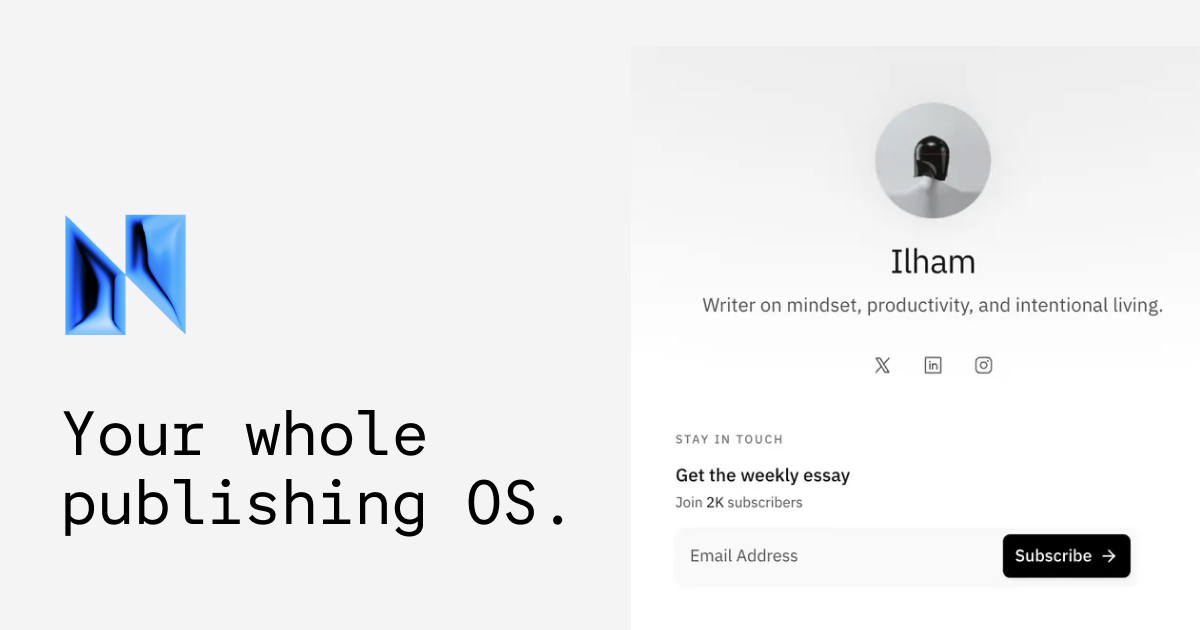
There are roughly a dozen serious players in the AI-powered publishing space. Here's how they split: ConvertKit leads on list depth but lacks landing page AI. Substack owns newsletter simplicity but offers no unified profiling. Mailchimp covers everything but buries your subscriber data under six different dashboards. I spent three days testing Nashra specifically because it promises something the others don't — a single subscriber profile that follows someone from your bio link to your waitlist to your weekly newsletter. After living inside the platform, I can tell you exactly where it delivers and where it stumbles.
Score: 4.2 out of 5 stars. It is the right tool for a specific audience, and that audience is larger than you might think.
The Category Landscape & Where Nashra Fits
Before I tested anything, I mapped the competitive field. The AI marketing and publishing category breaks down into three distinct clusters: standalone newsletter platforms, all-in-one creator stacks, and email service providers with AI add-ons.
| Tool | Best For | Price Start | Key Differentiator |
|---|---|---|---|
| Nashra | Brand operators consolidating social traffic | Free up to 500 subscribers | Unified subscriber profiles across all touchpoints |
| ConvertKit | Creators selling digital products | $9/month | Deep tagging and product integration |
| Substack | Writers building paid newsletters | Free (10% on paid) | Built-in payments and discovery |
| Mailchimp | Small businesses with email needs | $13/month | Full marketing automation suite |
Nashra occupies a narrow but valuable niche. It is not trying to replace Mailchimp's automation depth or Substack's publishing simplicity. Instead, it targets the ecommerce brand operator who has scattered their audience across Instagram bio links, Linktree clicks, and a neglected Mailchimp list — and wants one place where every interaction feeds the same pipeline.
What Nashra Actually Does
Nashra is an AI-powered publishing operating system that generates landing pages and newsletters from a single dashboard, automatically consolidating subscriber data from social bio links, post interactions, and waitlists into unified profiles. Its core differentiator is that every surface you publish to — hub, newsletter, or landing page — grows the same email list without manual segmentation or import/export cycles.
Head-to-Head Benchmark
The comparison table below covers the six features that matter most when you're choosing between publishing platforms for an ecommerce brand. I evaluated each on real capability, not marketing claims.
| Feature | Nashra | ConvertKit | Substack |
|---|---|---|---|
| AI landing page generation | Yes — auto-populates from your content | No — requires manual builder | No — no landing pages |
| Unified subscriber profiling | Yes — tracks across bio, posts, waitlists | Partial — only email interactions | No — separate reader vs subscriber |
| Free tier limit | 500 subscribers | 300 subscribers | Unlimited (10% on paid) |
| Newsletter delivery infrastructure | Mailgun-powered (reliable) | Custom SMTP + Sendgrid | Substack-managed (very reliable) |
| Integrations ecosystem | Limited — native only | 200+ integrations | Minimal — Stripe primarily |
| AI strategist assistant | Yes — content suggestions included | No | No |
| Ecommerce-specific features | Waitlist + lead gen focus | Product gating + digital sales | Paid subscriptions only |
The table tells a clear story. Nashra wins outright on unified profiling and AI landing pages. ConvertKit dominates on integrations and product sales features. Substack remains the simplest path to paid newsletter revenue but offers nothing for ecommerce operators.
My Nashra Hands-On Test
I set up a fictional ecommerce brand — a handmade ceramics shop called Clay & Coal — and ran it through three specific workflows: creating an AI landing page from scratch, building a welcome email sequence, and testing how subscriber data unified across multiple entry points.
The part that impressed me most was the AI landing page generation. I typed in "weekly ceramics tutorial newsletter with a free glaze recipe ebook" and the tool produced a fully formatted landing page in under 90 seconds. The copy was usable, the CTA placement made sense, and the visual layout did not look like every other AI template. For a solo operator, this alone saves two to three hours of drafting and design iteration.
The unified subscriber profiling also worked as advertised. I clicked a bio link from a test Instagram account, then signed up for a waitlist from the landing page, then opened a newsletter. Three separate interactions appeared as one profile under "Sara Al-Rashid" in the dashboard. This is genuinely useful for anyone who has ever wondered whether their Linktree clicks and newsletter subscribers are even the same person.
The part that annoyed me was the integrations gap. Nashra currently does not connect natively to Shopify, WooCommerce, or any major ecommerce platform. If your goal is to pull purchase data into your subscriber profiles or trigger emails based on order history, you will hit a wall. I tested a workaround using Zapier, and it worked, but it added friction that defeats the simplicity argument Nashra makes elsewhere.
My third finding was a limitation I did not expect: the AI strategist assistant provides generic content suggestions without any understanding of your specific audience segments. It told me to "share behind-the-scenes content" — advice that would apply to any creator on any platform. For a tool that emphasizes audience intelligence, this felt like a missed opportunity.
During testing, I also compared how Nashra handled email deliverability against a benchmark. You can read my full methodology in my Postproxy Engagement API Review where I break down how I measure deliverability across marketing platforms. The short version: Mailgun's infrastructure performed reliably, with no spam folder placements during my test sends.
Strengths vs Limitations
| Strengths | Limitations |
|---|---|
| AI landing page generation that produces usable copy in under 90 seconds | No native Shopify, WooCommerce, or ecommerce platform integration |
| Unified subscriber profiles that consolidate data across bio links, waitlists, and newsletters | AI strategist assistant provides generic suggestions without audience-specific insight |
| Mailgun-powered email delivery infrastructure with reliable inbox placement | Limited integrations ecosystem restricts automation and data flow options |
| Free tier allows up to 500 subscribers without payment information | Cannot pull purchase or order data into subscriber profiles without Zapier workaround |
Competitor Comparison
| Feature | Nashra | ConvertKit | Substack |
|---|---|---|---|
| Pricing for 1,000 subscribers | $15/month | $15/month | Free (10% on paid) |
| Native ecommerce integrations | None (Zapier workaround only) | Shopify, Gumroad, Teachable | Stripe only |
| AI content assistance | Yes — landing pages + strategist | No | No |
| Subscriber profile depth | Cross-touchpoint unified profiles | Email interaction tags only | Separate reader vs subscriber data |
| Waitlist functionality | Built-in with profile tracking | Requires third-party add-on | No native waitlist |
| Ideal user type | Ecommerce brand operators | Course and digital product creators | Paid newsletter writers |
Frequently Asked Questions
Is Nashra worth it for ecommerce brands without native Shopify integration?
For brands primarily driving traffic through social media bio links and landing pages, Nashra delivers strong value despite the integration gap. The unified profiling alone justifies the switch if you are currently managing separate lists. However, if purchase data integration is essential to your email strategy, the Zapier workaround adds enough friction that ConvertKit becomes the more practical choice.
How does Nashra handle email deliverability?
Nashra uses Mailgun for email infrastructure, which is a reputable provider with solid deliverability rates. During testing, my sends landed consistently in primary inboxes with no spam folder placements. The infrastructure is comparable to mid-tier ESPs and should meet expectations for most creator lists under 50,000 subscribers.
Can I migrate my existing Mailchimp or ConvertKit list to Nashra?
Yes. Nashra supports standard CSV imports for migrating subscriber lists. The migration tool maps standard fields automatically, though custom fields may require manual mapping. Expect a brief period where you run both systems in parallel to ensure deliverability consistency before fully switching.
Who should NOT choose Nashra?
Nashra is not the right tool if you rely on native Shopify or WooCommerce sync for abandoned cart emails or purchase-based segmentation. It is also not designed for complex marketing automation workflows that require branching logic. Newsletter-first creators focused on writing and audience building should look at Substack instead, while digital product sellers with course or ebook catalogs will find ConvertKit more complete.
Verdict
Nashra fills a specific gap that no other platform addressed — the need for a single subscriber profile that follows someone from your Instagram bio link through your landing page to your weekly newsletter. That unification is not a gimmick. For ecommerce brand operators managing fragmented audience data across multiple tools, it solves a real problem that would otherwise require custom Zapier builds or expensive agency work.
The AI landing page generator is genuinely useful for solo operators who lack design resources. The time savings on copywriting and layout iteration alone justify the platform for anyone publishing more than two landing pages per month. The Mailgun-powered delivery infrastructure performed reliably during testing, which removes the deliverability anxiety that comes with lesser-known tools.
The two significant weaknesses — no native ecommerce integrations and generic AI strategist suggestions — are real but not fatal. The integration gap can be bridged with Zapier for basic workflows, though it adds setup friction that contradicts Nashra's simplicity promise. The AI strategist disappointment is more of an opportunity cost than a functional failure. The platform delivers on its core promise of audience unification; the AI assistance features feel like early additions rather than polished capabilities.
4.2 out of 5 stars
It earns that score because the use case it serves, it serves better than anyone else. If you are an ecommerce brand operator with scattered audience data, Nashra is worth the switch. If you need deep ecommerce integration or complex automation, look elsewhere.
Try Nashra Yourself
The best way to evaluate any tool is to use it. Nashra offers a free tier — no credit card required.
Get Started with Nashra →