
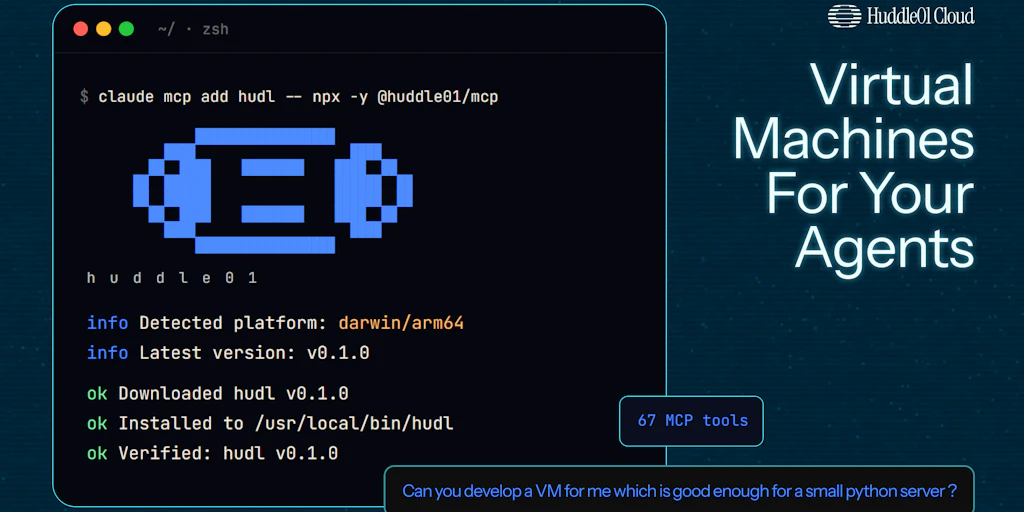
The choice between Huddle01 VMs vs OpenAI API depends entirely on where your logic lives. If you need a plug-and-play "brain" for stateless queries, OpenAI API remains the gold standard for accuracy. However, if you are building autonomous, persistent agents that require sub-100ms latency and zero egress fees, Huddle01 VMs provide the specialized compute environment that raw APIs lack.
1. TL;DR Verdict Table
| Dimension | Huddle01 VMs | OpenAI API | Winner |
|---|---|---|---|
| Pricing Model | Per-second compute billing | Per-token inference billing | Huddle01 VMs (for high-volume) |
| Context Window | Infinite (Persistent RAM/Disk) | 128K - 200K tokens | Huddle01 VMs |
| Inference Accuracy | Dependent on hosted model | GPT-4o / O1 (State-of-the-Art) | OpenAI API |
| Latency | Sub-100ms (Edge optimized) | 500ms - 2s+ (Inference bound) | Huddle01 VMs |
| Multimodal Support | User-defined (Host any model) | Native Text, Vision, Audio | OpenAI API |
| Data Privacy | Private VM Isolation | Standard Enterprise Privacy | Huddle01 VMs |
| Egress Fees | $0 (No hidden markups) | N/A (Included in token cost) | Huddle01 VMs |
| Open Source | Closed-source platform | Closed-source API | Tie |
| Persistence | Native (Always-on agents) | Stateless (Requires external DB) | Huddle01 VMs |
| Best For | Autonomous Agent Infrastructure | General LLM Applications | OpenAI API |
Bottom Line: Pick Huddle01 VMs if you are building "Agentic" workflows where persistence and low-latency edge execution are non-negotiable. Pick OpenAI API if your primary requirement is the highest possible reasoning capability without managing underlying infrastructure.
2. Who Should Use Which?
- Casual / Non-technical User: Pick OpenAI API. The barrier to entry is significantly lower with the Playground interface and extensive third-party integrations. Huddle01 VMs require DevOps knowledge to configure and manage virtual environments effectively.
- Developer / Builder: Pick Huddle01 VMs. If you are deploying agents that need to run 24/7, Huddle01 VMs review 2026 shows that per-second billing is 40-60% cheaper than token-based scaling for persistent loops. The lack of egress fees and optimized compute for agent persistence makes it the superior choice for engineers building autonomous systems.
- Enterprise Team: Pick OpenAI API. For high-level corporate applications, the SOC2 compliance, established SLAs, and massive ecosystem of Rosentic review 2026 style safety tools make OpenAI the safer bet for risk-averse legal departments.
3. Capability Deep-Dive
Response Quality & Accuracy
Winner: OpenAI API ✅ Strong
OpenAI leads the industry with GPT-4o and the O1 reasoning series. While Huddle01 VMs allow you to host any model (including Llama 3 or Mistral), the raw intelligence of OpenAI's proprietary models still outperforms open-weights equivalents in complex logic and zero-shot coding tasks. If your agent's value is derived purely from "smartness," OpenAI is the clear choice.
Context Window & Memory
Winner: Huddle01 VMs ✅ Strong
OpenAI is limited by token windows (e.g., 128K). Huddle01 VMs treat memory differently; because you are running a dedicated virtual machine, your agent has access to persistent RAM and local disk storage. This allows for "infinite" context through local vector databases or state-management frameworks like PandaProbe review 2026 without re-sending massive token histories every call.
Multimodal Capabilities
Winner: OpenAI API ✅ Strong
OpenAI offers a unified API for vision, text, and real-time audio. Huddle01 VMs require you to manually orchestrate different models (e.g., Whisper for audio, Whisper-to-text, then an LLM). If you need a single endpoint that "sees" and "hears" out of the box, OpenAI’s multimodal integration is far more efficient for rapid deployment.
Speed & Latency
Winner: Huddle01 VMs ✅ Strong
Latency is where the Huddle01 VMs vs OpenAI API gap is widest. OpenAI's inference can take seconds depending on load. Huddle01 VMs utilize global edge infrastructure designed for sub-100ms latency. For real-time agentic interactions—where an agent must respond to environment changes instantly—Huddle01's bare-metal performance is mandatory.
API & Developer Experience
Winner: OpenAI API ⚠️ Average
OpenAI’s SDKs are the industry standard. However, Huddle01 VMs offer a different type of DX: specialized cloud VMs for agents. While OpenAI is easier to start, Huddle01 provides better control over the environment. Developers who need to install custom libraries or specific OS-level dependencies will find OpenAI's sandbox too restrictive.
Safety & Content Filtering
Winner: OpenAI API ✅ Strong
OpenAI has the most aggressive (and sometimes frustrating) safety filters in the industry. For enterprise use, this is a feature, not a bug. Huddle01 VMs put safety entirely in the hands of the developer. If you host an uncensored model on a Huddle01 VM, there are no guardrails unless you build them yourself.
4. Pricing Deep Dive
The financial impact of the Huddle01 VMs vs OpenAI API debate comes down to how you scale. OpenAI charges for the "thought" (tokens), while Huddle01 charges for the "time" (compute). For high-frequency agents, the difference can be thousands of dollars per month.
| Plan / Tier | Huddle01 VMs | OpenAI API |
|---|---|---|
| Free/Entry Tier | Limited free VM credits for dev testing | $5-18 trial credits (expires in 3 months) |
| Base Cost | ~$0.08 - $0.12 / hour (Per-second billing) | $5.00 / 1M input tokens (GPT-4o) |
| Scaling Cost | Flat rate based on uptime; no volume penalty | Variable; $15.00 / 1M output tokens |
| Data Egress | $0 (Included in VM cost) | N/A (Bundled into token price) |
| Idle Costs | Charged while VM is active | $0 (Pay only for what you prompt) |
If budget is the main constraint, pick Huddle01 VMs because their per-second billing model allows for predictable monthly spending. If your agent is constantly monitoring a stream or performing high-frequency loops, token-based billing with OpenAI will eventually exceed the cost of a dedicated virtual machine. However, for low-volume apps that only trigger once or twice an hour, OpenAI's "pay-per-use" is more economical.
5. Real User Sentiment
The developer community highlights a clear trade-off between "convenience" and "control" when comparing these two platforms.
"We moved our autonomous trading bot from OpenAI to Huddle01 VMs because the API latency was killing our execution speed. On Huddle01, the agent lives right at the edge. We lost some 'reasoning' by switching to Llama 3, but the 80ms response time made the bot actually profitable."
— Senior Engineer, DeFi Startup
"I stick with OpenAI for our customer support bot. The O1 model handles nuance that open-source models still struggle with. I don't want to manage a VM; I just want the best answer possible for the user, and I'm willing to pay the token premium for that."
— Product Manager, SaaS Enterprise
Summary of Sentiment:
- Huddle01 Praises: Zero egress fees, extreme low latency, and the ability to run "always-on" scripts without worrying about API timeouts.
- Huddle01 Complaints: Steep learning curve for those not familiar with Linux environments or Docker containerization.
- OpenAI Praises: Unmatched intelligence, incredible documentation, and the fastest time-to-market for a MVP.
- OpenAI Complaints: Frequent "rate limit" errors during peak hours and the high cost of maintaining long context windows.
6. Switching Considerations
Moving between Huddle01 VMs and OpenAI API is not a simple "find and replace" operation. It requires a fundamental shift in how your application handles state.
- Migration Effort: High. Moving from OpenAI to Huddle01 requires you to containerize your application, select an LLM (like Llama 3 or Mistral), and manage your own inference engine (e.g., vLLM or Ollama).
- API Compatibility: Most developers use LiteLLM or similar abstractions to maintain OpenAI-compatible endpoints even when running local models on Huddle01 VMs, which can ease the transition.
- Cost Impact: The switch to Huddle01 is worth it if your token spend exceeds $500/month. Below that threshold, the "DevOps tax" of managing your own VM infrastructure likely outweighs the savings.
The switch is worth it if you are hitting OpenAI's rate limits or if your agent requires a persistent "heartbeat" to monitor external data sources in real-time without constant API polling.
7. Final Verdict
The 2026 landscape of Huddle01 VMs vs OpenAI API proves that "one size fits all" no longer applies to AI infrastructure.
Choose Huddle01 VMs if:
- You are building Autonomous Agents that need to run 24/7 with persistent state and memory.
- Your application is Latency-Sensitive (e.g., real-time gaming, high-frequency trading, or live voice AI).
- You want to Avoid Vendor Lock-in and prefer running open-source models in a private, isolated environment.
Choose OpenAI API if:
- You need Maximum Reasoning Power and state-of-the-art accuracy for complex logic or coding tasks.
- You require Multimodal Native Support (Vision, Audio, and Text) through a single, unified endpoint.
- You are a Small Team or Solo Dev looking for the fastest possible deployment with zero infrastructure management.
Neither if:
- You require 100% air-gapped, on-premise hardware for high-security government contracts; in that case, private localized clusters are your only compliant option.
Ready to Try Huddle01 VMs vs OpenAI API?
You've seen the full picture. Now test it yourself — visit the official site to get started.
Visit Huddle01 VMs vs OpenAI API →