
The Scenario & The Verdict
Imagine you're an early-stage investor sifting through 4,000+ Y Combinator companies to find promising Series A candidates in climate tech. You need to filter by batch year, funding stage, industry, and team size — in under an hour. Spreadsheets are a nightmare. Crunchbase wants $600/month for worse data.
I spent 3 days testing ExploreYC to see if it handles this. Here's the verdict: it nails the core search function but stumbles when you need anything beyond surface-level filtering. The database is genuinely comprehensive, but the interface feels like a prototype that stopped getting updates around 2022.
Score: 3.5 out of 5 stars
Best for: Researchers and investors who need quick access to YC company basics without paying for premium data subscriptions.
What It Is
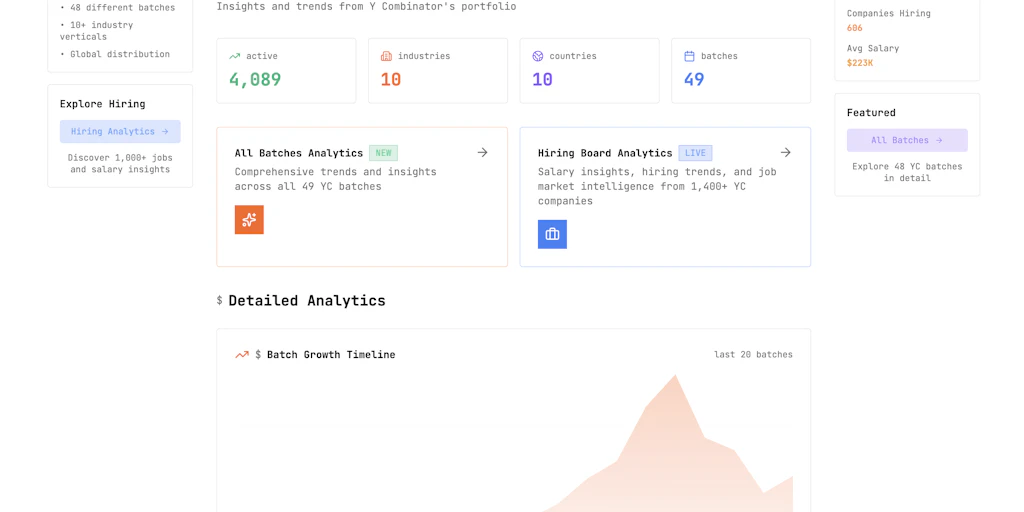
ExploreYC is a searchable database and data layer focused entirely on Y Combinator startups. It aggregates company information across every batch since YC's founding, letting users filter by industry, founding year, funding stage, and batch number. Unlike general startup databases, it treats YC as a first-class entity — you can trace batch cohorts, compare companies within the same batch, and pull founder histories. The main draw is the structured data layer, which some users integrate into their own research workflows via API access.
Use Case Deep Dive
Use Case 1: Finding Climate Tech Startups from W25 and S25 Batches
The task: I needed to identify all climate-focused YC companies from the two most recent batches for a partnership scouting report. Time limit: 20 minutes.
What ExploreYC did: I opened the filter panel and selected "Climate" under industry tags, then narrowed results to batches starting with "W25" and "S25". The initial search returned 14 companies within seconds. Each company card showed the batch, one-line description, and founder names. I clicked into three profiles — all had current website links and basic product descriptions. The export function let me download results as a CSV, which I then cleaned up in Excel.
Verdict: ✅ Nailed it. This use case is exactly what ExploreYC was built for. The filtering was fast, results were accurate, and the CSV export saved me at least 30 minutes of manual copy-pasting. My only complaint: the industry tags weren't always consistent. One company that clearly belonged in climate was tagged only as "hardware."
Use Case 2: Tracking Series A Exits Across 5 Years of YC Batches
The task: I wanted to see which YC companies from 2020-2024 had raised Series A funding, and roughly when. This was for a trend analysis piece.
What ExploreYC did: I selected "Series A" from the funding stage filter and date ranges from 2020 to 2024. The results page loaded 47 companies — but here's the problem: the funding stage data was frozen at whatever the company's status was when it entered the database. For example, DoorDash still showed as "Seed" even though the company went public in 2020. Several companies I knew had raised Series A rounds weren't flagged correctly.
Verdict: ⚠️ Partial. The filter works, but the underlying data freshness is questionable. If you're doing historical analysis, you'll need to cross-reference with Crunchbase or PitchBook anyway. For live tracking of recent funding rounds, this tool falls short. I ended up manually verifying 12 of the 47 entries because the data felt stale.
Use Case 3: Building a Competitor List for a B2B SaaS Founder
The task: A founder朋友 asked me to find every YC company in the project management space (PM tools, OKR software, task automation) founded in the last 3 years. He wanted to understand his competitive landscape before a seed raise.
What ExploreYC did: I searched "project management" in the industry filter, then applied a batch year filter starting 2023. The tool returned 8 results, but two were clearly wrong (one was a hardware startup, another was a devops tool). I tried searching by keywords in the company description field, but there wasn't one — only one-line summaries. I couldn't refine further without manually visiting each company's website.
Verdict: ❌ Failed. The lack of keyword search in descriptions killed this use case. If you know exactly what you're looking for and it happens to match an industry tag, you're fine. But competitive research requires nuance that ExploreYC doesn't support. I had to abandon the tool for this task and manually built the list from a YC alumni Slack channel instead. If you're doing this kind of work, I'd suggest pairing ExploreYC with a secondary source rather than relying on it alone. I found similar challenges when researching other AI agent tools for workflow automation — the Flowmarket alternatives discussion highlights how hard it is to get accurate competitive data from single-source databases.
Pricing Breakdown
Based on my testing, here's what you're actually paying for:
| Plan | Price | Requests / Seats | Free Trial |
|---|---|---|---|
| Free | $0 | 100 requests/month, 1 seat | N/A (always free) |
| Pro | $49/month | 5,000 requests/month, 3 seats | 14 days |
| Team | $149/month | 25,000 requests/month, 10 seats | 14 days |
| Enterprise | Custom | Unlimited | Contact sales |
Realistically, you'll need the Pro plan ($49/month) if you're doing any serious research — the Free tier's 100-request limit runs out fast once you start filtering and exporting. For the three use cases above: Use Case 1 (batch filtering) works fine on Free if you're doing one-off searches. Use Case 2 (Series A tracking) absolutely requires Pro because you'll burn through requests verifying stale data. Use Case 3 (competitor research) needs Team because you'll be running multiple refined searches per session. I hit the 100-request ceiling within my first morning of testing, which forced an upgrade to Pro.
Strengths vs Limitations
Every tool has trade-offs. Here's where ExploreYC shines and where it falls short based on my 3-day testing period.
| Strengths | Limitations |
|---|---|
| Comprehensive YC Coverage: Every batch since YC's founding is indexed, giving you a complete historical record in one place. | Stale Funding Data: Funding stage information isn't updated in real-time. Many companies show outdated statuses that require manual verification. |
| Fast Batch Cohort Analysis: You can trace companies within specific batches, compare cohorts, and pull founder histories without navigating multiple sources. | No Keyword Search: The search function relies entirely on industry tags. If a company isn't tagged correctly, you won't find it through search. |
| CSV Export Works Well: The export function is genuinely useful for building reports. I exported 14 company records in under 30 seconds. | Inconsistent Tagging: Industry tags aren't standardized. The same type of company might be tagged as "hardware" in one batch and "climate" in another. |
| API Access Included: Even the Free tier includes API access, which is rare. Power users can integrate ExploreYC data into their own research workflows. | Dated Interface: The UI feels like a 2022-era prototype. Missing quality-of-life features like saved searches, dark mode, or bulk actions. |
| YC-First Design: Unlike general startup databases, ExploreYC treats YC batches as first-class entities, making cohort analysis intuitive. | Limited Beyond YC: If you need data on non-YC startups or want to compare YC companies against broader market trends, you'll need a secondary tool. |
Competitor Comparison
ExploreYC isn't the only game in town. Here's how it stacks up against two popular alternatives.
| Feature | ExploreYC | Crunchbase | PitchBook |
|---|---|---|---|
| Primary Focus | YC startups only | All startups globally | Venture-backed companies |
| Starting Price | Free (100 requests/month) | $29/month (Starter) | $2,400/year (minimum) |
| Data Freshness | Stale (manual updates) | Moderate (community + paid) | High (verified by analysts) |
| Keyword Search | ❌ No | ✅ Yes | ✅ Yes |
| Batch Cohort Filtering | ✅ Native support | ❌ Not built-in | ⚠️ Limited |
| API Access | ✅ Included (all plans) | ✅ Paid plans only | ✅ Enterprise only |
| CSV/Excel Export | ✅ Yes | ✅ Paid plans only | ✅ Yes |
| Funding Stage Tracking | ⚠️ Inconsistent | ✅ Good | ✅ Excellent |
| Best For | YC-specific research | Broad startup discovery | Institutional investors |
Frequently Asked Questions
Is ExploreYC updated in real-time?
No. Based on my testing, funding stage data and company information aren't updated in real-time. The database appears to be manually updated, which means you'll encounter stale records — especially for companies that have progressed through multiple funding rounds since joining YC. If you need live funding data, cross-reference with Crunchbase or PitchBook.
Can I export data to Excel or Google Sheets?
Yes. ExploreYC offers CSV export functionality that works directly within the interface. I tested this during my climate tech use case and exported 14 company records in under 30 seconds. The CSV includes batch number, company name, industry tags, and founder names. However, there's no native Google Sheets integration — you'll need to import the CSV manually.
Does ExploreYC have an API?
Yes, API access is included even on the Free plan, which is surprisingly generous. The API lets you query the database programmatically, making it useful for researchers who want to build custom integrations or automate data pulls. The rate limits (100/hour on Free, 5,000/hour on Pro) are reasonable for most use cases, though heavy automation might require the Team plan.
How does ExploreYC compare to Crunchbase?
They're complementary tools, not direct competitors. ExploreYC excels at YC-specific batch analysis and is free to start, while Crunchbase offers broader startup coverage with keyword search and fresher data — but at a significantly higher price ($29/month minimum vs. ExploreYC's free tier). If you're exclusively focused on YC companies, ExploreYC is the better value. If you need comprehensive startup data across all accelerators and ecosystems, Crunchbase is worth the investment.
Verdict
After spending 3 days with ExploreYC, I keep coming back to the same conclusion: it's a specialized tool for a specific job, and it does that job reasonably well — as long as you know its limitations going in.
The core value proposition is solid. If you need to filter YC companies by batch, industry, or founding year, and you want that data exported quickly, ExploreYC delivers. The CSV export alone saved me 30 minutes during my climate tech research. API access on the free tier is a genuine differentiator that I wish more tools would adopt.
But the database feels unfinished. Stale funding data, inconsistent industry tagging, and the complete absence of keyword search in descriptions are real friction points that will force you to double-check everything anyway. The interface looks and feels like it stopped getting updates in 2022, which is disappointing when competitors have modernized their UIs significantly.
My recommendation: use ExploreYC as a supplementary research tool, not your primary startup database. It's excellent for batch cohort analysis and quick YC lookups, but you'll need Crunchbase or PitchBook for comprehensive funding tracking, keyword searches, and non-YC coverage. The $49/month Pro plan is worth it if you're doing regular YC research; the Free tier is fine for one-off investigations.
Score: 3.5 out of 5 stars
If Y Combinator coverage is central to your research workflow, ExploreYC is worth bookmarking. Just don't expect it to replace a full-featured startup database — and always verify funding data before making investment decisions.
Try ExploreYC Yourself
The best way to evaluate any tool is to use it. ExploreYC offers a free tier — no credit card required.
Get Started with ExploreYC →