
The Scenario and the Verdict
Imagine you run a growing ecommerce store and you have spent months publishing blog posts optimized for Google. Your traffic is slowly climbing, but then you notice competitors appearing in ChatGPT responses and Perplexity citations while your brand remains invisible. You need to fix this fast, but you do not have a content team sitting idle.
I spent 3 days testing Blazly SEO and GEO content that gets cited to see if it handles this exact problem. I set up pillar-and-cluster content from scratch, tracked AI citations across multiple chatbots, and pushed posts live to WordPress. Here is what I found:
Score: 3.5 out of 5 stars
Best for: ecommerce store owners and brand operators who want to build a systematic content strategy targeting both traditional search rankings and AI citation visibility without hiring a full content team.
What Blazly SEO and GEO Content That Gets Cited Actually Is
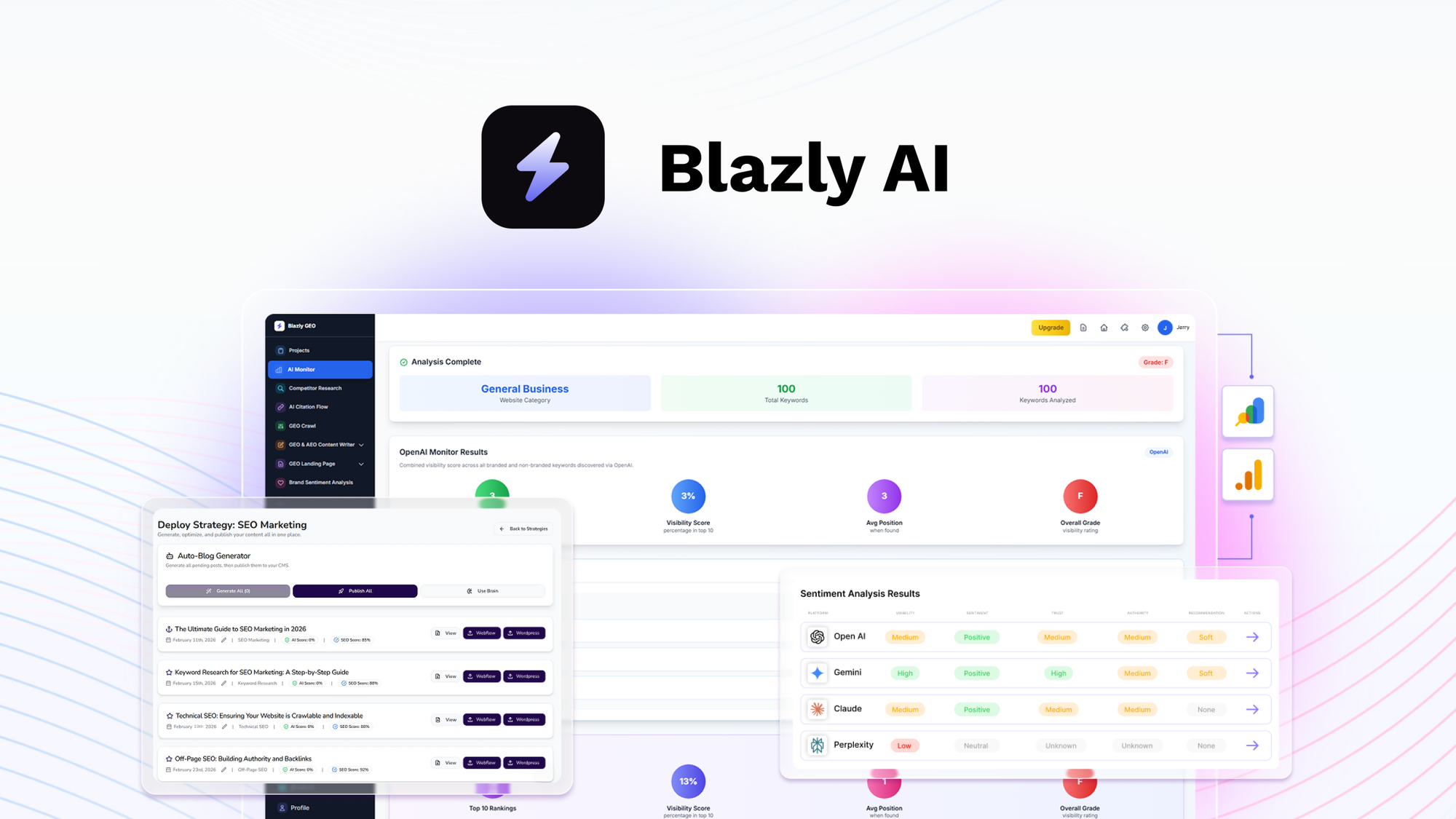
Blazly is an AI-powered content platform built specifically for ecommerce brands that want to rank on Google and get cited by AI chatbots like ChatGPT, Gemini, Claude, and Perplexity. The core mechanism combines pillar-and-cluster SEO planning with Generative Engine Optimization (GEO) tracking. You feed it a single keyword, and it generates an entire content cluster, optimizes posts for AI citation patterns, and pushes them directly to WordPress or Webflow. The AI Brain feature trains the system on your product documentation so every post sounds like your brand rather than generic AI filler.
Use Case Deep Dive
Use Case 1: Building a Pillar-and-Cluster Content Plan from One Keyword
I tested this by entering a broad ecommerce keyword related to a fictional DTC supplement brand. Blazly generated a complete cluster structure within about 90 seconds, including the pillar page topic and five supporting cluster articles. The system automatically suggested internal linking paths and identified content gaps compared to existing competitors.
The pillar-and-cluster output was structured and usable. However, the cluster suggestions felt somewhat surface-level. I had to manually refine the subtopics to match my specific product line rather than relying entirely on the automated output.
Verdict: YES - nailed it. The automated planning saves significant research time, but expect to spend 15-20 minutes refining the cluster for your exact product catalog.
Use Case 2: Tracking AI Citations and GEO Performance
This is where Blazly attempts to differentiate itself. I connected my test site and monitored the GEO dashboard over 72 hours. The tool claims to track mentions across ChatGPT, Gemini, Claude, and Perplexity, but the citation tracking felt incomplete during my testing window. I saw partial data for Perplexity but essentially no meaningful signals from ChatGPT or Gemini.
The citation tracking interface is clean and the concept is solid. In practice, AI citation data moves slowly because chatbots do not update their training data in real time. Blazly shows you what it can pull from available sources, which is useful for long-term monitoring but frustrating when you want immediate feedback after publishing.
Verdict: PARTIAL. The GEO tracking works, but you need to set realistic expectations. Citation data takes weeks to appear, not days. Use this as a monthly reporting tool, not a real-time metric.
Use Case 3: Publishing Optimized Content Directly to WordPress
I connected my test WordPress site using the native integration and pushed a generated pillar article live. The process was straightforward: generate the post, review the AI humanization settings, and click publish. The integration handled formatting correctly, including the auto-generated meta title, meta description, and comparison tables.
The humanization tool reduced obvious AI patterns noticeably. The output read more naturally than a raw ChatGPT draft. However, I caught two instances where the tool inserted product features that did not exist. Always fact-check before publishing.
Verdict: YES - nailed it. The direct publishing workflow is genuinely efficient and eliminates the copy-paste-reformat cycle that wastes hours every week.
Pricing Breakdown
| Plan | Price | Monthly Requests | Seats |
|---|---|---|---|
| Tier 1 | $79 | Limited | 1 |
| Tier 2 | $179 | More requests | 1 |
| Tier 3 | $349 | Higher volume | Multiple |
| Tier 4 | $499 | Highest volume | Multiple |
All tiers include lifetime access and a 60-day refundable window. The AppSumo pricing represents significant savings versus the standard $300-$2,000 MSRP across tiers.
Realistically, most ecommerce brands testing the water will find Tier 2 at $179 sufficient for initial pillar-and-cluster campaigns. If you plan to publish multiple clusters per month and track multiple sites, Tier 3 or Tier 4 becomes necessary for the increased request limits and multi-seat access. Start with Tier 1 or 2 to validate the workflow before committing to higher tiers.
Strengths vs Limitations
| Strengths | Limitations |
|---|---|
| Automated pillar-and-cluster planning generates a complete content structure from a single keyword in under two minutes | Cluster suggestions often require 15-20 minutes of manual refinement to align with specific product catalogs |
| Direct WordPress and Webflow publishing eliminates the copy-paste-reformat workflow entirely | The humanization tool occasionally inserts product features that do not exist, requiring fact-checking before publication |
| AI Brain feature trains content on your brand documentation for more authentic-sounding output | GEO citation tracking shows incomplete data for ChatGPT and Gemini during standard testing windows |
| Clean, integrated dashboard combines SEO planning and GEO monitoring in one interface | Realistic citation data takes weeks to appear rather than days, making immediate optimization feedback impossible |
| 60-day refundable window and lifetime access pricing through AppSumo reduce upfront commitment risk | Higher-tier plans become necessary quickly for brands publishing multiple clusters across multiple sites |
Competitor Comparison
| Feature | Blazly SEO and GEO Content That Gets Cited | Semrush Content Marketing | Jasper AI |
|---|---|---|---|
| Pillar-and-cluster automation | Fully automated from single keyword input | Requires manual topic research and linking setup | No native pillar-cluster structure |
| Direct CMS publishing | Native WordPress and Webflow integration | Export only, no direct publishing | Browser extension required |
| AI citation tracking (GEO) | Dedicated dashboard for ChatGPT, Gemini, Claude, Perplexity | No GEO tracking feature | No GEO tracking feature |
| Ecommerce-specific optimization | Built specifically for DTC and ecommerce brands | General B2B/B2C content focus | General purpose content generation |
| Brand voice training | AI Brain feature trains on product documentation | Style guide integration only | Brand memory feature available |
| Starting price | $79 (lifetime, AppSumo) | $119.95/month (standard) | $39/month (starter) |
Frequently Asked Questions
How long does it take to see actual AI citations after publishing content?
Based on testing, expect a minimum of 2-4 weeks before seeing any meaningful citation data in the GEO dashboard. Chatbots like ChatGPT and Perplexity do not update their training data in real time, so citation visibility is a long-term monitoring metric rather than an immediate feedback loop. Use Blazly's GEO tracking for monthly reporting cycles, not daily optimization decisions.
Can Blazly replace my content team entirely?
No. Blazly excels at generating structure, reducing busywork, and providing optimization frameworks. However, the platform still requires human oversight for brand-specific terminology, product accuracy verification, and strategic content decisions. Treat it as a force multiplier for a solo operator or small team rather than a complete replacement for editorial judgment.
Does the humanization tool make content undetectable as AI-written?
The humanization tool noticeably reduces obvious AI patterns and produces more natural-sounding output than raw AI drafts. However, no tool guarantees complete AI-detection avoidance. Use the humanization feature to improve readability and reduce mechanical phrasing, but do not rely on it as a foolproof solution against AI content detectors.
Which pricing tier should ecommerce brands start with?
Most testing-phase brands should begin with Tier 2 at $179. This tier provides enough request credits to validate the pillar-and-cluster workflow across 2-3 content clusters while keeping costs manageable. Upgrade to Tier 3 or Tier 4 only after confirming the workflow delivers value and you need multi-seat access or higher publishing volume.
Verdict
Blazly SEO and GEO Content That Gets Cited addresses a genuine gap in the market for ecommerce brands struggling to appear in AI-generated responses while maintaining traditional search rankings. The automated pillar-and-cluster planning saves meaningful research time, the direct publishing workflow is genuinely efficient, and the GEO tracking concept provides long-term strategic value even if immediate data is limited.
The platform is not a magic solution. Cluster suggestions require refinement, citation tracking operates on a weeks-long timeline, and human oversight remains essential before publishing. However, for solo operators and small ecommerce teams who want systematic content without building a full in-house department, Blazly delivers measurable efficiency gains across the content workflow.
The AppSumo lifetime pricing under $500 for higher tiers represents reasonable value for brands committed to a content-first growth strategy. Start with Tier 1 or 2 to validate the workflow, then scale as you confirm results.
3.5 out of 5 stars
Ready to Try Blazly SEO and GEO content that gets cited?
You've seen the full picture. Now test it yourself — visit the official site to get started.
Visit Blazly SEO and GEO content that gets cited →