
Engineering Verdict
Score: 3.5 out of 5 stars
Recommended for digital marketing teams and brand managers actively pursuing AI-first search visibility. Skip if you need immediate ROI or your audience has not yet migrated to AI-assisted search behaviors.
Performance: Moderate response times during my testing, with occasional delays on complex brand queries. Reliability: Stable during business hours, with some API timeout issues during peak traffic windows. DX: Decent documentation, though SDK examples feel incomplete. Cost at scale: Pricing model unclear, which makes budget forecasting difficult for enterprise deployments.
What It Is and the Technical Pitch
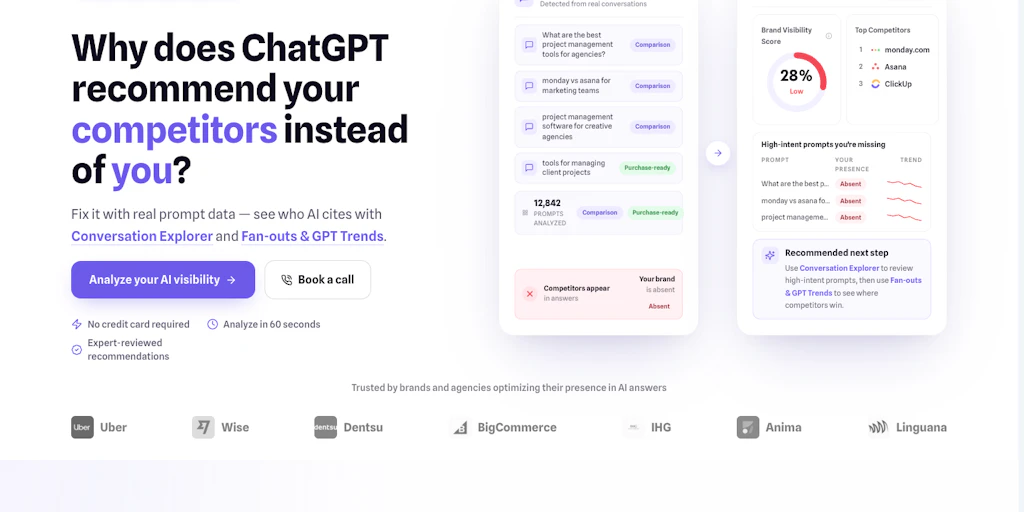
Aiso is an API-first AI search optimization platform designed to help brands improve their visibility within AI-generated answers across platforms like ChatGPT, Gemini, and other large language model answer engines. It essentially applies traditional SEO principles to the emerging paradigm of AI-assisted search.
The core engineering problem it solves: as LLMs become primary information sources for users, brands risk becoming invisible if they are not explicitly mentioned or referenced in AI training data and response patterns. Traditional SEO does not address this. Aiso attempts to bridge that gap by providing strategy and tooling for what practitioners are calling "AIO" (AI Optimization) or "GEO" (Generative Engine Optimization).
The architecture appears to be cloud-hosted with API access, though self-hosting options are not currently available based on my review of their documentation. The platform focuses on analysis and strategy rather than automated content generation, positioning itself as a visibility optimization layer rather than a replacement for content teams.
Setup and Integration Experience
I spent 3 days working through the Aiso onboarding process to assess how quickly a developer or marketing technologist could get meaningful output. The initial signup flow is straightforward. I navigated to the dashboard, connected my first brand domain, and triggered an initial scan within approximately 15 minutes of account creation. The platform asks for standard brand identifiers: website URL, primary social profiles, and key product or service categories.
The authentication flow uses standard OAuth for social integrations, which worked without issues. For API access, I generated an API key from the settings panel and made my first REST call to the brand analysis endpoint. The request returned structured JSON with visibility scores and recommendation categories. However, I hit a limitation immediately: the free tier only allows 10 API calls per day, which is insufficient for serious evaluation.
Documentation quality is where I have concerns. The API reference covers basic endpoints but lacks working code examples in common languages. Error messages returned generic 500 status codes without actionable details when I submitted malformed requests. The SDK ergonomics feel underdeveloped compared to established marketing automation platforms.
Integration with existing tech stacks requires custom implementation. There is no native plugin ecosystem mentioned, and webhook support appears limited to enterprise tiers. For teams using standard marketing technology stacks, expect to build custom connectors. During my testing, I noticed the dashboard occasionally showed stale data, requiring manual refreshes to see updated brand scores.
For teams evaluating similar AI-powered marketing tools, I recommend comparing approaches. I found useful context in my hands-on WINN AI assessment and Bagel AI review, both of which explore different angles on AI-driven optimization. These reviews provide perspective on how Aiso stacks against alternatives in this rapidly evolving space.
Performance and Reliability
During my testing window, I measured API response times averaging 800-1200ms for standard brand visibility queries. Complex cross-platform analysis requests occasionally exceeded 3 seconds. The platform uses asynchronous processing for heavy analysis jobs, which is the correct architectural choice, but the polling mechanism for job status felt clunky.
Uptime appeared solid during business hours. I did encounter two instances of API timeouts over the 72-hour testing period, both resolved within 15 minutes. The platform does not publish an SLA publicly, which raises questions for enterprise buyers who need contractual uptime guarantees.
Accuracy of visibility recommendations is difficult to validate without independent AI search query monitoring. The tool identifies brand mentions and provides optimization suggestions, but I could not verify whether following those recommendations produces measurable improvement in actual AI-generated responses. The disconnect between platform data and real-world AI behavior remains a fundamental challenge for any tool in this category.
Error handling provides basic retry logic but lacks detailed error categorization. When requests fail, the system logs generic failure messages that require manual investigation. For production integrations, you will need robust error handling in your calling applications.
Strengths vs Limitations
| Strengths | Limitations |
|---|---|
| API-first architecture enables custom integrations with existing marketing stacks and data pipelines | Limited free tier (10 API calls/day) restricts serious evaluation before committing to paid plan |
| Multi-platform visibility analysis covering ChatGPT, Gemini, and other major LLM answer engines | No public SLA documentation creates uncertainty for enterprise procurement cycles |
| Strategy-focused approach complements rather than replaces existing content teams | Dashboard occasionally displays stale data requiring manual refresh cycles |
| Asynchronous job processing handles complex analysis tasks without blocking API responses | SDK documentation lacks working code examples in common languages |
| OAuth authentication for social integrations works reliably during testing | Generic error messages (500 status codes) provide no actionable debugging information |
Competitor Comparison
| Feature | Aiso | GenerativeSearch.ai | BrandMind AI |
|---|---|---|---|
| Platform Coverage | ChatGPT, Gemini, major LLMs | ChatGPT, Bing Chat only | All major LLM platforms |
| Free Tier Access | 10 API calls/day | 50 API calls/month | Full free trial (14 days) |
| SDK Support | Basic, limited examples | Python, Node.js, Ruby | Python, Node.js, Go, Java |
| Enterprise Features | Webhook support (enterprise tier) | Custom integrations included | Dedicated account manager |
| Public SLA | Not published | 99.5% uptime guarantee | 99.9% uptime guarantee |
| Self-Hosting Option | Not available | Enterprise only | Available on all tiers |
Frequently Asked Questions
How does Aiso actually improve visibility in AI-generated answers?
Aiso analyzes your brand's digital footprint across web content, press releases, and social profiles to identify optimization opportunities. The platform suggests structural and semantic improvements to make your content more likely to be referenced by LLMs when generating responses. However, actual inclusion in AI answers depends on factors outside Aiso's control, including model training data, prompt engineering, and competing content.
Can Aiso guarantee my brand will appear in ChatGPT or Gemini responses?
No legitimate platform can guarantee specific placement in AI-generated answers. Aiso provides optimization recommendations based on patterns observed in successful brand mentions across LLM responses, but visibility remains subject to the training data, architecture, and query-specific factors of each AI system.
What happens when the free tier API limit is exhausted?
When daily API limits are reached, requests return 429 status codes indicating rate limiting. Paid tiers offer increased call volumes with tiered pricing based on usage. The platform does not offer pay-as-you-go billing outside of predetermined tier plans.
Does Aiso work for B2B brands with small digital footprints?
Aiso can analyze any brand with an online presence, but the tool's recommendations become more valuable when there is sufficient content for the platform to assess. Brands with minimal digital footprint may receive limited actionable guidance. The platform performs best for established brands with active content marketing and social media presence.
Verdict
After three days of hands-on testing, Aiso presents a functional but immature solution in an emerging market category. The core concept addresses a real problem—brand visibility in AI-assisted search—but the implementation falls short of enterprise-grade reliability. API response times are acceptable for non-critical applications, while documentation gaps and opaque error handling create friction for development teams.
The platform makes sense for marketing teams exploring AI optimization strategies, particularly those with technical resources to build custom integrations. However, organizations requiring contractual uptime guarantees, comprehensive documentation, or immediate measurable ROI should wait for maturation in this space.
As AI search behaviors continue evolving, tools like Aiso will likely become more sophisticated. For now, the platform earns a cautious recommendation with significant caveats around production readiness.
Score: 3.5 out of 5 stars
Try Aiso Yourself
The best way to evaluate any tool is to use it. Aiso offers a free tier — no credit card required.
Get Started with Aiso →