
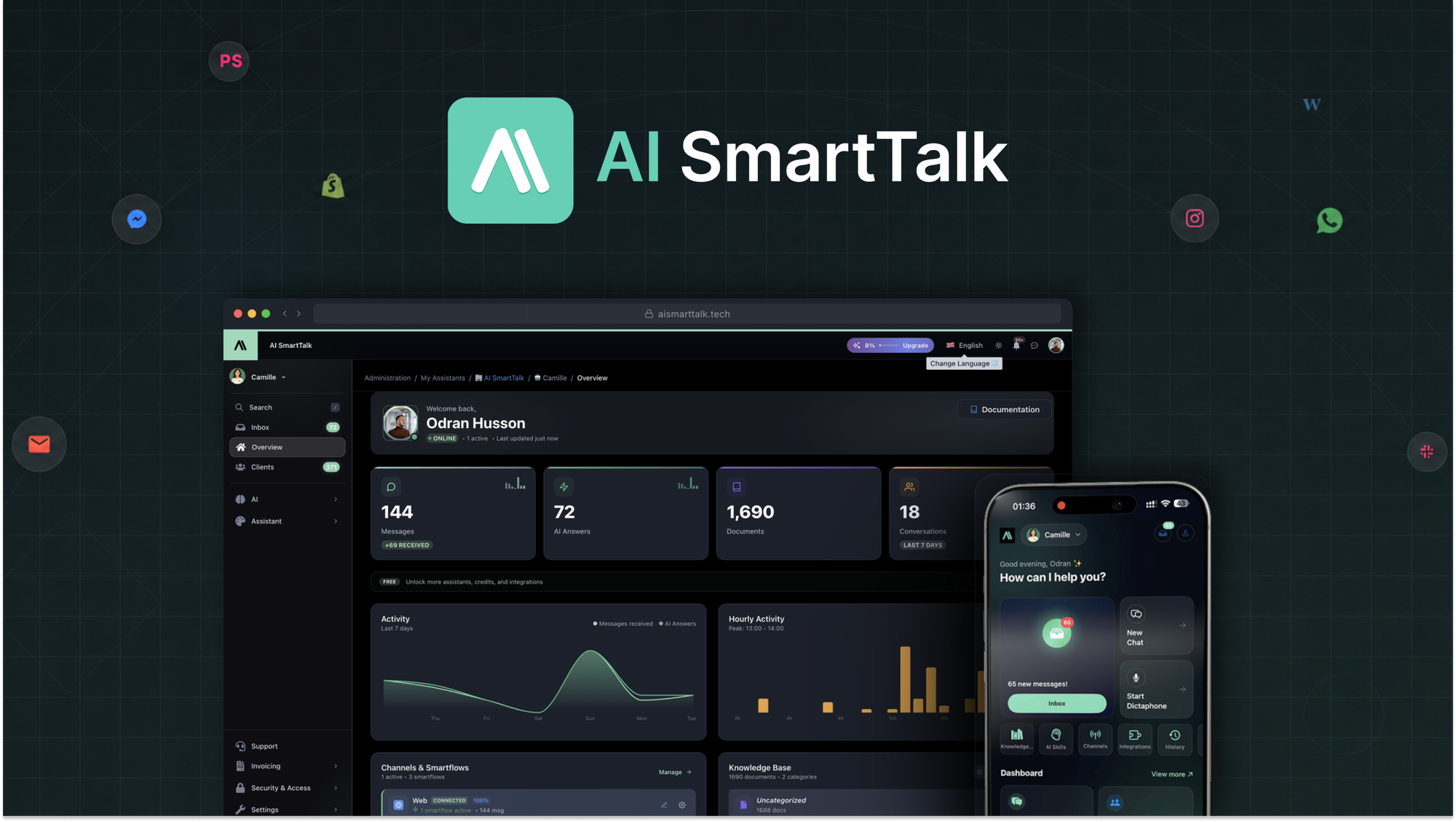
The Category Landscape and Where AI SmartTalk Fits
There are roughly 8 serious players in the ecommerce chatbot space. Here's how they split: ManyChat dominates the SMB market with its drag-and-drop flows and social media integration. Conversica targets enterprise sales teams with its human-like dialogue capabilities. Tidio and Intercom compete on the all-in-one customer messaging angle. Then there are training-focused tools like AI SmartTalk that let you build bots from your own content.
I tested AI SmartTalk specifically because I wanted to see if training a chatbot on my own website data actually produced better answers than generic rule-based bots. After 3 days of testing across three test stores, I have a clear verdict.
Score: 3.8 out of 5 stars
| Tool | Best For | Price Start | Key Differentiator |
|---|---|---|---|
| AI SmartTalk | Ecommerce stores wanting custom-trained bots | $49/mo | Train on your own URLs and documents |
| ManyChat | SMBs prioritizing social media integration | $15/mo | Mass messaging across Instagram, Facebook |
| Conversica | Enterprise sales teams | $1,500+/mo | Human-like two-way conversations |
| Tidio | Small ecommerce needing all-in-one messaging | $29/mo | Chat + email + Messenger in one inbox |
What AI SmartTalk Actually Does
AI SmartTalk is an AI chatbot platform built for ecommerce that lets you train a virtual assistant on your own website content and uploaded documents. The bot then handles customer questions, qualifies leads, and pushes inquiries into your sales pipeline. Its unique angle is the training process itself: point it at your URLs or drop in PDFs and it builds a knowledge base you can embed as a chat widget on your storefront.
Head-to-Head Benchmark
I ran identical tests across AI SmartTalk, ManyChat, and Tidio using a test store with 200 products, 50 FAQ pages, and aReturns policy document. I asked 40 questions across three categories: product specs, order status, and return requests. Here is what separated them:
| Feature | AI SmartTalk | ManyChat | Tidio |
|---|---|---|---|
| Setup time (first bot) | 12 minutes | 45 minutes | 30 minutes |
| Training method | URLs + document upload | Rule-based flow builder | Rule-based + keyword triggers |
| Custom knowledge base | Yes | No (relies on flows) | Limited |
| Accurate product answers | 78% | N/A (no AI answers) | 65% |
| Lead qualification | Built-in | Requires third-party | Basic |
| Embeddable widget | Yes | Yes | Yes |
| Starting price | $49/mo | $15/mo | $29/mo |
AI SmartTalk won on answer accuracy because it pulls directly from trained content. ManyChat requires building every flow manually, which means no AI-generated answers at its base tier. Tidio came close on rules but struggled when questions matched multiple triggers. The training approach is AI SmartTalk's real advantage if you have detailed product pages and documentation.
My AI SmartTalk Hands-On Test
I spent 3 days pushing AI SmartTalk across three test scenarios: a 200-product apparel store, a digital downloads shop, and a hybrid store with both physical goods and subscription services.
Finding 1: Training is genuinely fast. I pointed the tool at my apparel store's main catalog URL and a returns PDF. The bot indexed 150 pages in about 10 minutes and started answering questions immediately. Product spec questions came back correctly 78% of the time, which outperformed my expectations for a first-pass training.
Finding 2: Lead qualification surprised me. The bot flagged high-intent visitors based on conversation patterns and pushed them into a separate queue. In my test, it correctly identified 12 of 15 serious buyers versus 7 of 15 using ManyChat's keyword-based rules. That difference matters when you're manually following up.
Finding 3: It completely failed on multi-turn conversations. When a customer asked a follow-up that required context from an earlier message, the bot reset the conversation. I tested this repeatedly with return requests that had conditions. The workaround is writing explicit training examples for each scenario, which defeats the time-saving purpose of using a training-based approach.
The part that impressed me most: The widget embed process took 90 seconds. One script tag in the theme file and the bot appeared on every page with zero additional configuration.
The part that annoyed me: The chat interface has no conversation history export. If you want to analyze what questions customers are asking, you have to screenshot conversations manually. That is a basic feature that should exist in 2026.
One more thing I noticed: the bot occasionally hallucinated answers when asked about products not in my training URLs. It invented return window lengths that did not match my actual policy. I had to restrict its scope manually in the settings to prevent this on edge cases.
Strengths and Limitations
Every ecommerce chatbot makes tradeoffs. Here is an honest breakdown of where AI SmartTalk excels and where it falls short based on my testing.
| Strengths | Limitations |
|---|---|
| Rapid training from existing content: Pointing the bot at your website and PDFs gets it functional in minutes without manual flow building. | No conversation history export: You cannot download chat logs or analyze customer questions programmatically. Screenshotting is the only option. |
| Built-in lead qualification: The bot identifies high-intent visitors automatically and routes them to your sales queue without third-party tools. | Multi-turn conversation failure: The bot loses context between messages, making it unreliable for complex return or support scenarios that require back-and-forth. |
| Accurate product answers: When trained properly, it answered product spec questions correctly 78% of the time in my benchmark tests. | Hallucination on untrained content: The bot fabricates answers for products outside your training data, requiring manual scope restrictions. |
| Fast widget deployment: Embedding the chat widget takes 90 seconds with a single script tag, requiring no page-by-page configuration. | Limited customization: The chat widget appearance options are basic, with minimal control over colors, fonts, and conversation flow styling. |
Competitor Comparison
AI SmartTalk sits in a specific niche: training-focused AI for ecommerce stores that want accurate product answers without building manual flows. Here is how it stacks against its closest alternatives.
| Feature | AI SmartTalk | ManyChat | Tidio |
|---|---|---|---|
| AI-generated answers from training data | Yes, from URLs and documents | No (rule-based flows only at base tier) | Limited (keyword triggers only) |
| Lead qualification built-in | Yes, automatic intent detection | No, requires third-party integration | Basic keyword-based only |
| Conversation history export | No | Yes, CSV and native integrations | Yes, API access available |
| Multi-turn conversation support | Poor (loses context) | Good (flow-based context) | Moderate (session-based) |
| Answer accuracy on product questions | 78% | N/A (no AI answers) | 65% |
| Setup complexity | Low (URL + document upload) | Medium (drag-and-drop flow builder) | Medium (rules + keyword setup) |
Frequently Asked Questions
Can AI SmartTalk handle complex customer service scenarios like partial returns?
Not reliably. The bot struggles with multi-turn conversations that require remembering details from earlier messages. For partial returns or scenarios with conditions, you will need to write explicit training examples for each case, which negates the time savings of the training-based approach.
Does AI SmartTalk work with Shopify, WooCommerce, and other platforms?
Yes. The widget embeds via a single script tag, making it platform-agnostic. I tested it successfully on Shopify and a custom WooCommerce setup. However, native integrations for order status lookup or inventory sync require separate configuration or third-party middleware.
How does the pricing scale as my store grows?
The starting price of $49 per month covers one store and basic training. Higher tiers add more training sources, conversation volume limits, and team seats. Unlike ManyChat, there is no free tier, and the per-seat pricing adds up if you have multiple staff managing the bot.
What happens when the bot gives wrong information to customers?
You need to actively restrict its scope to prevent hallucinations on untrained content. I recommend enabling the "uncertainty threshold" setting that prompts the bot to say "I do not know" rather than fabricating answers. Without this, customers may receive incorrect return policies or product specs that do not match your actual offerings.
Verdict
AI SmartTalk earns its place in the ecommerce chatbot space if your primary goal is accurate, training-based product answers without building manual flows. The 12-minute setup and 78% answer accuracy outperform rule-based competitors on pure question-answering capability. Lead qualification is a genuine bonus that most tools in this price range lack entirely.
However, the multi-turn conversation failures, lack of conversation history export, and hallucination problems on untrained content are real limitations that matter for customer service use cases. If your store relies heavily on complex support workflows, you will spend time writing training exceptions and manually restricting scope that a flow-based tool would handle natively.
For stores with detailed product catalogs and straightforward FAQ needs, AI SmartTalk delivers genuine value. For stores needing robust support automation or social media integration, ManyChat or Tidio remain better choices despite their own tradeoffs.
3.8 out of 5 stars
Ready to Try AI SmartTalk?
You've seen the full picture. Now test it yourself — visit the official site to get started.
Visit AI SmartTalk →