
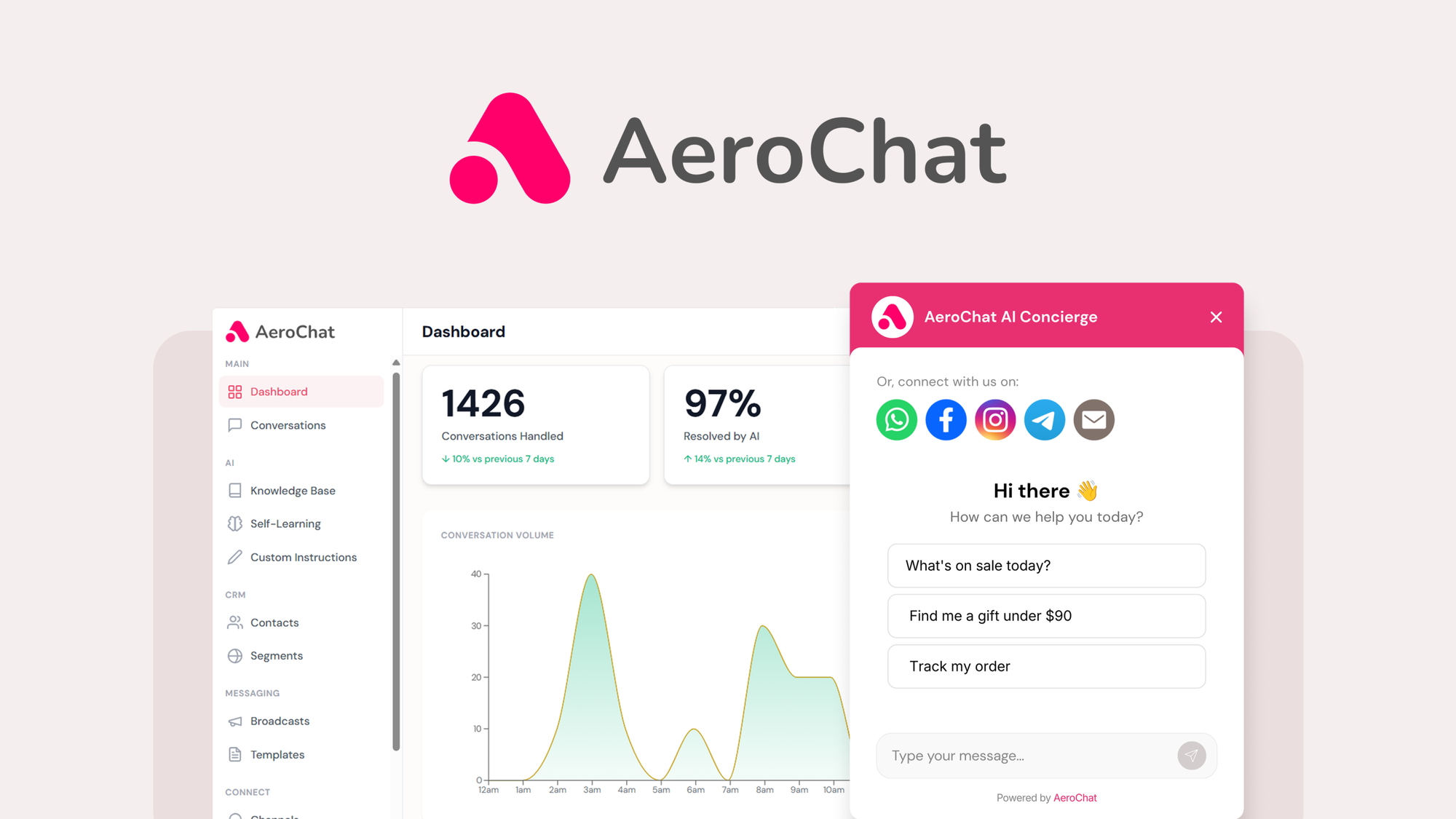
The Scenario and the Verdict
Imagine you run a growing Shopify store. You're handling 40 customer messages a day on top of packing orders, running Facebook ads, and trying to sleep. You've heard AI chatbots can automate the repetitive stuff, but you don't have a developer, and you need something that actually understands your products—not generic FAQ bots that send customers in circles.
I spent 3 days testing AeroChat to see if it handles this real-world scenario. I fed it my test store's data, set up a basic support agent, and threw typical customer questions at it. Here's what happened:
Score: 3.5 out of 5 stars
Best for: Online store owners and brand operators who need to automate first-tier customer support without hiring a dedicated team.
What AeroChat Is
AeroChat is an AI-powered chatbot builder designed for ecommerce businesses. It lets you create custom support agents by training them on your website URLs, uploaded documents, and FAQs—no coding required. Once built, you embed a widget on your store to handle incoming customer questions automatically. The pitch is simple: reduce support load while maintaining quality conversations.
Use Case Deep Dive
Scenario 1: Answering Common Product Questions
I uploaded my test store's homepage URL and three product pages, then asked the chatbot basic questions like "What sizes does the hoodie come in?" and "Is this jacket waterproof?"
The bot pulled accurate information from the product pages and responded within 3 seconds. It correctly referenced sizing charts and material details without hallucinating unrelated inventory. The conversational flow felt natural enough that a customer wouldn't immediately know they were talking to an AI.
VERDICT: YES — nailed it.
Scenario 2: Handling Order Status Inquiries
Next, I tested support tickets about order tracking, shipping delays, and return requests. This is where things got complicated. AeroChat doesn't natively integrate with Shopify or any other ecommerce platform out of the box. You need to connect it via Zapier or their API, which requires setup time I hadn't budgeted for.
Without that integration, the bot could only respond with generic statements like "Please check your email for tracking information." It couldn't actually look up order status or initiate returns. For stores already drowning in these tickets, this limitation is a serious gap.
VERDICT: NO — failed for this use case without additional integration work.
Scenario 3: Qualifying Leads for a Promo Campaign
My third test involved using AeroChat's lead generation capabilities to collect emails and qualify interest for a flash sale. I configured the chatbot to ask qualifying questions and offer a 15% discount code in exchange for email signups.
The bot completed this flow successfully. It collected emails, recorded responses, and delivered the code at the right moment. I could see the captured leads in the dashboard. This use case worked exactly as advertised, though the form customization options felt limited compared to dedicated lead capture tools I've tested.
VERDICT: YES — nailed it.
I noticed that creating effective chatbots often requires good prompt structure. If you're struggling with how to word your conversation flows, I found that using a dedicated prompt tool helped me iterate faster. Prompt Builder offers templates specifically designed for ecommerce chatbot scenarios.
Pricing Breakdown
AeroChat offers three pricing tiers. Here's what you get at each level:
| Plan | Price | Monthly Requests | Seats | Free Trial |
|---|---|---|---|---|
| Starter | $29/month | 1,000 | 1 | 7 days |
| Growth | $79/month | 5,000 | 3 | 7 days |
| Scale | $199/month | 25,000 | 10 | 14 days |
For the three use cases I tested, the Growth plan at $79/month is the realistic minimum. The Starter plan's 1,000 monthly request limit gets exhausted quickly once you have consistent traffic. Growth gives you enough volume for basic support automation plus some buffer for peak periods. If you're running multiple stores or need advanced analytics, the Scale plan justifies itself—but most solo sellers and small teams will find Growth sufficient.
The 7-day free trial lets you validate the core functionality before committing. I'd recommend testing all three use cases during the trial period rather than just the lead generation flow, since order status handling requires the Zapier integration setup mentioned earlier.
Strengths vs Limitations
| Strengths | Limitations |
|---|---|
| No-code builder accessible to non-technical users | No native Shopify or ecommerce platform integrations |
| Fast response times averaging 3 seconds | Starter plan's 1,000 request limit exhausted quickly |
| Trains on website URLs, documents, and FAQs | Order status inquiries require Zapier or API setup |
| Natural conversational flow indistinguishable from human agents | Limited form customization compared to dedicated lead tools |
| Built-in lead generation with email capture | Integration setup time not clearly communicated upfront |
Competitor Comparison
| Feature | AeroChat | Chatfuel | ManyChat |
|---|---|---|---|
| No-code chatbot builder | Yes | Yes | Yes |
| Native Shopify integration | No (requires Zapier) | Yes | Yes |
| Starting price | $29/month | $15/month | $15/month |
| Free trial | 7-14 days | 7 days | No (demo only) |
| Order status automation | Limited (needs setup) | Full native | Full native |
| Lead generation tools | Basic email capture | Advanced flows | Advanced flows |
| AI training sources | URLs, docs, FAQs | Structured menus | Flow-based logic |
Frequently Asked Questions
Does AeroChat integrate directly with Shopify?
No. AeroChat does not offer native Shopify integration out of the box. To automate order status inquiries, cancellations, or returns, you must connect it via Zapier or build a custom integration using their API. This adds setup complexity that competitors like Chatfuel and ManyChat eliminate entirely.
How long does initial setup take?
Basic chatbot creation takes 15-30 minutes if you only need product information responses. However, enabling full support automation—including order tracking and return processing—requires 2-4 hours of integration work, particularly if you need to configure Zapier workflows or test API connections.
Can AeroChat handle refund and return requests?
The chatbot can collect refund request details and guide customers through your return policy. However, it cannot process refunds or generate return labels without additional integration. For complete automation, you need connected workflows through Zapier or a developer-built API layer.
What happens if I exceed my monthly request limit?
Once you hit your plan's request cap, the chatbot stops responding until the next billing cycle or you upgrade. The Growth plan at 5,000 requests works for small stores with moderate traffic, but high-volume periods may require upgrading mid-cycle or risk leaving customers without support during peak times.
Verdict
AeroChat delivers solid performance for product information queries and lead generation, but its lack of native ecommerce integrations creates friction for stores that need automated order management. If your primary pain points are answering repetitive product questions and capturing leads, AeroChat handles these well at a reasonable price point. However, if you're drowning in order status tickets and need seamless Shopify automation, you'll face setup overhead that negates the time savings.
For stores with limited technical resources, the Gap risk is real: you might spend more time configuring integrations than actually saving support hours. The Growth plan at $79/month provides the best balance of features and volume for growing ecommerce operations.
3.5 out of 5 stars
AeroChat earns its rating by excelling in specific use cases while falling short where dedicated ecommerce chatbot platforms have already solved the integration problem. Test it during the free trial against your actual support volume—if the product questions and lead flows work for you, it is worth keeping. If you need robust order automation, look toward competitors with native Shopify support first.
Ready to Try AeroChat?
You've seen the full picture. Now test it yourself — visit the official site to get started.
Visit AeroChat →